Recent Posts







“Innovation is the specific instrument of entrepreneurship. The act that endows resources with a new capacity to create wealth.” — Peter Drucker
The boardroom conversation around digital transformation has fundamentally changed. The question is no longer whether organizations should innovate, but where innovation should originate and how it can scale globally. Increasingly, the answer lies within GCCs (Global Capability Centers), also known as Global In-house Centers (GICs), Enterprise Capability Hubs, and Global Business Services (GBS) organizations. Once viewed primarily as cost-optimization engines, modern GCCs have evolved into strategic innovation centers that own intellectual property, build digital products, drive enterprise transformation, and accelerate business growth. They now sit at the intersection of technology, talent, and transformation. As enterprises navigate AI disruption, cloud modernization, and changing customer expectations, GCCs are becoming the operational backbone that converts innovation strategy into measurable business outcomes. The future of business innovation isn’t siloed; it’s distributed, collaborative, and intelligent.
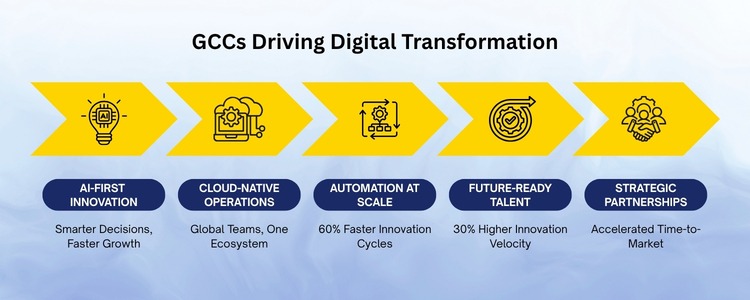
Technology alone does not create innovation. Talent does.’ Ask any GCC leader what holds back transformation, and they’ll point to the same thing: finding great talent. Skilled AI engineers, cloud architects, cybersecurity pros, data scientists, and automation experts are the desired talent pool. They mix full-time hires with gig experts, tap into universities, and partner with startups. They’ve built continuous learning cultures, set up internal academies, and launched AI-powered upskilling programs, tools that really set them apart. But it’s not just about skills. You need a mix of perspectives. Organizations with teams scattered across countries, cultures, and specialties see better ideas and stronger innovation than those stuck in one place. And let’s not forget about keeping people around. The best organizations win loyalty by giving people autonomy, a sense of ownership, access to the latest tech, and real paths for growth. When companies link their talent strategies directly to their innovation goals, they don’t just move faster; they see innovation velocity jump by up to 30% and bring new ideas to market sooner.
‘Innovation rarely happens in isolation.’ GCCs aren’t just sticking to their own turf anymore; they’re reaching out and building real ecosystems. They’re teaming up with startups, universities, research labs, accelerators, and tech providers. India, Singapore, and Poland are key networks in the global chain. Open innovation lets companies build new solutions together. It cuts down research costs and speeds up how fast ideas turn into real products. And here’s something that’s really picking up steam: GCCs are working with several universities at once. They use academic know-how to develop cutting-edge tech and industry-tailored solutions. All that collaboration leads to quicker innovation and a much stronger competitive edge, just what you need when the market’s changing fast.
By 2026, top organizations are set to make AI a core part of their operations. Automation will be smarter than ever, cloud-native workflows will be standard, and there’ll be real, measurable strides toward net-zero sustainability. These days, the United Nations Sustainable Development Goals aren’t just background noise. They’re shaping GCC strategies, think ESG innovation, responsible tech, and running businesses sustainably. AI isn’t the whole story. Companies are gearing up for what’s next, pouring resources into quantum computing, immersive AR/VR, digital twins, and tighter cybersecurity. Meanwhile, smart workforce planning needs to focus on building skills that barely even exist yet. The GCCs that weather the storm best are doubling down on managing geopolitical risks, shoring up cyber defenses, and keeping talent pipelines steady. If you want to stay ahead, the formula is straightforward: back breakthrough technologies, keep your team’s skills relevant, form smart partnerships, and stay agile. The organizations that run with this plan won’t just keep up, they’ll lead the next wave of enterprise innovation.
Global Capability Centers aren’t just background support anymore. They’re now at the heart of innovation, pushing digital transformation, launching new products, and giving companies a real edge. If you still think of GCCs as just a way to save money, you’re missing out, and honestly, you’re setting yourself up to lag behind. The companies that treat their GCCs as innovation hubs are the ones leading the pack. So the real question isn’t if you should shift your mindset. It’s how fast you can turn your GCC into a powerhouse.
I write where strategy meets storytelling. As a passionate writer and literary enthusiast, I craft GCC-focused content that transforms industry insights into compelling narratives. Drawn to global business ecosystems, I enjoy turning research, innovation, and ideas into content that informs, connects, and inspires. With an analytical mind and a creative soul, I bring curiosity, collaboration, and a sharp eye for detail to every project. Adaptable and growth-driven, I believe the right words do more than communicate – they leave an impression.
GCCs: At Forefront With Digital Transformation
How does talent acquisition collaborate with innovation strategy?
Generating Smart Partnerships: National & International
The 2026 Innovation to reach 2030 Goals

Conclusion

Pratibha Soni










Error: Contact form not found. Error: Contact form not found.Subscribe to our Newsletter
Subscribe to our Newsletter