Recent Posts






Summary
As Vijay Shekhar Sharma famously observed when discussing ecosystem-driven growth: “The next wave of Indian innovation will scale faster through strategic partnerships than through isolated execution.” Partnerships aren’t just nice to have anymore; they’re what keep businesses alive. Back in the day, networking meant shaking hands at events, swapping business cards, and hoping something good would happen down the line. Now, growth runs on ecosystems. When people see you in the media, you gain credibility. Credibility opens the door to partnerships. Partnerships bring you new customers. And when you show traction with customers, investors start to pay attention. The pathway is pretty clear: Early-stage startup support → GCC partnership → Digital transformation support → Enterprise validation → Global growth Picture this: you launch a company, and right from the start, you tap into AI innovation labs, experienced product architects, experts who know how to break into markets, compliance pros, and a network that’s plugged in globally. That’s not just theory; that’s exactly what a GCC-driven innovation network brings to the table. For startups in India in particular, partnering with a GCC levels the playing field. Suddenly, the tools and resources that used to be reserved for big, well-funded companies are yours: enterprise tech, digital transformation, and insider knowledge on scaling across borders, without needing to be a unicorn. So by 2026, partnerships aren’t simply a piece of strategy. They’re the baseline determining a founder’s success.
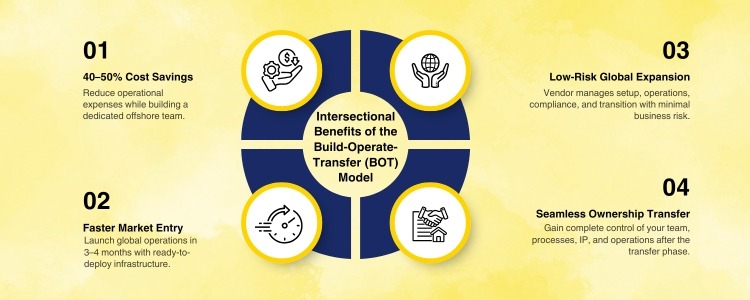
“Global giants move beyond simple office space to dedicated, high-tech campuses engineered for end-to-end product ownership, signaling India’s irreversible rise as a nerve center of global innovation.” Inductus GCC Times-March 2026 Build-Operate-Transfer (BOT) is a strategic offshore expansion model that allows companies to create a dedicated development center or operational unit with minimal risk. During the build phase, an experienced partner sets up the infrastructure, hires the right talent, and establishes operational processes. During the operating phase, the partner manages the day-to-day running of the service, but the client retains strategic control and governance. The third phase, Transfer, is a seamless transfer of full ownership, teams, and processes to the organization. This phased approach allows for faster market entry and lower operational complexity and typically provides up to 50% cost savings within 18 months and full operational independence within 24-36 months.
The Build-Operate-Transfer (BOT) model is an excellent option for organizations looking for scalable growth with less operational risk. For tech startups growing 3-5x per year, they can rapidly scale engineering capacity without having to make upfront long-term infrastructure commitments. Mid-market companies seeking expansion into emerging markets require local hiring expertise but also need to uphold global operational standards. This improves cost predictability and financial flexibility for enterprises looking to reduce CAPEX and move to an OPEX-driven model. The BOT approach is also well suited to organizations that run IP-sensitive operations, as its phased transition builds trust, ensures governance, and allows for a secure transfer of knowledge and ownership. Example: A Bengaluru-based FinTech firm scaled from 50 to 250 engineers across BOT within 18 months, achieving 35% cost savings while maintaining data security compliance.
A Comparative Analysis Productivity Key Components of BOT Model
“No man is an island”—John Donne. This quote has a billion interpretations, and in the ecosystem of global expansion and partnership, one can mark that there is ‘no growth in isolation’; thus, to expand one’s roots and market a business on a global scale, it is a priority to collaborate, as such a BOT model aids in this task. Global expansion is no longer a luxury but a survival strategy. But 67% of offshore ventures fail within the first 18 months because of misalignments, cost overruns, and knowledge gaps. Build-Operate-Transfer (BOT) model: a tried and tested approach that has allowed companies to de-risk international expansion and reduce setup costs by 40-50%. Key Advantages for Global Expansion: How a BOT Model Aids in Global Expansion: Precautionary Checklist before BOT Commitment ☑ Regulatory Compliance Audit – Verify labor laws, data privacy (GDPR, CCPA) and local tax frameworks in target geography ☑ Vendor Due Diligence – Check financial strength, past BOT projects, references and certifications of the client (ISO 27001, SOC 2) ☑ Contract Drafting – Engage lawyers, specify IP rights, exit clauses, SLAs and penalties ☑ IP & Security Agreement – Crystal clear data ownership and confidentiality protocols ☑ Technology Fit – Make sure the vendor’s tech stack aligns with your enterprise standards. ☑ Knowledge Transfer Framework – Define handover milestones, documentation requirements and competency gates ☑ SLA Definition – Define measurable KPIs: delivery timelines, quality standards, team stability, escalation procedures ☑ Exit Strategy Documentation – Document vendor relationship termination, team absorption and transition risks
To sum it up, the Build-Operate-Transfer model does more than just help companies expand overseas; it lets them grow without taking on too much risk. When you have skilled teams handling the Build and Operate stages, everything runs faster and more smoothly. Costs stay in check, and you can actually build operations that last. In an environment where everyone’s fighting over talent and market share, BOT stands out as the smartest way to scale up internationally, quickly, safely, and with fewer surprises.
I write where strategy meets storytelling. As a passionate writer and literary enthusiast, I craft GCC-focused content that transforms industry insights into compelling narratives. Drawn to global business ecosystems, I enjoy turning research, innovation, and ideas into content that informs, connects, and inspires. With an analytical mind and a creative soul, I bring curiosity, collaboration, and a sharp eye for detail to every project. Adaptable and growth-driven, I believe the right words do more than communicate – they leave an impression.
How Networking and partnerships matter in 2026
Everything you should know about BUILD-OPERATE-TRANSFER Model
Companies that are actively opting for BOT Model
Understanding the key components of Build-Operate-Transfer Model
Model
Cost
Time
Knowledge Transfer
Risk Mitigation
BOT
40-50% savings
8-12 weeks
Phased, structured
High (vendor responsibility)
COPO (Captive offshore)
0% savings initially
4-6 months
Slow buildup
Medium (you own it)
Flex/Temporary Staff
20-30% savings
2-4 weeks
Minimal
Low (contractor dependency)
DIY Offshore
30% savings
16-20 weeks
Ad-hoc, risky
Very Low (execution risk)
How Build-Operate-Transfer Model aids in Global Expansion
Conclusion

Pratibha Soni






Error: Contact form not found. Error: Contact form not found.Subscribe to our Newsletter
Subscribe to our Newsletter
