Recent Posts







In today’s hypercompetitive landscape, US companies are under enormous pressure to cut costs, move faster, and scale smarter. Shared Service Centers have quietly become one of the most powerful levers available. Companies that haven’t explored this model yet are leaving serious value on the table.
A Shared Service Center (SSC) is a centralized organization that manages similar business operations across several departments. It can be run internally or by a third party. Consider HR, IT support, payroll, procurement, finance & accounting, and legal compliance. An SSC unifies those services into a single, efficient center rather than each department managing its own back-office operations with all the waste and duplication that goes along with it. Better quality, reduced expenses, and a company that can concentrate on its strengths are the outcomes.
Shared service centers provide rapid cost savings through the elimination of redundant roles, process standardization, and economies of scale. Businesses centralize operations to cut down on duplication and boost efficiency rather than having several departments handle the same job. This strategy is particularly beneficial for US businesses because domestic labor prices are on the rise. Operating expenses might rise dramatically when companies manage large back-office teams domestically. Businesses can benefit from significant cost savings while maintaining control and quality due to this hybrid approach. Internal teams can simultaneously refocus on higher-value tasks like strategy, innovation, and customer experience. The fact that SSCs force you to document, standardize, and optimize your processes is one of their most underappreciated advantages. Understanding how processes operate is a prerequisite for consolidating them, and this discovery stage alone reveals significant inefficiencies.
Business process optimization in the USA has historically been treated as a one-time project. SSCs make it a living, breathing discipline—because the center has a mandate to continuously improve
Data entry shouldn’t take up 60% of your finance team’s work. Manual payroll reconciliation shouldn’t be the focus of your HR department. The back-office outsourcing advantages of an SSC provide strategic liberation; when transactional work is centralized, your core teams shift from processing to advising. Inconsistency increases risk in a chaotic company. Different teams may keep different records, apply policies differently, and adhere to different procedures. This eventually results in mistakes, gaps in compliance, and higher risk exposure. By providing control, visibility, and similarity, shared service centers provide a structural solution to this problem. Consistent policy application Centralized audit trails Easier compliance Faster regulatory response
These days, SSCs are no longer centralized teams working more quickly by hand. They are technologically advanced intelligent hubs, and the digital transformation of shared services has made them truly remarkable. Robotic Process Automation Artificial Intelligence and Machine Learning Cloud ERP and SaaS Platforms Self-Service Portals Advanced Analytics Instead of viewing their SSCs as cost centers, the companies at the cutting edge of digital transformation are using them as innovation hubs to test automation, improve AI technologies, and implement best practices across the entire organization.
Although shared service centers have many benefits, they are not a one-size-fits-all solution. The size, complexity, and growth goals of your business will determine the best fit. An SSC becomes highly valuable when multiple business units are performing the same back-office functions in different ways. This situation frequently results in increased expenses, inconsistent procedures, and redundant work. Centralization can instantly increase control and efficiency in these situations. Additionally, it is a good fit for businesses that are expanding into new markets, growing quickly, or making frequent acquisitions. Scaling operations can easily become complicated and ineffective without a systematic strategy. A shared service center offers a solid base that lets the company expand without losing control. However, putting an SSC into practice necessitates thorough planning. Organizations must invest in the appropriate technology, align leadership, and standardize procedures. Just as important is change management, since teams must adapt to new systems and ways of working.
Shared service centers can benefit businesses of all sizes; the effects are frequently most noticeable in particular groups.
There has never been a better business case for shared service centers in the United States. Lean, smart, and focused businesses will prevail as competition heats up, margins narrow, and digital tools become stronger. By releasing your finest employees, standardizing your operations, and growing with you, shared services give you an advantage.
Hyderabad, Bangalore and Pune have become significant pharma innovation centres with global delivery centres of major biotechnological and pharmaceutical firms such as Novartis, Pfizer, AstraZeneca and GSK. They offer an economic benefit of calculation, a variety of scientific and technical human resources, and speedy time-to-market. On average, businesses reduce between 25-40 percent of the operational costs and increase the rate of innovation. The next-generation operations of Pharma GCC focus on advanced molecular modelling, AI/ML-based drug discovery, cloud supercomputing, and data integration platforms, as well as quantum-ready simulations. Pharma GCCs use AI to screen molecules, predict the efficacy of drugs, optimise clinical trials and aid in making data-driven decisions, resulting in smarter, faster and safer drug pipelines. Pharma GCCs will be global innovation ecosystems that are a combination of computational chemistry, generative AI, and quantum computing. They will turn into the hubs linking data science, discovery and regulatory intelligence in the global arena. Aditi, with a strong background in forensic science and biotechnology, brings an innovative scientific perspective to her work. Her expertise spans research, analytics, and strategic advisory in consulting and GCC environments. She has published numerous research papers and articles. A versatile writer in both technical and creative domains, Aditi excels at translating complex subjects into compelling insights. Which she aligns seamlessly with consulting, advisory domain, and GCC operations. Her ability to bridge science, business, and storytelling positions her as a strategic thinker who can drive data-informed decision-making.
What Is a Shared Service Center
The Real Benefits of Shared Services for US Companies
Every business unit follows the same rules and procedures. This ensures fairness, accuracy, and reliability across the organization.
We track finance, HR, and legal activities in one place. This creates clear records that are straightforward to review, monitor, and audit when needed.
For public companies and regulated industries, compliance is critical. A centralized model makes it easier to meet regulatory requirements and maintain proper documentation.
When regulations change, companies can update processes in one system instead of multiple disconnected ones. This allows faster adaptation across all locations and business units.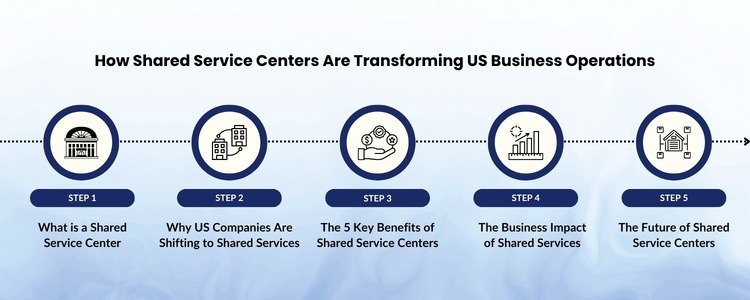
Digital Transformation in Shared Services: The Game-Changer
Software bots handle repetitive operations including data entry, reconciliations, and invoice processing. This eliminates fatigue-related mistakes, cuts expenses, and minimizes manual labor.
Advanced tools allow predictive analytics for cash flow, intelligent document processing, smart routing of service requests, and early detection of anomalies. As a result, businesses can switch from reactive to proactive decision-making.
Cloud-based systems give the entire company real-time visibility. Stakeholders have fast access to the correct information thanks to the smooth integration of centralized data into dashboards.
Employees do not need to contact the Shared Service Center to handle regular HR and IT needs. This increases speed and user satisfaction while lowering the volume of help.
Leaders of shared service centers are able to quantify and illustrate business effects. For instance, automation can lower audit risks and improve compliance, while quicker invoice processing can increase working capital.Is a Shared Service Center Right for Your Company?
When Does a Shared Service Center Make Sense
Who Benefits the Most
The bottom line

frequently asked questions (FAQs)
1.Who are the Pharma GCC development leaders in India?
2.Which economic benefits do Pharma GCCs have?
3.Which technologies are influencing Pharma GCC operations nowadays?
4.What is the role of AI in Pharma GCC processes?
5.How will Pharma GCCs look in five years to come?

Aditi









Error: Contact form not found. Error: Contact form not found.Subscribe to our Newsletter
Subscribe to our Newsletter