Recent Posts






What are shared services centers at their core? Shared Services Centers (SSC) are an internal delivery model where an organization consolidates core business functions such as finance, human resources, IT, procurement, etc., into one centralized unit that supports multiple business units or geographies. In an SSC, the SSC is fully integrated into the organization, unlike outsourcing. Internally, it operates on a service-provider model with SLAs, not contracts. SSCs have emerged as a cornerstone of shared services management as global enterprises expand across borders. In the last decade, adoption has skyrocketed across North America, Europe, and Asia-Pacific, driven by the need for cost control and process standardization. However, shared service center challenges continue to be a quiet operational reality that many enterprises underestimate at the point of setup.
GBS is widely regarded as the evolved, next-generation form of the SSC model, broader in mandate, more technology-enabled, and more deeply aligned with enterprise strategy. For businesses at a crossroads between the two, the choice isn’t just structural; it reflects the organization’s maturity and long-term ambitions in Global Business Services (GBS). Understanding where an SSC ends and where GBS begins is key to making the right operational investment.
On paper, a shared services center is a lean, logical response to organizational sprawl. In practice, however, the gap between the promise and the performance can be significant. Common SSC challenges don’t always announce themselves at launch; they surface gradually through missed SLAs, rising stakeholder frustration, and operational inefficiencies that compound quietly over time. What follows are five pressure points that SSC leaders across industries consistently grapple with, often without a clear playbook to navigate them. Many SSCs are stood up without a rigorous change management framework, which means processes get migrated rather than redesigned, resulting in duplication, not consolidation. The irony is sharp: a model built to eliminate redundancy often creates new layers of it when the groundwork is rushed. Getting the architecture right before go-live is not a best practice; it is the practice. Compounding this is the misalignment that frequently develops between the SSC and its parent organization, where leadership expects transformation outcomes from a model that was funded and staffed for transactional delivery. Goals drift, goalposts shift, and accountability becomes diffuse. The honest industry diagnosis here isn’t that SSCs fail to perform; it’s that they’re often set up to be measured against targets they were never resourced to meet. But perhaps the most immediate competitive pressure is talent. SSCs in emerging markets—India, Poland, the Philippines, and Romania—are finding it increasingly difficult to retain skilled professionals in finance, analytics, and IT when GCCs and multinational corporations offer steeper salary bands, broader career trajectories, and higher-visibility work. This talent attrition quietly erodes the SSC’s capability base, making shared services optimization not just a process challenge but a people strategy challenge. SSC leaders are increasingly required to make the case for the model’s relevance, not just to leadership but also to the workforce itself. The transition phase is where most delivery failures are born, even if they only become visible months later. Business units hand off processes with the expectation that the SSC will simply absorb and run them; SSC teams receive them without the context needed to run them well. Standardized workflows, robust technology integration, and disciplined knowledge transfer protocols are not optional add-ons — they are load-bearing elements of a delivery model that consistently meets its commitments. What’s increasingly evident is that experience design is no longer a peripheral concern in SSC operations; it’s a core competency. Organizations that treat their internal customers with the same intentionality as external ones, investing in UX-led service portals, SLA transparency, and proactive communication, are consistently outperforming those that view internal satisfaction as a soft metric.
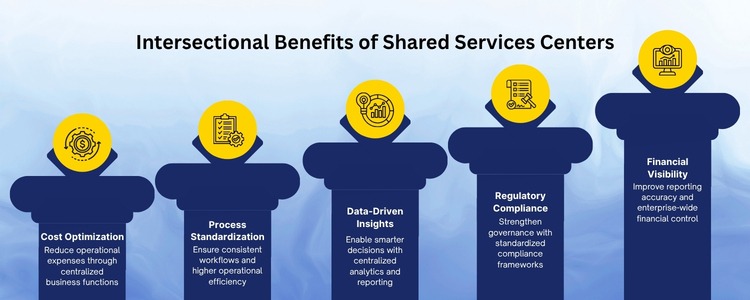
Despite the challenges, the SSC model continues to deliver measurable value when implemented with discipline. Here’s why enterprises still invest in it:
Shared service centers are not a broken model; they’re a maturing model. The companies that will get the most value from their SSCs in the coming years are those willing to take on shared service center challenges head-on: investing in governance frameworks that can withstand scrutiny, technology stacks that remove structural failure points, and talent strategies that make the SSC a place where people want to build careers. The foundation is strong. Now it asks for the intention.
I write where strategy meets storytelling. As a passionate writer and literary enthusiast, I craft GCC-focused content that transforms industry insights into compelling narratives. Drawn to global business ecosystems, I enjoy turning research, innovation, and ideas into content that informs, connects, and inspires. With an analytical mind and a creative soul, I bring curiosity, collaboration, and a sharp eye for detail to every project. Adaptable and growth-driven, I believe the right words do more than communicate – they leave an impression.
Table of Differences Between Shared Services Center & Global Business Services
Parameter
Shared Services Center (SSC)
Global Business Services (GBS)
Scope
Typically covers one or two functions (e.g., Finance & HR)
Covers end-to-end enterprise functions across all verticals
Ownership
Internal, often siloed by function
Integrated under a single governance model
Scalability
Moderate, built for stability, not rapid scaling
High, designed for agility and cross-functional growth
Service Complexity
Transactional and process-driven
Strategic, analytical, and value-generating
Strategic Value
Cost efficiency and standardization
Business transformation and competitive advantage
List of Common Challenges SSCs Face
List of Advantages of SSCs

Conclusion

Pratibha Soni










Error: Contact form not found. Error: Contact form not found.Subscribe to our Newsletter
Subscribe to our Newsletter