Recent Posts





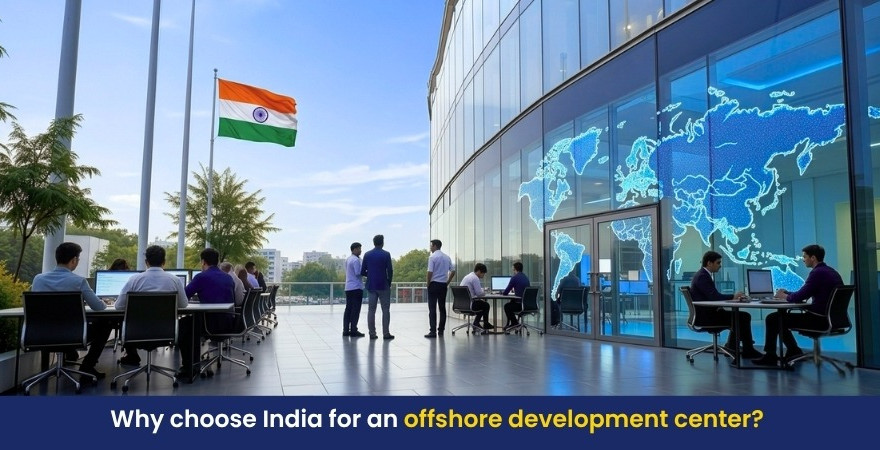
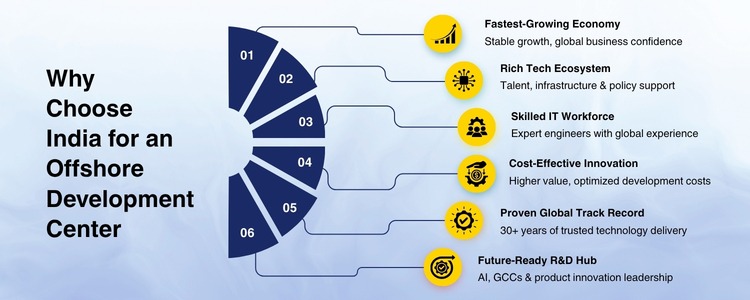
India today stands among the fastest-growing major economies in the world, a position it has held with remarkable consistency even as global markets have wavered. This growth isn’t accidental; it’s the outcome of sustained reforms in ease of doing business, a rapidly digitizing economy, and policies that actively court foreign investment in technology and infrastructure. For a company evaluating where to set up an offshore development center in India, this economic backdrop matters more than it might first appear. A stable, growing economy signals policy continuity, currency resilience, and long-term operational safety, three things every CFO quietly checks before signing a multi-year lease or building a large tech team abroad. India’s expanding share of global digital exports further reinforces this: the country isn’t just growing in size; it’s growing in the exact sector that offshore centers depend on. Betting on India, in this sense, is less a gamble and more a calculated alignment with where global economic momentum is already headed.
Call it fertile ground, not just cheap ground. India’s resource advantage stretches well beyond the labor-cost argument that dominates most outsourcing conversations. It starts with talent density; the country produces one of the largest annual pools of STEM and engineering graduates anywhere in the world, but it doesn’t end there. Add to this a maturing digital infrastructure: expanding data center capacity, reliable cloud availability zones from every major hyperscaler, and Tier-2 cities like Coimbatore, Indore, and Jaipur emerging as viable tech hubs beyond the traditional metros. Government-backed frameworks, special economic zones, IT park incentives, and Digital India initiatives have made the logistics of building an offshore development center noticeably smoother than in many competing geographies. What makes this resource base genuinely distinctive is its variety: India isn’t a single-dimension cost play; it’s a layered ecosystem where talent, infrastructure, and policy reinforce each other. This convergence is precisely what has allowed India’s software development services to scale from simple code shops into full engineering partners for global enterprises.
If India’s economy is the foundation, its IT talent is the load-bearing wall. English-language proficiency, early exposure to global tech stacks, and a culture of continuous upskilling have made Indian engineers a known quantity to global CTOs: not a discovery, but a dependable constant. What’s changed, though, is how the affordability conversation has matured. Cost efficiency in India today isn’t about hiring cheap; it’s about value engineering and accessing senior-level architects, full-stack developers, and QA specialists at rates that free up budget for innovation elsewhere, rather than draining it on payroll. This is where companies typically choose between two structural paths. A dedicated development team India model gives a business a long-term, fully integrated extension of its own engineering org, with the same processes, same culture, and embedded permanently. IT staff augmentation in India, by contrast, is the tactical fix: bringing in specific skills to plug short-term gaps without restructuring the whole team. Neither is inherently better; the right choice depends on whether the need is a sprint or a marathon. But both point to the same underlying truth: India has built an ecosystem where talent and economics no longer compete with each other; they compound.
India’s credibility as an offshore hub wasn’t built overnight; it was earned across nearly three decades. The story begins in the late 1990s and early 2000s, when the Y2K crisis pushed global companies to look at India almost by accident, initially for back-office and BPO work. What followed was a steady, uninterrupted climb: Bengaluru, Hyderabad, and Pune evolved from outsourcing addresses into genuine technology corridors, and the nature of the work itself shifted from cost-arbitrage IT services to full-stack product engineering, R&D, and eventually Global Capability Centers run by the world’s largest enterprises. This matters because it separates India from newer, less-tested offshore destinations. Investors and enterprises aren’t experimenting with India; they’re building on top of a two-decade track record of delivery at scale, across recessions, technology shifts, and global disruptions. That institutional memory is a quiet but decisive factor when a company decides where to build an offshore development center: the risk of “will this actually work” has already been answered, repeatedly, by companies that came before.
The next phase for Indian ODCs looks less like execution and more like invention. Expect the center of gravity to shift from delivery hubs, teams that build what headquarters designs, toward genuine co-creation hubs where Indian teams contribute to product strategy, IP generation, and core R&D rather than just implementation. This shift is already visible in the accelerating growth of Global Capability Centers and the deep-tech investment flowing into India’s AI and machine learning talent pipeline. Over the next decade, the more likely trajectory is one where global enterprises stop treating their Indian centers as a cost function and start treating them as a design partner, a place where product roadmaps originate, not just where they get built. Businesses that recognize this shift early and structure their offshore development center in India accordingly stand to gain a genuine innovation edge over competitors still using the old outsourcing playbook.
Choosing India for an offshore development center was never purely a cost decision, and it certainly isn’t one today. It’s a strategic bet backed by a growing economy, a genuinely diverse resource base, a proven three-decade track record, and a trajectory pointing toward innovation leadership. For businesses thinking beyond the next fiscal quarter, an offshore development center in India isn’t a shortcut. It’s infrastructure for the next decade of growth.
I write where strategy meets storytelling. As a passionate writer and literary enthusiast, I craft GCC-focused content that transforms industry insights into compelling narratives. Drawn to global business ecosystems, I enjoy turning research, innovation, and ideas into content that informs, connects, and inspires. With an analytical mind and a creative soul, I bring curiosity, collaboration, and a sharp eye for detail to every project. Adaptable and growth-driven, I believe the right words do more than communicate – they leave an impression.
India: Leading Economy of the World
How Indian Grounds are Flourished with Variety of Resources
From IT Talent to Affordable Rates: The ODC Narratives of India
How India becomes investors' No. 1 Choice: Historical Perspective
Future Prediction: How Indian ODCs will Redefine Business Innovation

Conclusion

Pratibha Soni








Error: Contact form not found. Error: Contact form not found.Subscribe to our Newsletter
Subscribe to our Newsletter