Recent Posts






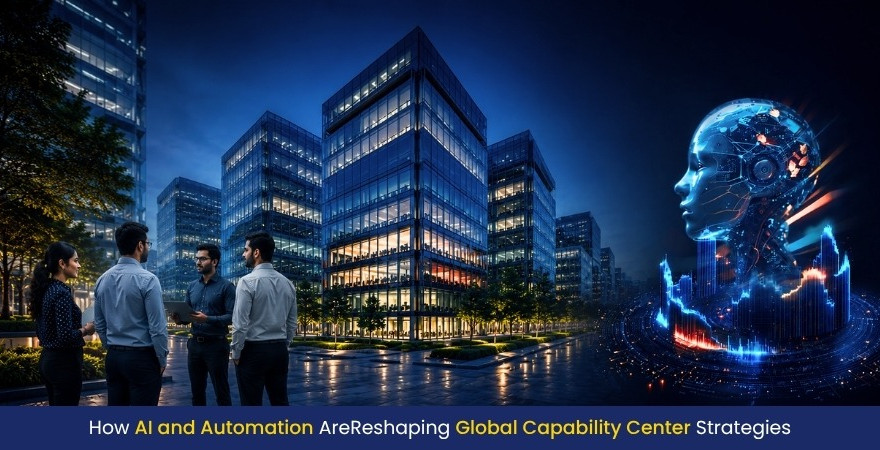
Global Capability Centers are not confined to offshore service providers; with the flux of time and technological advancements, what started as back-office technical, HR, and finance guides has undergone a modern transition with the incorporation of artificial intelligence in Global Capability Centers. This collaboration raised the platform, introducing automation in GCCs with AI backup that transformed GCCs into a “systemic juggernaut.” “The AI-Enabled Global Capability Center market, which was valued at USD 32.78 billion in 2023, is projected to reach USD 211.08 billion by 2032, growing at a CAGR of 21.03%.” INFOSYS. On close scrutiny of the statement, one can observe how rapidly the dynamics of the market are shifting in favor of AI. On the other hand, AI isn’t limited to mere analytical help but rather has developed into generative and agentic AI, which not only takes down human intervention but also upgrades to the formulation of new content, solving intricate nuances with ease. “Digital Transformation” is centralised for GCCs in current times. There adaptation with the trends of time, predicts the paradigm of upcoming innovations bringing the evolution closer. With AI leading the way, these centers make enterprise operations run smoother and help leaders make smarter decisions in real time. Add in Generative and Agentic AI, and you get autonomous workflows, smarter customer interactions, and better problem-solving, really pushing innovation further. So it’s no surprise that more organizations are pouring resources into AI-centric GCC models. They’re not just cutting costs or boosting efficiency; they’re building an ecosystem that thrives on fresh ideas and is ready to scale when needed.
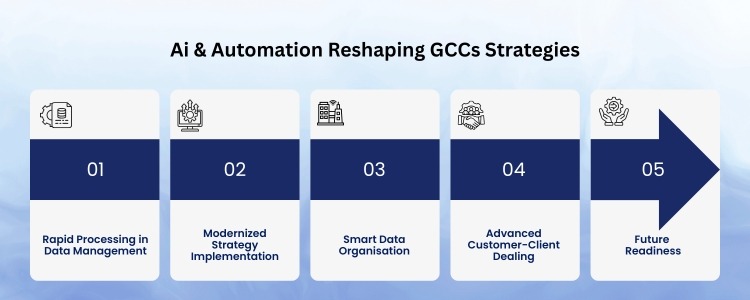
AI-powered systems have really changed how GCCs approach transformation. The focus isn’t just on cutting costs anymore—now it’s about finding new ways to innovate and building smarter capabilities. Companies are plugging AI directly into their day-to-day operations, which means they’re getting better at forecasting, managing workflows, and handling enterprise governance. Generative AI is making a big difference here. It lets organizations automate strategic reporting, pull out sharper analytical insights, and speed up how teams communicate. With these tools, GCCs aren’t just support centers anymore; they’re becoming actual business drivers, making decisions and shaping strategies. With the guidance of automation and AI, the businesses are at ease with spotting market trends, optimizing customer support, and predicting risk so damages could be foreseen and minimized. Consequently, decision-making doesn’t interrupt the harmony of industry; it becomes smarter and faster. Today’s GCC automation is built around adaptability, predictive intelligence, and digital resilience. This approach keeps organizations ahead of the curve in technology and helps them thrive even as the market changes. Automation has really changed the game for GCCs. Now, operations run faster and more accurately, since AI can handle routine, data-heavy work way better than people ever could. It cuts down on turnaround times, keeps mistakes to a minimum, and tackles jobs in finance, HR, compliance, procurement, and IT without skipping a beat. Smart algorithms and robotic process automation basically step in where humans used to slog through repetitive tasks. But it’s not just about speed. With AI, teams get real-time oversight, predictive maintenance, and quick escalation across workflows, so departments stay on track. And when you throw generative and agentic AI into the mix, things move even quicker—AI whips up reports, drafts responses, and solves tricky operational problems on its own. All this ultimately boosts productivity and helps companies use resources smarter, turning GCCs into hubs that are agile, efficient, and ahead of the curve. Generative AI has really changed how GCCs connect with customers and clients. Now, these centers use smart chatbots, virtual assistants, and tools that can actually read the mood of a conversation. This means customers get instant, personalized help no matter where they reach out—on chat, email, or voice. AI doesn’t just spit out canned replies. It looks at what customers have done before, what they like, and how they’ve interacted in the past, then tailors every response to fit. That’s a big step up from the old, one-size-fits-all support. People get answers faster, service feels more consistent, and it just builds more trust all around. More than speed, automation hastens up the operations; this smoothens the working even for hefty loads of overburdening, time-taking tasks, and transforms it into efficient working. AI helps support teams too; it writes replies, summarizes conversations, and solves everyday problems without needing a human every time. Because of all this, GCCs aren’t just handling calls anymore. They’re setting the standard for customer-focused innovation while keeping things efficient behind the scenes. AI in GCCs has revamped the handling and sorting of data, making database management way more feasible, especially at ease with integrating multiple international clients at once. GCCs can give desirable structures to information and even determine accuracy better than the older methods. Advanced automation isn’t just about speed—it means GCCs can pull out important data, spot patterns, detect issues, and sync updates across different locations in real time. Automation also makes a big difference with compliance, cybersecurity, and risk. AI keeps a constant watch over sensitive business info, catching potential problems before they get out of hand. And let’s talk about generative AI for a second. It’s great at making sense of complicated datasets, turning raw numbers into clear reports and visual summaries so leaders can actually use the data to make smart decisions. So, database management in GCCs isn’t just about storing information anymore. It’s an active, intelligence-driven system at the heart of growth and smooth operations.
The transformation in AI-driven technology and rapid utilization of AI in global capability centers previews a rhetorical change in functioning businesses and innovates it to grow globally. The future projections indicate that by the end of this decade, approximately 70% of GCCs will incorporate AI-led operational models, and businesses implementing intelligent automation are already reporting significant increases in customer responsiveness, cost effectiveness, and productivity. Even the 2026 projection portrays over 2100+ GCCs with a revenue of USD 98.5 billion. Automation in GCCs is gradually changing organizational functioning within sectors, from intelligent database handling and tailored client engagement to complex analytics and autonomous operations. The rise of generative AI in Global Capability Centers (GCCs) shows just how much these centers are changing. They’re not just handling day-to-day tasks anymore; they’re becoming real hubs for innovation. Now, GCCs are stepping up in areas like business intelligence, cybersecurity, digital engineering, and research. If GCCs want to stay ahead and keep growing, they need a smart plan to bring AI into their operations. That’s how they’ll build resilience, sharpen their competitive edge, and keep pace in this fast-moving digital world where everyone’s racing to make smarter, quicker decisions.
I write where strategy meets storytelling. As a passionate writer and literary enthusiast, I craft GCC-focused content that transforms industry insights into compelling narratives. Drawn to global business ecosystems, I enjoy turning research, innovation, and ideas into content that informs, connects, and inspires. With an analytical mind and a creative soul, I bring curiosity, collaboration, and a sharp eye for detail to every project. Adaptable and growth-driven, I believe the right words do more than communicate – they leave an impression.
Remodeling the World of GCCs
Conclusion

Pratibha Soni








Error: Contact form not found. Error: Contact form not found.Subscribe to our Newsletter
Subscribe to our Newsletter