Recent Posts







The BOT model divides a complex organizational establishment into three sequential but overlapping phases. The Build phase (typically 6–12 months) tasks the partner with legal incorporation, real estate acquisition, talent recruitment, and infrastructure provisioning. The Operate phase (typically 18–36 months) shifts focus to delivery performance, process optimization, KPI attainment, and gradual knowledge transfer. The transfer phase (typically 6–12 months) is the culmination, where legal ownership, operational control, employer-of-record status, and strategic direction formally pass to the client organization. This structure is deceptively simple. In practice, the transfer phase carries disproportionate complexity because it must simultaneously manage legal transition, organizational psychology, operational continuity, and cultural integration, often across multiple jurisdictions, regulatory regimes, and time zones. It is the moment when every assumption made during Build and every gap tolerated during Operate becomes consequential.
The BOT model originated in public infrastructure financing, a mechanism allowing governments to leverage private capital for large-scale projects while retaining long-term public ownership. One precedent stands out as directly relevant to modern technology GCC transfers: the Bangkok Mass Transit System (BTS Skytrain) concession agreement with the Bangkok Metropolitan Administration introduced ‘condition-based transfer triggers’, where transfer did not occur on a fixed calendar date but upon verified attainment of operational performance standards. This principle, born in rail infrastructure, is now embedded in sophisticated GCC BOT contracts globally, and its absence from poorly structured contracts is a leading cause of transfer failure.
The Transfer phase is not a single handover moment but a sequence of interdependent sub-phases, each with its own stakeholder ownership, risk profile, and success criteria. The following framework, synthesized from practitioner engagements across technology, BFSI, pharma, and shared services sectors, represents global best practice.
The 90 days preceding Transfer Day (T-Day) determine whether the transfer succeeds or fails. This window must be used to complete a Transfer Readiness Audit, a structured assessment of five readiness dimensions: legal and compliance readiness, people and HR readiness, technology and infrastructure readiness, process and documentation readiness, and governance readiness. Organizations that skip or compress this audit consistently encounter what practitioners call ‘transfer shock’, a post-handover period of operational degradation caused by undocumented processes, unclear accountability, and unprepared internal leadership. The GCC case study from Bengaluru documents that dual-hub operations (primary engineering in Bengaluru, QA and support in Chennai) required a 90-day pre-transfer window to align governance structures, complete shadow leadership cycles, and validate SOP documentation across both locations before transfer could proceed without operational regression.
The legal transfer is frequently the most technically complex sub-phase, particularly for cross-border BOT engagements. In technology GCC contexts, the legal transfer typically involves five categories of asset migration. Entity transfer or novation covers the formal registration of the client’s legal entity in the host jurisdiction, or the novation of the existing entity from partner ownership to client ownership. In India, this involves filings with the Ministry of Corporate Affairs, potential Foreign Direct Investment compliance under FEMA regulations, and updates to statutory registrations including GST, PF, ESI, and professional tax registrations. Jurisdictions such as Poland, the Philippines, and Mexico have analogous processes with varying timelines ranging from 30 to 120 days. Intellectual property assignment requires formal deed execution for all IP created during the Operate phase. Well-structured BOT contracts specify IP ownership continuously, typically vesting IP in the client immediately upon creation, but the transfer phase requires consolidation of assignment documentation, code repository transfers, trademark registrations, and patent filings where applicable. Organizations operating under ISO/IEC 27001 or SOC 2 frameworks must additionally ensure that certifications are transferred or re-issued to the client entity before transfer, as certifications are typically held by the operating entity rather than the project. Contract novation covers vendor agreements, software license agreements, office lease agreements, and service agreements that must be formally re-assigned from the BOT partner to the client. This process requires counterparty consent in most jurisdictions and should commence no later than 120 days before T-Day to allow for negotiation and documentation timelines.
The employment transition is operationally and culturally the most consequential workstream of the entire BOT lifecycle. In technology GCC engagements, the team being transferred typically includes 30 to several hundred professionals who have been employed by the BOT partner for 2–3 years. These individuals have professional relationships, performance expectations, and career development associations with the partner organization. The transfer asks them to maintain continuity of work while fundamentally restructuring their employment relationship. Three risk factors characterize people transitions that fail. The first is retention attrition, the period around transfer is statistically the highest attrition risk point in a GCC lifecycle, as employees face employment uncertainty and may receive counter-offers from the market or from the departing partner. Organizations that manage this risk effectively establish direct engagement programs with the transferring workforce at least 90 days before T-Day, communicate compensation and benefits parity or improvement, and identify and invest disproportionately in retaining high-impact individuals. The second risk factor is leadership vacuum. BOT partners frequently provide functional leadership — engineering managers, delivery leads, operations directors — who anchor team performance. If these leaders depart or if the client fails to install equivalent leadership capability before transfer, operational performance degrades. The practitioner standard is to begin ‘shadow leadership’ programs 6–12 months before transfer, where client-designated internal leaders work alongside partner leadership in parallel, building operational familiarity before assuming sole accountability. The third risk factor is cultural discontinuity. Teams that have operated under a BOT partner’s culture, processes, and management style must reorient to the client organization’s operating model. This is particularly acute in cross-cultural BOT engagements, for example, a US enterprise taking ownership of a team in India or Poland. Leading organizations address this through structured cultural onboarding programs, regular leadership visits during the Operate phase, and deliberate integration of the GCC team into the parent organization’s communications, celebrations, and strategic narratives.
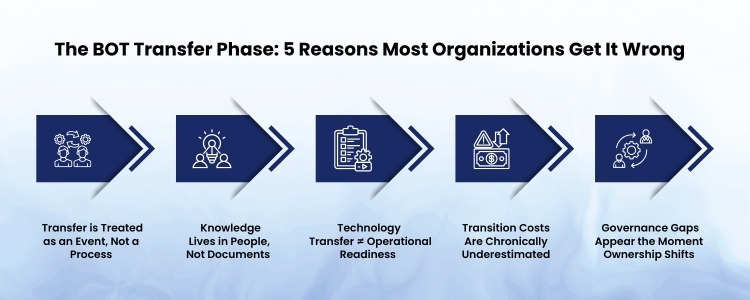
Knowledge transfer is the workstream most frequently described as ‘sufficient’ in pre-transfer assessments and most frequently cited as ‘inadequate’ in post-transfer retrospectives. The gap exists because knowledge transfer is treated as a documentation exercise rather than an organizational capability exercise. Effective knowledge transfer architecture operates across three layers. Explicit knowledge, documented processes, standard operating procedures, run-books, decision frameworks, and technical specifications is the visible layer. Organizations with strong transfer outcomes typically complete explicit knowledge documentation 60–90 days before T-Day, conduct structured review sessions to validate accuracy, and store documentation in systems to which the client has full, partner-independent access. Tacit knowledge, the judgment, relationships, and contextual understanding held by individual team members, is the harder layer to transfer. The practitioners who manage this most effectively use techniques including structured knowledge elicitation sessions (recorded and transcribed), cross-functional job rotation during the final Operate phase, and ‘error scenario rehearsal’, simulated incident or exception scenarios where transferring teams must resolve issues using only documentation and internal resources, with the BOT partner observing but not intervening. The gaps revealed by these rehearsals become the input to a final pre-transfer knowledge remediation sprint. Institutional knowledge, the understanding of how the BOT center interacts with external stakeholders, regulatory bodies, vendor relationships, and the broader organizational ecosystem — is the deepest and most frequently overlooked layer. Transfer plans must explicitly document key external relationships, their history, sensitivities, and the individuals responsible for maintaining them. In regulatory-sensitive sectors such as BFSI and pharma, the transfer of compliance relationships — including relationships with external auditors, regulatory contacts, and certification bodies — requires particular care.
The most common failure mode is transferring on a fixed date regardless of operational readiness. Sophisticated BOT contracts, following the precedent established in infrastructure projects such as the BTS Skytrain, define transfer triggers based on verified performance milestones rather than fixed dates. These triggers typically include sustained KPI attainment over a defined period (commonly 3–6 consecutive months), completion of leadership capability assessment, IP documentation completeness above a defined threshold, and legal entity establishment in the host jurisdiction. Organizations lacking condition-based triggers are vulnerable to transferring operations that are not yet stable, creating a post-transfer period of firefighting that undermines the business case for the entire BOT engagement.
Legal and regulatory processes in cross-border BOT engagements are invariably slower than anticipated. Entity registration, tax authority notifications, vendor contract novations, and employment transfer filings all involve third parties with their own timelines. Organizations that initiate legal transfer processes fewer than 90 days before T-Day routinely experience delayed transfers or are forced to operate in a hybrid state, where legal ownership has transferred but operational systems, payroll, or vendor contracts remain with the partner creating compliance exposure and governance ambiguity.
The Knowledge Cliff occurs when tacit and institutional knowledge, held by the BOT partner’s senior operational team, is not systematically transferred before partner teams disengage. This failure mode is typically invisible until after transfer, when the receiving organization encounters exceptions, edge cases, or relationship sensitivities that were never documented. The DECODE Agency practitioner framework recommends beginning knowledge transfer activities on Day 1 of the Operate phase, assigning internal leads to shadow partner senior engineers from the engagement’s outset, a discipline that most organizations do not implement until the final months of the Operate phase.
The period 90 days before and 90 days after T-Day represents peak attrition risk. BOT partner organizations, seeking to manage their own resource planning post-engagement, may proactively recruit alternative roles for high-performing team members. Simultaneously, competitor organizations recognize the employment vulnerability of individuals in transfer situations and actively target them. Organizations that do not establish retention programs, including financial retention incentives, accelerated career development commitments, and direct leadership engagement, routinely lose 15–25% of the transferred workforce within 180 days of T-Day.
Perhaps the most structurally damaging failure mode is the Governance Void, the period post-transfer when the clear governance and decision-making structure of the BOT partnership dissolves but client-side governance structures have not yet matured. During the Operate phase, governance clarity is typically strong: the BOT partner owns operational decisions, escalation paths are established, and accountability is clearly assigned. Post-transfer, if the client has not installed equivalent governance, including internal operational leadership, clear escalation protocols, vendor management capability, and financial reporting structures, operational discipline degrades rapidly. The BPM practitioner framework emphasizes that KPI monitoring, operational audits, and reporting mechanisms must be transitioned to client ownership at least 60 days before T-Day, with client leadership demonstrating independent governance capability before the partner formally disengages.
A US-headquartered enterprise storage company with no prior India presence engaged a BOT partner to establish a dual-hub GCC targeting niche storage engineering competencies, roles with limited availability uniformly across Indian tech hubs. The engagement, documented in the Plugscale case study, illustrates transfer planning at scale. The Build phase involved a city selection analysis across Bengaluru, Hyderabad, Pune, and Chennai based on storage engineering talent supply, infrastructure, and regulatory environment, resulting in a dual-hub model. Within 90 days of Build phase initiation, 30 engineers were onboarded without quality compromise. The Operate phase ran for approximately 24 months, during which the partner maintained knowledge continuity through comprehensive SOP documentation, shadow leadership cycles with designated client internal leads, and structured governance transition plans with parallel reporting phases. The transfer was characterized by four pillars: design, build, operate, and transfer, with each stage rooted in data-driven decision-making and process rigor. Post-transfer, the organization retained full operational independence with knowledge continuity protected by the parallel reporting structures established during the Operate phase. The engagement is referenced in practitioner literature as a model for managing transfer in technically specialized GCC contexts.
Pfizer’s Manila GCC, which began as a BOT engagement to test market viability in Southeast Asia, demonstrates a second-generation transfer dynamic, the conversion of a transferred GCC into a next-generation capability hub. Following a three-year BOT engagement covering regulatory affairs and clinical data management operations, Pfizer assumed control of the Manila center. Rather than maintaining it as a shared services operation, the post-transfer strategy pivoted toward AI-driven research support, with the Manila GCC becoming a global hub for AI-assisted regulatory submission management. This case illustrates a principle that leading BOT practitioners increasingly emphasize: transfer is not the conclusion of the BOT journey but the beginning of the client’s independent capability-building story. Organizations that design their post-transfer strategy during the Operate phase, using the stability of the BOT engagement to pilot new capabilities before assuming ownership, extract significantly more long-term value than those that treat transfer as an endpoint.
The BTS Skytrain BOT concession agreement with the Bangkok Metropolitan Administration introduced the ‘condition-based transfer trigger’ concept to public infrastructure. Rather than specifying a fixed transfer date, the concession agreement defined performance, maintenance, and financial conditions that must be verified before transfer of operational control to the public authority. This approach transferred risk appropriately: the concession holder was motivated to maintain superior operational standards to satisfy transfer conditions, and the public authority received an operation in verified good condition rather than one handed over under time pressure regardless of state. This mechanism has migrated from infrastructure BOT into technology GCC contracts, where ‘transfer readiness milestones’, covering team maturity benchmarks, SLA attainment consistency, documentation completeness verification, and leadership capability assessment, now appear as standard clauses in sophisticated BOT agreements drafted by experienced legal counsel.
The following KPI framework, synthesized from practitioner standards across technology GCC, infrastructure, and BFSI sectors, represents global best practice for transfer authorization criteria. Organizations should adapt thresholds based on sector, jurisdiction, and engagement complexity, but the dimensions represent a universal minimum standard.
The following sequenced playbook, structured around T-Day (the legal transfer date), provides a globally applicable execution framework. Organizations should customize timelines based on jurisdictional complexity and engagement scale. T-180 Days: Transfer Strategy Activation T-90 Days: Legal and HR Activation T-30 Days: Final Validation T-Day: Transfer Execution T+1 to T+60: Hypercare and Stabilization T+60 to T+180: Independence Validation
The transfer phase of a BOT engagement is not the finish line — it is the starting line for independent enterprise capability. Organizations that approach transfer as an administrative conclusion to a vendor engagement consistently underperform against those that approach it as an organizational transformation requiring the same strategic rigor, leadership attention, and execution discipline as the original Build phase. The global acceleration of BOT adoption — driven by enterprises seeking to establish GCCs in talent-rich markets without bearing the full cost and risk of independent establishment — means that transfer management competency is becoming a mainstream enterprise capability requirement. As Everest Group data confirms, nearly half of new GCC formations in major markets now involve BOT or BOT-adjacent models. The organizations that develop institutional competency in managing transfers — encoding lessons learned, refining their contracting standards, and building internal transfer expertise — will be positioned to iterate the BOT model across multiple markets and functions, compounding their advantage. The central discipline required is time. Successful transfer is earned in the months before T-Day, not manufactured on T-Day itself. Every knowledge gap left undocumented during the Operate phase, every legal initiation delayed, every leadership shadow program deferred, accumulates as transfer risk. The organizations featured in this report as reference practices share a common thread: they treated transfer-readiness as an ongoing operational discipline, not a one-time pre-transfer scramble.
For organizations currently in a BOT engagement, the immediate priority is a Transfer Readiness Assessment calibrated to the phase of the engagement. Those in the Build phase should embed transfer-readiness requirements into governance documentation and hiring profiles from inception. Those in the Operate phase should assess shadow leadership progress, documentation coverage, and legal entity preparation against the global framework presented here. Those approaching transfer should apply the T-180 playbook without compression. For organizations evaluating BOT as an entry strategy, the learning from this analysis is direct: the quality of transfer provisions in the initial contract, the partner’s documented track record of completed transfers (not just operational performance), and the client organization’s internal readiness to assume ownership are the three due-diligence dimensions most predictive of BOT success — and all three are assessable before the engagement begins.
The GCC BOT model is a phased approach where a partner builds and operates a GCC before transferring full ownership to the enterprise once maturity criteria are met. It progresses through build, operate, and transfer phases with defined governance, allowing enterprises to assume ownership gradually. BOT offers a transitional ownership path, while captive GCCs require full ownership and responsibility from inception. Hybrid models suit organizations seeking flexibility, combining partner-led execution with selective internal control. Operational stability, governance maturity, compliance readiness, and leadership capability are key transfer thresholds. With multifaceted experience in Legal, Advisory, and GCCs, Yashasvi weaves law, business growth, and innovation. He leads a cross-functional team across legal, marketing, and IT to drive compliance and engagement. His interests span Law, M&A, and GCC operations, with 15+ research features in Forbes, ET, and Fortune. A skilled negotiator, he moderates webinars and contributes to policy forums.
The Architecture of BOT
The Infrastructure Precedent That Matters
The Five Sub-Phases of Transfer
Phase
Duration
Primary Owner
Key Deliverables
Pre-Transfer Planning
3–6 months before T-Day
Joint (Partner + Client)
Readiness audit, legal filings, governance design
Asset & IP Transfer
T-Day ± 2 weeks
Legal & Compliance Teams
IP assignment deeds, contract novations, data handover
People Transition
T-Day to T+30 days
HR & People Operations
Employment transfers, payroll switch, ESOP realignment
Operational Handover
T-Day to T+60 days
Outgoing Partner (Hypercare)
SOP sign-off, run-book delivery, incident responsibility shift
Post-Transfer Stabilization
T+60 to T+180 days
Client Internal Leadership
KPI ownership, vendor exits, leadership independence
Pre-Transfer Planning: The 90-Day Runway
Legal and IP Transfer Mechanics
People Transition: The Most Underestimated Workstream
Knowledge Transfer Architecture
Failure Mode 1: Calendar-Driven Transfer
Failure Mode 2: Late Legal Initiation
Failure Mode 3: Knowledge Cliff
Failure Mode 4: Attrition Cascade
Failure Mode 5: Governance Void
Technology Sector: Storage Engineering GCC, India (Bengaluru–Chennai)
Pharma Sector: Manila AI Research Hub (BOT to GCC 3.0 Conversion)
Infrastructure Sector: Bangkok Mass Transit System (BTS Skytrain)
KPI Standards for Transfer Authorization
Metric
Baseline (Operate Exit)
Target at Transfer
SLA Attainment Rate
≥92% over 3 months
≥95% sustained for 6 months
Process Documentation Coverage
80% of critical processes
100% of critical, 90% of standard
Client Leadership Readiness Score
Shadow cycle 50% complete
Shadow cycle 100% + sign-off
Attrition Rate (annualized)
<18%
<12% pre-transfer, plan for <15% post
Legal Entity Establishment
In progress
Completed, statutory registrations active
IP Assignment Documentation
Draft deeds prepared
All deeds executed and registered
Vendor Contract Novations
Inventory complete
≥90% novated, remainder in process
Incident Resolution Independence
<40% partner-independent
≥85% independently resolved
The Transfer Execution Playbook
Reframing the Transfer Phase
Recommended Next Steps

frequently asked questions (FAQs)
1.What is the GCC BOT model?
2.How does Build Operate Transfer work for GCCs?
3.BOT vs captive GCC: what is the difference?
4.Is a hybrid GCC model suitable for enterprises?
5.What factors determine BOT transfer readiness?

Yashasvi Rathore









Error: Contact form not found. Error: Contact form not found.Subscribe to our Newsletter
Subscribe to our Newsletter
