Recent Posts







Organizations are under growing pressure to scale quickly, manage operating expenses, and access specialist talent worldwide in today’s rapidly changing business environment. At this point, having a clear staffing model and structure for Offshore Delivery Centers (ODCs) becomes more than just an operational decision; it becomes a strategic advantage. Cost arbitrage is no longer the only option for offshore staffing. Modern companies are using advanced offshore resource planning, skill-based hiring, and the Global Delivery Model to build high-performing, distributed teams that continuously provide value. By strategically placing the appropriate people in the right places, businesses may achieve faster delivery cycles, more productivity, and greater capacity. Choosing the appropriate offshore staffing approach, however, is the real challenge. Among the many available models, each of which offers different levels of control, flexibility, cost, and risk, organizations must carefully assess which structure best suits their long-term strategy, technology requirements, and commercial objectives. The purpose of this guide is to make decision-making easier. It offers an organized, data-driven viewpoint on offshore staffing models, assisting you in creating, contrasting, and putting into practice the best ODC setup.
A vendor (or partner) develops and manages a unique offshore workforce that works only on your projects under an ODC employment model. You retain strategic control over scope, priorities, and quality while the partner handles hiring, infrastructure, HR, payroll, and compliance. Companies like Infosys and Tata Consultancy Services have mastered this model through their Global Delivery Model, serving clients worldwide. Key differences from traditional outsourcing: Common ODC engagement variants: Start small (5–10 members) and scale to 50+ as processes mature.
A well-thought-out ODC structure adds a robust local leadership layer for smooth communication while mirroring your onshore organization. Core roles in the ODC staffing model: Governance flow:
For 24/7 “follow-the-sun” operations, quicker time-to-market, and risk diversification, the global delivery model divides work among onshore (client headquarters), nearshore, and offshore locations.
Traditional headcount-driven staffing models are rapidly becoming obsolete. Organizations are moving toward skill-based personnel in contemporary Offshore Delivery Centers (ODCs), where they prioritize capabilities and expertise over job titles. By using this method, companies may create highly specialized teams that directly match project objectives, improving productivity, creativity, and long-term scalability. How to Implement Skill-Based Staffing Benefits:
For any Offshore Delivery Center (ODC) to be successful, effective offshore resource planning is essential. Organizations run the danger of bench time, skill shortages, and team burnout without a systematic approach, all of which have a direct influence on output and delivery schedules. A clearly defined resource planning strategy guarantees optimal utilization, smooth scalability, and uniform performance across dispersed teams. Core Components of a Robust Offshore Resource Plan
An organized, staged approach is necessary for the successful establishment of an Offshore Delivery Center (ODC). Organizations may reduce risks, accelerate onboarding, and guarantee long-term success with a clear implementation path. Step-by-Step Implementation Roadmap Top challenges & solutions:
Offshore Delivery Centers (ODCs) are quickly changing to satisfy the needs of agile, digital-first businesses as global delivery patterns continue to change. Technology, adaptability, and a greater emphasis on talent optimization will influence ODC staffing in the future.
The ODC staffing model integrated into a global delivery strategy is one of the most effective approaches if you require long-term, dedicated capacity with complete control. Organizations can create true competitive advantage through scalable, high-performing global teams and cost savings by adopting skill-based staffing and disciplined offshore resource planning.
Hyderabad, Bangalore and Pune have become significant pharma innovation centres with global delivery centres of major biotechnological and pharmaceutical firms such as Novartis, Pfizer, AstraZeneca and GSK. They offer an economic benefit of calculation, a variety of scientific and technical human resources, and speedy time-to-market. On average, businesses reduce between 25-40 percent of the operational costs and increase the rate of innovation. The next-generation operations of Pharma GCC focus on advanced molecular modelling, AI/ML-based drug discovery, cloud supercomputing, and data integration platforms, as well as quantum-ready simulations. Pharma GCCs use AI to screen molecules, predict the efficacy of drugs, optimise clinical trials and aid in making data-driven decisions, resulting in smarter, faster and safer drug pipelines. Pharma GCCs will be global innovation ecosystems that are a combination of computational chemistry, generative AI, and quantum computing. They will turn into the hubs linking data science, discovery and regulatory intelligence in the global arena. Aditi, with a strong background in forensic science and biotechnology, brings an innovative scientific perspective to her work. Her expertise spans research, analytics, and strategic advisory in consulting and GCC environments. She has published numerous research papers and articles. A versatile writer in both technical and creative domains, Aditi excels at translating complex subjects into compelling insights. Which she aligns seamlessly with consulting, advisory domain, and GCC operations. Her ability to bridge science, business, and storytelling positions her as a strategic thinker who can drive data-informed decision-making.
1. What Is an ODC Staffing Model?
2. Typical ODC Team Structure and Governance
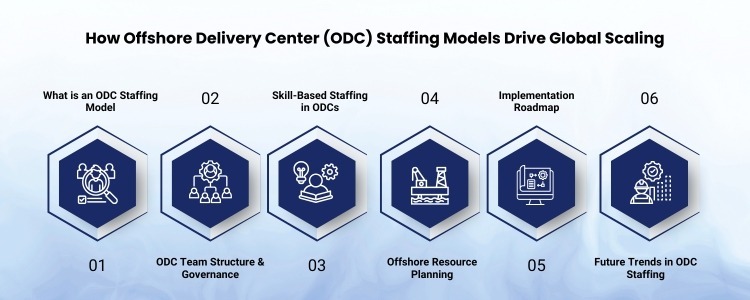
3. ODC in the Global Delivery Model (GDM)
4. The Rise of Skill-Based Staffing in ODC
5. Offshore Resource Planning: Best Practices
6. Implementation Roadmap & Best Practices
Challenge
Solution
Communication Gaps
Daily stand-ups and overlapping working hours
Cultural Differences
Cross-cultural training and team-building initiatives
High Attrition
Strong employer branding, career growth paths, and retention incentives
7. Future Trends in ODC Staffing
Conclusion: Is an ODC Staffing Model Right for You?

frequently asked questions (FAQs)
1.Who are the Pharma GCC development leaders in India?
2.Which economic benefits do Pharma GCCs have?
3.Which technologies are influencing Pharma GCC operations nowadays?
4.What is the role of AI in Pharma GCC processes?
5.How will Pharma GCCs look in five years to come?

Aditi








Error: Contact form not found. Error: Contact form not found.Subscribe to our Newsletter
Subscribe to our Newsletter