Recent Posts






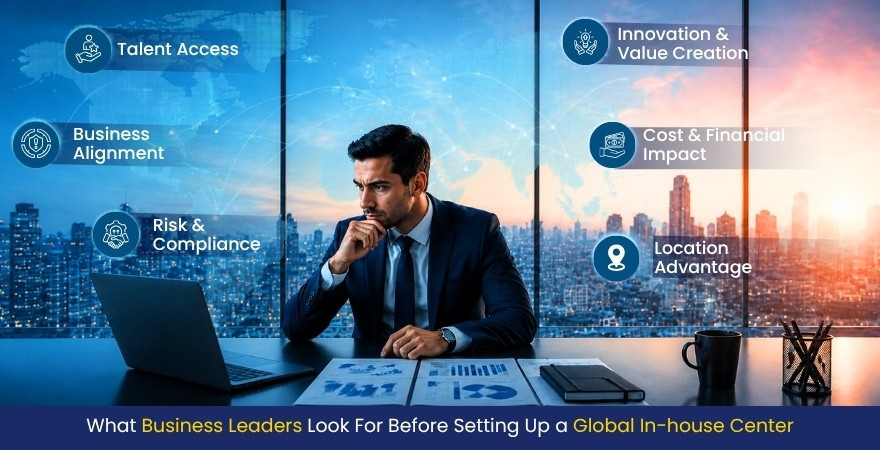
Global In-house Centers (GICs) or Global Capability Centers (GCCs) have evolved from cost-effective offshore units into strategic engines for innovation, talent, and growth. It also outlines the practical factors business leaders evaluate before committing to a setup, especially when guided by modern GCC-enabled consulting firms, like ours, Inductus Ltd.
“Originally called captive centers in the early 1990s, GICs are offshore centers that perform designated functions for large organizations. Bain&co. Global in-house centers did not begin as the strategic powerhouses they are today. In the early 1990s, they were typically known as “captive centers,” created to execute defined work offshore while the parent company retained ownership, control, and intellectual property. Over time, these centers became far more than delivery units; they developed into enduring capability hubs that supported technology, operations, analytics, finance, and engineering. “The market size of India’s global capability centers (GCCs) is likely to grow to $99 billion-$105 billion by 2030 from $64.6 billion in fiscal 2024, according to a report by IT industry body Nasscom and consulting firm Zinnov released on Wednesday.” The Print. Today, GCCs are no longer a niche operating model. The number of GCC-linked companies is expected to rise to roughly 2,100 to 2,200, and employment to reach 2.5 million to 2.8 million people. Reuters reported in May 2026 that India hosts more than half of the world’s global centers and is expected to have nearly 2,200 centers with a talent base of 2.36 million by the end of the fiscal year ending in March.
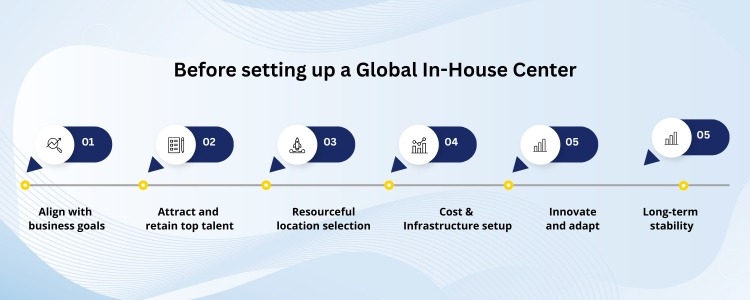
Before setting up a global in-house center, business leaders think about a lot of things. They want to know if the center will help the company achieve its goals, if it will be able to innovate and adapt to change, and if it will be able to attract and keep employees. They also think about the location of the center. They want to know if the location has the talent, infrastructure, and cost structure to support the company’s goals. They do not just think about the short-term benefits. Also, about the long-term potential of the location.
The successful global in-house centers are set up with a clear strategic vision. They are not just set up to save money. To drive innovation and growth. Business leaders think about how the center will fit into the company’s strategy and how it will help the company achieve its goals. Location fit: talent, infrastructure, cost, and ecosystem The location of a global in-house center is very crucial. Business leaders think about the talent, infrastructure, cost, and ecosystem of the location. They want to know if the location has the skilled labor and expertise to support the company’s goals and if it has the right infrastructure to support the company’s operations. A talent strategy that is built for capability, not headcount alone Global in-house centers need a talent strategy that is built for capability, not just headcount. Business leaders think about how to attract and keep employees and how to develop the skills and expertise of the team. They want to know if the location has a talent pool and if it can support the company’s long-term goals. Governance, Operating Model, and Organizational Control The governance structure of a global in-house center is very important. Business leaders think about how the center will be managed, be it bilateral or contract-based, and how it will be controlled. They want to know if the center will be able to make decisions and if it will be able to adapt to change. Legal Regulatory, Tax and Risk Readiness Setting up a global in-house center is a process. Business leaders need to think about the regulatory, tax, and risk implications of setting up a center in another country. They want to know if the location has a supportive business environment and if it can support the company’s long-term goals. Technology Ambition and Innovation Potential Technology ambition is key to the success of a global in-house center. Business leaders think about how the center will use technology to drive innovation and growth. They want to know if the location has the right technology infrastructure and if it can support the company’s long-term goals. Setting up a global in-house center is a complex decision. Business leaders need to think about the strategy, location, talent, governance, and technology of the center. They need to think about how the center will fit into the company’s strategy and how it will help the company live up to its full potential.
For today’s business leaders, a global in-house center is no longer a simple offshore extension. It is a decision about control, capability, resilience, and enterprise transformation. The real question is not whether the center can reduce cost; it is whether the center can help the company think faster, build better, and scale with confidence. That is why the most successful GCCs are designed with strategy first, enabled by consulting support, and governed like core assets rather than support functions.
Companies can cut their costs by 30-50% due to the availability of high-quality but inexpensive labor from India. The low cost of property and infrastructure investments also adds to the efficiency of operations. A favorable currency position also assists multinational corporations in managing their expenditures and maximizing benefits. Most significantly, all these economies are achieved without sacrificing quality, innovation, or speed of delivery. India is home to a massive resource pool of skilled professionals in AI and data science, making innovation easier. Over 500 GCCs with an emphasis on AI are available for technologies such as machine learning and GenAI. These GCCs assist firms in developing their own proprietary platforms and IP. .Thus, Indian GCCs are crucial in the context of global AI innovation and transformation. India is expected to have 2,100-2,500 GCCs by 2030 due to high growth. These centers will become more important for international business, innovation, and product development. GCCs will be at the forefront of innovation, including AI, digitization, and decision-making. In general, they will make a significant contribution to India’s economy and international business. India boasts an enormous reservoir of STEM professionals, which allows firms to expand their workforce rapidly. It has a robust digital infrastructure, which fosters innovation and international business. Its cost efficiencies make it extremely effective as opposed to other international destinations. A developed environment in AI, cloud computing, and data science ensures constant innovation and development. Global Capability Centers (GCCs) in India are enterprise-owned hubs that deliver end-to-end services like product development, R&D, AI, and digital transformation. They go beyond traditional outsourcing to drive innovation and business strategy. With a keen analytical mindset and a passion for data-driven insights, Babita Gangwar brings expertise in research, analysis, and strategic evaluation. As a Research Analyst, she focuses on transforming complex data into actionable intelligence that supports informed decision-making. She collaborates across teams to deliver high-quality research outputs, ensuring accuracy, relevance, and impact. Her interests span market research, data analytics, and emerging industry trends. A detail-oriented professional, she actively contributes to knowledge development through reports, presentations, and research initiatives.
The Origins and Future of Global In-house Centers
Key Priorities Business Leaders Evaluate Before Establishing a Global In-house Center
A clear strategic reason, not just a cost case
Conclusion
frequently asked questions (FAQs)
1.What cost advantages do GCCs in India offer?
2.How do GCCs in India support AI and innovation?
3.What is the future outlook for GCCs in India?
4.What makes India a top destination for GCC expansion?
5.What are Global Capability Centers (GCCs) in India?

Babita Gangwar








Error: Contact form not found. Error: Contact form not found.Subscribe to our Newsletter
Subscribe to our Newsletter