Recent Posts






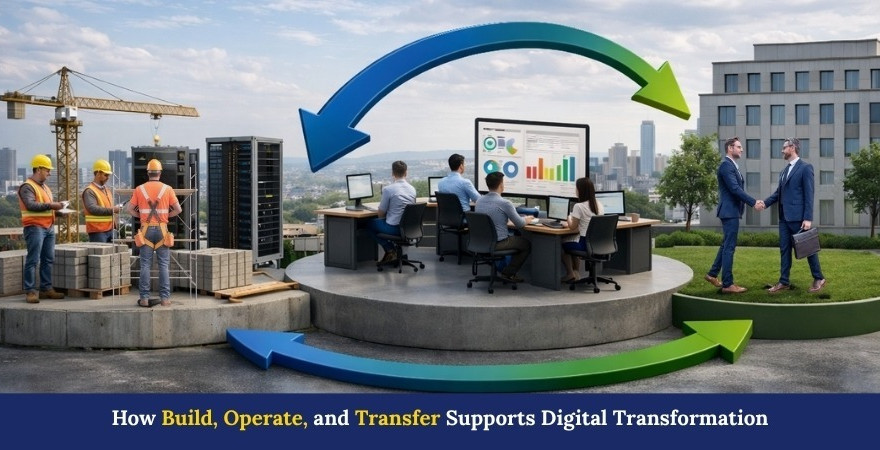
Many multinational companies are restructuring how they build and manage technology capabilities. Build Operate Transfer has gained attention as a structured engagement model that allows organizations to establish new functions with third-party support, retain governance throughout, and eventually take full ownership of what has been built. This post explains how the model works, how it fits within a broader business transformation strategy, and what leadership teams should consider before selecting it.
Build Operate Transfer is an IT service delivery model where a service provider establishes a technology or operations unit on behalf of the client, operates it for a predetermined amount of time, and then gives the client organization complete ownership. This strategy complements a more comprehensive company transformation plan while promoting digital transformation. There are three stages in which the model operates. The provider recruits staff, sets up infrastructure, and sets up procedures in accordance with the client’s specifications during the build phase. The provider manages daily operations during the operational phase, which lasts for two to five years on average. The client assumes responsibility for the team, systems, contracts, and procedures throughout the transfer phase. Intent is what sets this approach apart from traditional technology outsourcing. With standard outsourcing, the vendor maintains complete control. Build Operate Transfer has a clear transition to internal ownership from the beginning.
Organizations implementing a business transformation strategy frequently have to manage operational risk and cost while rapidly developing new capabilities. It takes a lot of resources to build everything internally from the beginning. The company permanently outsources a vital function. Neither choice is appropriate in every circumstance. Build-operate-transfer fills this gap. With the help of a specialized provider, it allows the company to set up operations centers, enter new markets, or build technical functions while pursuing direct ownership. The end result is a functional unit constructed in accordance with internal standards rather than a vendor’s delivery model because the customer is involved in governance decisions throughout. Instead of committing to long-term vendor agreements for strategically critical operations, this model offers firms conducting multi-year transformation efforts an opportunity to decide which capabilities to own internally over time.
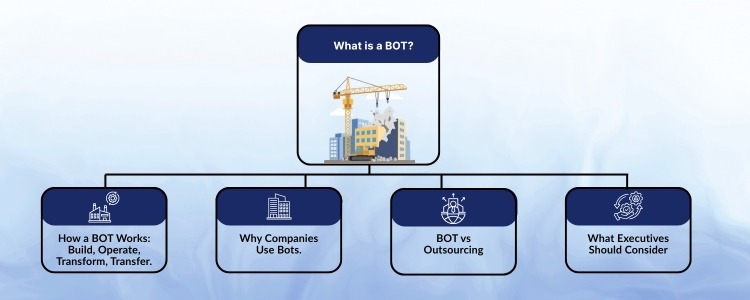
Build, Operate, Transfer is an IT service delivery approach that works best when a customer needs a fully functional team and infrastructure but lacks the local market access, recruitment networks, or managerial capacity to set it up on their own. Establishing a global capabilities center at a new location is a typical use. Build: The organization’s requirements, including sourcing objectives, technical requirements, and operational priorities in line with its digital transformation and business transformation strategy, are thoroughly assessed at the start of this phase. The provider defines the operating model, which includes the service catalog, governance framework, and general IT service delivery architecture. After that, the supplier sets up the infrastructure and hires personnel in the chosen area to create the distribution center. To obtain local knowledge and improve setup, this step makes use of technology outsourcing. Locations are usually selected according to strategic expansion requirements or current presence. Operate: By standardizing procedures, fulfilling service level agreements, and enhancing service delivery in accordance with the established IT service delivery model, this phase aims to produce a steady state of operations. This complements the organization’s business transformation strategy and supports continuous digital transformation. To increase capabilities, the supplier promotes workforce alignment, process enhancements, and technology adoption. Companies use technology outsourcing to facilitate large-scale execution and add necessary knowledge. This phase makes a more scalable and adaptable operating model possible and lays the groundwork for ongoing progress. Additionally, it enhances the company’s capacity to adapt to shifting business needs and fosters the growth of a competent workforce. During this stage, we switch our primary focus to developing enterprise capabilities and carrying out specified transformation objectives. To promote digital transformation and improve the IT service delivery model, the provider implements new technologies, analytics, and process enhancements across functions. The supplier facilitates continuous improvement, data-driven decision-making, and business process enhancements through an integrated operating approach. Technology outsourcing facilitates access to the specialized talents needed for implementation. This stage helps the company use technology more effectively in both client interactions and operations. To guarantee that digital transformation is maintained over time, it also creates governance frameworks and change management procedures that are in line with the business transformation plan. Transfer: The delivery center is solid and prepared for the organization’s transformation at this point. The business transformation plan predetermines the entire or partial extent of the transfer, including teams, operations, and assets. The organization gains ownership of the IT service delivery model, procedures, and systems, and the service provider leaves in a planned fashion. This guarantees the continuation of digital transformation projects while lowering reliance on technology outsourcing To specify the transfer scope, prevent Delays can occur, so early planning is necessary to guarantee a seamless transition. Effective implementation of this phase and the provider’s capacity to provide a thorough and stable handover are critical to the Build Operate Transfer model’s success.
In traditional technology outsourcing, companies usually hire a vendor to manage a function for several years. The vendor is in charge of the procedures, equipment, and team makeup. Although the client obtains outputs, they have no control over the internal development and management of the functions. The vendor builds in accordance with the client’s requirements within a build-operate-transfer structure. When making hiring, technology, and operational standards decisions, we consider the client’s post-transfer ownership and operations. The customer participates in governance from the start, significantly impacting the structure of the function and the actual transfer. BOT is best suited for businesses considering technology outsourcing choices when the long-term goal is to bring the function in-house. For functions that tolerate or prefer continuous vendor management, this paradigm is inappropriate.
Many organizations underestimate the amount of preparation needed for the transfer period. Process documentation, leadership continuity, and early planning for the contractual and HR aspects of the transfer are essential for a smooth transition. The transfer should be viewed by organizations as a project milestone that is scheduled at the start of the engagement rather than at the conclusion of the operational phase. This includes choices on which contracts and licenses will be redistributed, which positions will be transferred to the client’s payroll, and how governance will go from the vendor’s structure to the client’s own management hierarchy. Organizations usually face challenges to service continuity and struggle to retain employees during the transition when they view the transfer as a secondary concern. The handover usually proceeds with less operational disturbance when it is scheduled in advance.
Build-operate-transfer works well when the client has the organizational ability to absorb the function upon transfer and a clear long-term desire to own it. It is not effective in circumstances where senior sponsorship is lacking or where internal ownership of the function is unclear. The cost structure differs from standard outsourcing contracts. The client covers a transfer or buyout agreement, startup expenses, and continuing management fees during the operation period. Executives should model the entire cost for the entire duration of the partnership, not just the first few years. The vendor selection process should include a review of the provider’s performance, particularly during the transfer phase. It’s not always clear how well a provider handles the handover based on its capacity to create and run a function.
Build-Operate-Transfer provides enterprises with a clear path to developing and acquiring technology and operational capabilities without having to manage the entire setup process themselves. It bridges the gap between long-term outsourcing and starting from scratch inside a digital transformation initiative. It functions as an IT service delivery model when the client plans the transfer from the outset and intends to own what it develops. When long-term internal ownership of a capacity is a declared organizational goal, leaders should consider this model when making technology outsourcing choices.
Hyderabad, Bangalore and Pune have become significant pharma innovation centres with global delivery centres of major biotechnological and pharmaceutical firms such as Novartis, Pfizer, AstraZeneca and GSK. They offer an economic benefit of calculation, a variety of scientific and technical human resources, and speedy time-to-market. On average, businesses reduce between 25-40 percent of the operational costs and increase the rate of innovation. The next-generation operations of Pharma GCC focus on advanced molecular modelling, AI/ML-based drug discovery, cloud supercomputing, and data integration platforms, as well as quantum-ready simulations. Pharma GCCs use AI to screen molecules, predict the efficacy of drugs, optimise clinical trials and aid in making data-driven decisions, resulting in smarter, faster and safer drug pipelines. Pharma GCCs will be global innovation ecosystems that are a combination of computational chemistry, generative AI, and quantum computing. They will turn into the hubs linking data science, discovery and regulatory intelligence in the global arena. Aditi, with a strong background in forensic science and biotechnology, brings an innovative scientific perspective to her work. Her expertise spans research, analytics, and strategic advisory in consulting and GCC environments. She has published numerous research papers and articles. A versatile writer in both technical and creative domains, Aditi excels at translating complex subjects into compelling insights. Which she aligns seamlessly with consulting, advisory domain, and GCC operations. Her ability to bridge science, business, and storytelling positions her as a strategic thinker who can drive data-informed decision-making.
What Is Build-Operate-Transfer?
Alignment with a Business Transformation Strategy
BOT as an IT Service Delivery Model
Technology Outsourcing Through a BOT Structure
Planning the Transfer Phase
What Executives Should Evaluate
Summary
frequently asked questions (FAQs)
1.Who are the Pharma GCC development leaders in India?
2.Which economic benefits do Pharma GCCs have?
3.Which technologies are influencing Pharma GCC operations nowadays?
4.What is the role of AI in Pharma GCC processes?
5.How will Pharma GCCs look in five years to come?

Aditi







Error: Contact form not found. Error: Contact form not found.Subscribe to our Newsletter
Subscribe to our Newsletter