Recent Posts






In today’s fast-evolving business landscape, organizations are under constant pressure to innovate, scale, and stay ahead of shifting customer expectations. The development of technologies like cloud computing and artificial intelligence is revolutionizing businesses worldwide.
A Global Capability Center (GCC), also called a captive center or global in-house center, is a wholly owned offshore or nearshore facility created by an organization to provide essential business services.
The offshore delivery model and captive center model are two distinct approaches for outsourcing operations to a cheaper destination; however, the two models have distinct structures. In an offshore delivery model run by an external vendor, the customer pays for the output delivered, while the vendor manages all aspects related to hiring, training, retention, and operational processes. In a Global Capability Center, the parent company manages all these aspects directly.
The GCC model comes in different flavors. Organizations select among four different models based on their level of risk tolerance, scalability, financing options, and the degree of control they need at the outset. This method offers full control, greater congruence with business objectives, and enhanced data protection, thus making it more appropriate for organizations that have offshore experience and global presence. In the BOT model, an outside entity establishes the GCC during the initial period (usually 2 to 4 years). After establishing stability, the entire GCC is handed over completely to the parent organization. This method enables firms to enter into new markets swiftly without having to take any risks at the outset, particularly if they have no knowledge of the market. The GCC-as-a-Service model is a managed approach where a third-party vendor handles operations, hiring, and infrastructure on behalf of the parent company. Despite this, the GCC is wholly owned by the parent company and functions under its brand and governance structure. Without creating a legal entity, this technique allows businesses to swiftly establish a presence in new markets. It guarantees access to infrastructure and qualified personnel while lowering operational complexity and initial investment. It also provides the ability to grow operations in accordance with company requirements. For businesses looking for speed, efficiency, and less risk in GCC implementation, this makes it especially appropriate. The BOT model has grown in adoption among first-time GCC entrants. According to the report, between 2021 and 2024, almost 38% of new GCC installations in India adopted a BOT or GCC-as-a-Service arrangement. In particular, the GCC-as-a-Service model has gained popularity among mid-sized multinationals with $1 billion to $5 billion in revenue who wish to use offshore economics without having to deal with the whole overhead of a separate organization.
You operate in lower-cost regions to significantly reduce overall expenses. 2. Full Ownership & IP Control You retain complete ownership of all work produced from day one. 3. Access to Deep Talent Pools You hire from large, skilled global workforces in cost-efficient markets. Employees are directly aligned with your organization’s culture and structure. 5. Scalability Across Functions You can expand teams and capabilities without vendor constraints. Reduced dependence on onshore teams over time
The choice between the four GCC models is not purely a cost decision. It’s a decision about the government. The BOT and pure-captive models are appropriate for businesses that want to manage the center as a long-term strategic asset. Organizations who wish to test offshore delivery before investing the entire cash and entity overhead of a captive center might benefit from the joint venture and GCC-as-a-Service models.
At that scale, selecting the right operating model from the outset determines how quickly an organization reaches cost targets and how much operational control it retains over the long term.
To navigate this complexity, leading companies are relying on GCCs as strategic tools for achieving transformational change and growth.
What is a Global Capability Center?
A Global Capability Center (GCC) is a company’s own offshore hub that delivers critical business functions and drives innovation. Technology & Engineering (product development, DevOps, and cybersecurity); Data & Analytics (AI/ML models and business intelligence); Finance (financial planning, reporting, and treasury); Operations (supply chain, procurement, and customer operations); and Risk & Compliance (fraud detection and regulatory reporting) are just a few of the domains in which these centers operate. GCCs are essential in boosting productivity, facilitating digital transformation, and fostering enterprise-wide expansion through the integration of these capabilities.
1,800+
GCCs currently operating in India (2026)$46B
GCC spending in India in FY20242.1M
Professionals employed across Indian GCCs$110B
Projected GCC market size in India by 2030What is GCC in business, and how does it differ from outsourcing?
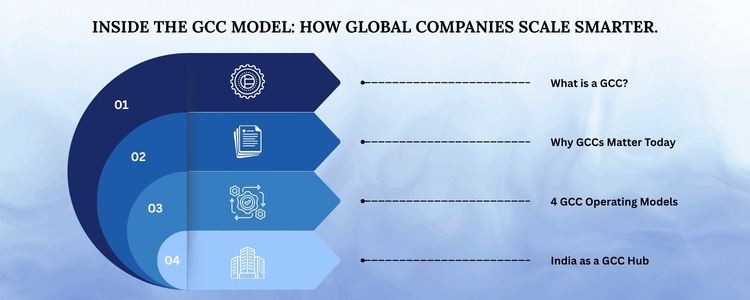
The 4 GCC models: how organizations structure their offshore operations
1. Pure Captive Model
In this model, the GCC will be wholly owned and managed by the parent organization from day one. The organization will have to handle the setup process, personnel recruitment, and daily activities without any third-party involvement.
Best for: Organizations with prior offshore experience and an established employer brand in the target market.
2. Build-Operate-Transfer (BOT) Model
Best for: Organizations entering a new geography without existing local infrastructure or vendor relationships.
The Joint Venture (JV) or hybrid model involves shared ownership between the parent company and a local partner. Both entities work together in the management of their relationship, costs, and human resources, depending on an agreement that was made earlier. The parent firm maintains control over the strategy and planning process, whereas the local partner brings in the market expertise and local knowledge. Such a strategy facilitates market entry more rapidly than any other strategy. It also makes it easier to understand the regulatory and cultural environment of the region.
Best for: Markets where local regulatory requirements, labor laws, or vendor access make a pure captive structure more difficult to execute.
Best for: Organizations that want the economics of a captive center without the fixed overhead of setting up a full legal and HR entity.
Model
Control level
Setup time
Capital outlay
Adoption share (2024)
Pure Captive
Full
18 to 24 months
$4M to $8M
52%
Build-Operate
Transitional
12 to 18 months
$2M to $5M
27%
Joint Venture / Hybrid
Shared
9 to 15 months
$1.5M to $4M
11%
GCC-as-a-Service
Governance only
3 to 6 month
$0.5M to $2M
10%

Benefits of the GCC Model
This leads to savings across:
This ensures control over:
This provides access to:
This results in:
This enables growth into the following:
What this means for organizations evaluating the model








Error: Contact form not found. Error: Contact form not found.Subscribe to our Newsletter
Subscribe to our Newsletter
