Recent Posts







Global enterprises are no longer operating in a predictable business environment. Economic fragmentation, geopolitical shifts, supply chain disruptions, cybersecurity risks, changing workforce dynamics, and the acceleration of AI-led transformation have forced multinational corporations to rethink how global operations are designed and managed. The turn towards the 21st century had led to multiple progressions across borders, with capitalization reaching its peak, and with that, multinational companies flourished and expanded with an intent to establish global operations. Shared Services Centers emerge as an efficient way to streamline localized markets, which have the potential to aggravate resilient global operations, reform strategies, and provide excellent facilities to MNCs to grow by benefiting them with financial services, talent acquisition, IT services, and qualified HR management teams. Shared services models, when combined with global capability centers, become a strategic blend of flexible, cost-efficient offshore centers that enable fast-scaling growth for MNCs seeking global markets. In 2026, enterprises aren’t just looking for shared services with consolidation mechanisms; they are expecting global business services to intersect with a honeycomb structure of operational excellence, digital transformation, analytics, automation, AI governance, talent centralization, and cross-functional collaboration within a unified enterprise framework. This shift is reformulating the future of global operations strategy for enterprises across industries, including banking, healthcare, manufacturing, retail, automotive, technology, trade, telecom, logistics, and energy.
As global business centers keep transforming, the strategic importance of shared services centers rises. The OECD says, “Governments are increasingly expected to play a strategic role in safeguarding critical supply chains.” This statement highlights how governments all over the world are prioritizing globalization in all sectors, especially in shared service-led business continuity for better global operations, and pushing government collaborations to safeguard the future. Another statement by the World Economic Forum says, “Harnessing shared data intelligence is key to predictive, responsive, and resilient supply networks.” Such statements highlight the urgent need to partner with countries and engage with SSC platforms, particularly IT sectors, to bring this to reality. One of the biggest challenges global enterprises face is fragmented decision-making due to disconnected systems and regional silos. Shared service centers create unified operational visibility by consolidating enterprise data, workflows, reporting structures, and governance processes into centralized platforms. This helps in real-time engagement with
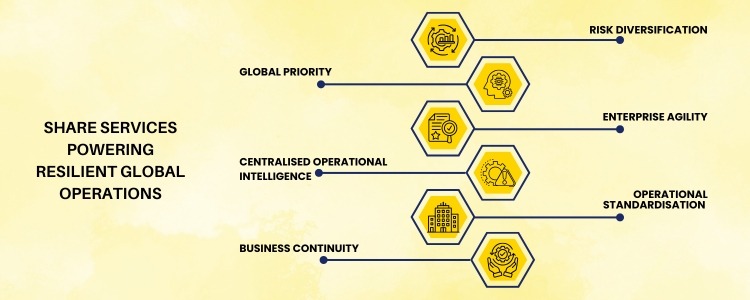
The pandemic era fundamentally reshaped enterprise thinking around operational continuity. Enterprises realized that overdependence on fragmented local operations creates vulnerability during disruptions. Thus, to minimize the risk, SSCs in different countries provide spine support in tough times. Modern shared service centers are designed with resilience architectures that support the following: . Operational Standardization Across Global Markets: As enterprises scale, process inconsistency is a pervasive issue in cross-border operations. It not only leads to operational inefficiency but also gives rise to further problems, including compliance loopholes and rising costs. Shared service centers can achieve standardization by unifying processes, a function that is critically important for seven heavily regulated industries, such as finance and healthcare. This model can improve operational scalability and reduce risk exposure. Enterprise agility is now a top priority for the board. In unstable markets, companies need to expand operations swiftly, deploy new capabilities quickly, penetrate new regions more rapidly, and adapt promptly to disruptions. Traditional decentralized operating models find it difficult to achieve this level of agility, as each region functions autonomously with its own systems, teams, governance frameworks, and technology platforms. The modern shared services model addresses this challenge by combining centralization with modular scalability.
A widespread misunderstanding in the market is that shared service centers serve merely as operational support units. In practice, the most advanced companies leverage shared services to speed up their transformations. These centers are increasingly leading efforts in: Due to their cross-functional scope, shared service centers are uniquely equipped to spot inefficiencies and spearhead enterprise-wide optimization projects.
With rising economic uncertainty, increasing operational complexity, and swift digital transformation, shared service centers are proving vital for creating resilient global operations. In addition to cost optimization, contemporary shared services models support centralized governance, operational flexibility, AI-powered transformation, uninterrupted business operations, and scalable global expansion. When combined with global business services and GCC ecosystems, shared service centers transform into strategic enterprise hubs that foster innovation, enable scalable workforce management, and drive intelligent decision-making. By 2026, organizations see shared services not just as back-office units but as essential components of a globally aligned, future-oriented operations strategy aimed at boosting long-term competitiveness and resilience.
I write where strategy meets storytelling. As a passionate writer and literary enthusiast, I craft GCC-focused content that transforms industry insights into compelling narratives. Drawn to global business ecosystems, I enjoy turning research, innovation, and ideas into content that informs, connects, and inspires. With an analytical mind and a creative soul, I bring curiosity, collaboration, and a sharp eye for detail to every project. Adaptable and growth-driven, I believe the right words do more than communicate – they leave an impression.
Towards Resilience: SSCs crafting new Narratives
Towards Resilience: SSCs crafting new Narratives
Shared Service Centers as Drivers of Enterprise Transformation

Conclusion

Pratibha Soni









Error: Contact form not found. Error: Contact form not found.Subscribe to our Newsletter
Subscribe to our Newsletter