Recent Posts







India commands 55% of the global offshore services market. Offshore development centers are no longer limited to large technology companies with dedicated global operations teams. Across multiple industries in the USA, mid-size and enterprise companies are using them to manage costs, access specialized talent, and maintain development output without proportional increases in headcount spend.
The technology industry has the longest history of offshoring IT services, and it continues to use ODC services more than any other industry in the United States. US software companies allocate between 28% and 35% of their overall engineering budget to offshore or nearshore development resources. Product companies that need to increase engineering staff without making corresponding US hires will benefit from offshore development centers that offer full-stack, cloud, and DevOps developers at 40% to 60% less than their US counterparts. Smaller software companies with fewer than 500 staff members have started outsourcing their development operations as an approach to assembling their product development teams more quickly than hiring domestically can allow for. The average hiring period for a software developer in the United States takes about 45 to 60 days (LinkedIn Talent Insights, 2024), whereas the same process occurs in 20 to 30 days in India’s ODC markets. Hiring a senior software developer in the US takes between 45 to 60 days on average (LinkedIn Talent Insights, 2024), while sourcing the same role in the existing ODCs of India takes around 20 to 30 days.
Financial institutions like banks and insurance companies, as well as financial technology companies, form the second-largest group of operators of ODCs among US corporations. Core processes outsourced to ODCs include the development of core banking software applications, software for regulatory compliance reporting, platform engineering, and fraud detection. Such processes are not ancillary. This is due to the fact that the rationale for outsourcing core technological development in the financial sector is similar to the case of the technology sector; in addition, the regulatory framework of India and the Philippines has developed sufficiently.
Healthcare technology and life sciences companies have increasingly turned to offshore development centers over the last five years. India is an important destination for this research due to the presence of engineers with expertise in life sciences. There has been an increase in the number of professionals in this sector by 22 percent from 2021 to 2023. This trend will facilitate further expansion of offshore development centers in healthcare technology and life sciences.
Technology ecosystems in US retail and e-commerce businesses comprise supply chain solutions, customer management tools, price engines, and logistics applications. It is challenging to develop and maintain these ecosystems entirely within the country owing to high engineering expenses and a lack of scalability. Offshore development centers are used to support ongoing technology operations. These centers handle: This setup allows US teams to focus on product planning and customer experience decisions. Companies dealing in e-commerce that set up offshore development centers in the period between 2018 and 2022 experienced accelerated product release schedules by an average of 30 percent when compared to fully onshore systems. The enhancement can be attributed to the increased duration of development across time zones (Kearney Digital Operations Study, 2023). The employment of offshore teams ensures non-stop development without adding onshore staffing. Common Factors Across Industries Talent availability
The cost of engineering is reduced by up to 30 percent to 60 percent due to offshore development. Offshore teams operate in time zones that are 9 to 12 hours ahead of the US. • Development work continues after US working hours, enabling near 24-hour progress
The industries that gain the most by having offshore development centers in the USA include the technology/software industry, financial services, healthcare technology, retail/e-commerce, media, and manufacturing. They all leverage their offshore capacity in different ways, but they all share common factors, such as lower costs of engineering staff, quicker access to specialized talent, and the ability to keep up with development without hiring additional US engineers.
Companies can cut their costs by 30-50% due to the availability of high-quality but inexpensive labor from India. The low cost of property and infrastructure investments also adds to the efficiency of operations. A favorable currency position also assists multinational corporations in managing their expenditures and maximizing benefits. Most significantly, all these economies are achieved without sacrificing quality, innovation, or speed of delivery. India is home to a massive resource pool of skilled professionals in AI and data science, making innovation easier. Over 500 GCCs with an emphasis on AI are available for technologies such as machine learning and GenAI. These GCCs assist firms in developing their own proprietary platforms and IP. .Thus, Indian GCCs are crucial in the context of global AI innovation and transformation. India is expected to have 2,100-2,500 GCCs by 2030 due to high growth. These centers will become more important for international business, innovation, and product development. GCCs will be at the forefront of innovation, including AI, digitization, and decision-making. In general, they will make a significant contribution to India’s economy and international business. India boasts an enormous reservoir of STEM professionals, which allows firms to expand their workforce rapidly. It has a robust digital infrastructure, which fosters innovation and international business. Its cost efficiencies make it extremely effective as opposed to other international destinations. A developed environment in AI, cloud computing, and data science ensures constant innovation and development. Global Capability Centers (GCCs) in India are enterprise-owned hubs that deliver end-to-end services like product development, R&D, AI, and digital transformation. They go beyond traditional outsourcing to drive innovation and business strategy. With a keen analytical mindset and a passion for data-driven insights, Babita Gangwar brings expertise in research, analysis, and strategic evaluation. As a Research Analyst, she focuses on transforming complex data into actionable intelligence that supports informed decision-making. She collaborates across teams to deliver high-quality research outputs, ensuring accuracy, relevance, and impact. Her interests span market research, data analytics, and emerging industry trends. A detail-oriented professional, she actively contributes to knowledge development through reports, presentations, and research initiatives.
This blog covers which US industries draw the most from offshore development centers, why each sector uses them differently, and what the data shows about adoption and cost outcomes.Technology and Software
India remains the primary destination for US technology companies, with Bengaluru, Hyderabad, and Pune housing the largest number of software offshore development centers. Poland, Romania, and Mexico are preferred nearshore destinations when time zone considerations outweigh costs.
Financial Services
Cost reduction through outsourcing in the USA within financial services has been extensively studied. In the case of US banking institutions, which already have offshore development centers, the cost per developer is estimated to be 38% to 52% lower annually than for the engineering teams in their respective countries. With 200 developers, annual savings would be around USD 4 million to USD 8 million.
With regards to offshore development centers, the Philippines has become a prominent destination for finance-related operations, particularly through the regulation provided by the Bangko Sentral ng Pilipinas on data residency and outsourcing management practices within the country.
Healthcare and Life Sciences
US companies use these centers for specific functions, such as:
• Clinical trial data management systems for data capture and regulatory reporting
• Medical device software development for diagnostic and monitoring systems
• Health insurance platform development for claims, billing, and policy management
HIPAA compliance constraints made offshore adoption difficult earlier, as organizations were reluctant to manage sensitive information from patients outside the United States. The trend shifted once offshore providers started implementing their compliance infrastructures. Offshore providers are certified today for SOC 2 Type II and ISO 27001 compliance. The certifications confirm adherence to the requisite standards concerning data security and process controls (HIMSS Global Health Technology Report, 2023).
In life sciences, companies, including contract research organizations, use offshore development centers for:
• Drug discovery data platforms for managing research data and workflows
• Regulatory submission systems for documentation and compliance reporting: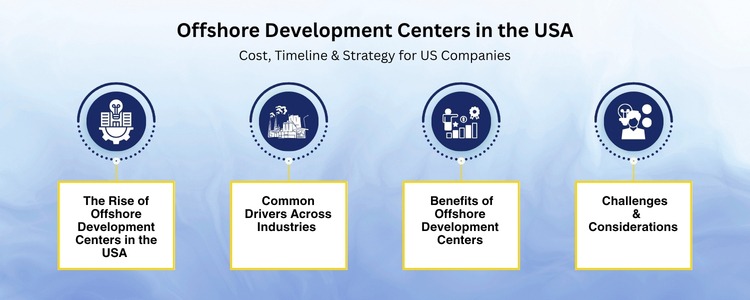
Retail and E-commerce
• Feature development for new functionality and updates
• Quality assurance for testing and defect management
Across all sectors listed above, three conditions consistently drive companies toward offshore development centers.
Supply Gap in U.S. Technology Talent Market. There were around 3.5 open technology positions for every eligible individual.
• Hiring timelines for specialized roles in the US typically range from 60 to 90 days
• Offshore markets such as India and Eastern Europe offer large annual engineering graduate pools
• Faster team scaling is possible without extended recruitment cycles
• Availability of mid-level and senior talent supports long-term capability buildingCost structure
• Infrastructure and facility costs are lower in offshore locations
• Recruitment and onboarding costs are reduced through local hiring partners
• Operating expenses such as payroll taxes and benefits are lower in many offshore markets
• Cost savings increase with scale as fixed costs are distributed across larger teams
Operational continuity:
• Faster turnaround for bug fixes and production issues
• Shorter release cycles due to parallel work streams across locations
• Support coverage can be extended without increasing US team shifts
• Continuous monitoring and maintenance improve system uptime and response timesSummary
The advantages of ODCs for US firms can be clearly seen three to five years later, once the offshored teams have settled down and the processes are standardized. Firms that consider the establishment of ODCs as a structural decision, not just an economic one, see their results in terms of costs and quality.
frequently asked questions (FAQs)
1.What cost advantages do GCCs in India offer?
2.How do GCCs in India support AI and innovation?
3.What is the future outlook for GCCs in India?
4.What makes India a top destination for GCC expansion?
5.What are Global Capability Centers (GCCs) in India?

Babita Gangwar








Error: Contact form not found. Error: Contact form not found.Subscribe to our Newsletter
Subscribe to our Newsletter