Recent Posts






The 21st century is all about rapid tech change, and innovations like AI, robotics, and cloud computing are moving faster than ever. Companies keep finding new ways for people and machines to work together, and honestly, the Shared Service Center (SSC) sits right at the heart of it. SSCs aren’t just about saving money anymore; they’ve turned into full-fledged innovation engines. Governments are jumping in, trying to build strong SSC ecosystems to pull in investors, create quality jobs, and boost up their economies. Businesses want to be more efficient and grow without limits, so it’s no surprise that automation is completely altering how shared services operate. In a world that’s becoming more digital by the minute, automation is driving real change and value.
Think of a shared service center like the engine room of a company; it pulls together key operations like finance, HR, procurement, IT, and customer support and handles them for several departments at once using consistent systems. Countries aren’t shy about pouring resources into these setups because they create skilled jobs, lure big global companies, and give digital economies a serious boost. India’s a standout here; it hosts thousands of Shared Service Centers and Global Capability Centers, making it pretty much the go-to spot for this kind of work worldwide. These centers see the volume of transactions climbing all the time, plus stakeholders keep raising the bar. So automation’s not really optional anymore; it’s a must. Automation lets SSCs cut out boring, repetitive tasks, boost accuracy, speed up decision-making, and lay a solid foundation for scaling up in the future. That’s how they stay sharp and keep growing.
Automation is shaking up how Shared Service Centers and Global Capability Centers (GCCs) work. It’s not just about streamlining workflows anymore. Now, companies roll out AI, machine learning, smart document tools, and predictive analytics across the entire business. You’ll see this shift everywhere, from India and Southeast Asia to Europe and North America. Top organizations are building automation into finance, HR, supply chain, cybersecurity, and customer service. These days, it’s not about how many people you employ but how digitally advanced your operation is. Automation isn’t just the latest trend; it’s more like a new industrial revolution. The game has changed: performance and efficiency now come from systems that learn, adapt, and keep getting better all on their own.
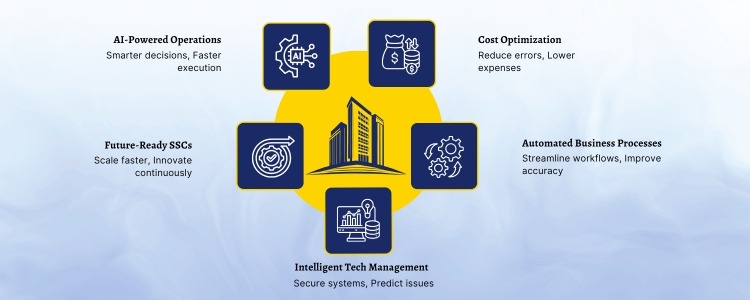
Artificial intelligence is changing the game for modern business, especially inside shared service centers. Now we’re seeing AI step up and do more than just crunch data. It spots patterns, predicts where things might get stuck, and handles routine decisions automatically. And that’s not just about cutting down the workload anymore. Companies are using AI to rethink how work gets done from the ground up. As these tools get smarter, SSCs are starting to play a bigger role; they’re not just handling transactions. They’re becoming true business partners, pushing innovation, speeding up digital transformation, and delivering all kinds of new value across the organization. Most companies used to boost efficiency by hiring more people or shuffling around how work gets done. Automation flips the script. Instead of just throwing more resources at a problem, automation wipes out those tedious manual tasks, cuts down on mistakes, and moves things along quicker. You get more done without spending more. With Shared Services Automation, organizations process invoices way faster, onboard new employees seamlessly, run compliance checks on autopilot, and make reporting much smoother. The payoff? Everything runs leaner, productivity jumps, costs drop, and services stay consistent, no matter which part of the business you look at. Let’s face it, business processes churn out way more data than people can handle by hand. Automation cuts through the clutter, making things run smoother with smart routing, instant approvals, fast document handling, and real-time checks. In shared service centers, this means procurement, hiring, payroll, vendor management, and financial reconciliation all get an upgrade. With routine tasks off their plates, teams can zero in on work that actually needs their brainpower, like analytics and strategy. The result? Operations become sharper, and employees enjoy their jobs more. Tech environments aren’t getting any simpler. As companies move to the cloud, embrace hybrid work, and lean on data for just about everything, things get messy fast. Automation has stepped up as the key to keeping this chaos under control. These days, shared service centers use AI to keep an eye on systems, handle incidents on the fly, tune cloud resources, strengthen cybersecurity, and even predict problems before they hit. With intelligent process automation, IT teams can spot trouble early, keep things running smoothly, and respond faster. Technology now sits at the heart of business success, so having smart, automated tech management matters. It keeps service delivery solid, secure, and ready to scale as needed. Automation isn’t just coming; it’s already here, and it’s the new standard for staying competitive. Companies that drag their feet on automation end up dealing with higher costs, clunky operations, and slipping service quality. The smartest shared service centers are jumping ahead by using flexible, intelligent platforms that keep up with shifting business needs, regulations, and what employees want. Tools like generative AI, autonomous workflows, digital twins, and advanced analytics are already changing how organizations work. Automation gives businesses the flexibility and resilience they need to handle constant change, and it lays the groundwork for lasting growth and innovation.
The way shared service centers have changed really tracks with how business has changed overall, moving from basic, manual work to smart, seamless systems. Automation isn’t just making things a bit smoother; it’s changing the entire way organizations work, ramp up, and stand out for excellent service. Whether we’re talking AI-driven decisions, automated workflows, better tech management, or slashing costs, automation stands out as the key force behind top-performing SSCs and GCCs. Right now, the real question isn’t if you should automate but how fast you can get it done. For companies focused on operational excellence, real innovation, and long-term growth, automation is the backbone of the next wave of shared and global capability centers. At Inductus GCC, we see this shift not as a nice-to-have, but as the actual plan for building future-ready global teams.
I write where strategy meets storytelling. As a passionate writer and literary enthusiast, I craft GCC-focused content that transforms industry insights into compelling narratives. Drawn to global business ecosystems, I enjoy turning research, innovation, and ideas into content that informs, connects, and inspires. With an analytical mind and a creative soul, I bring curiosity, collaboration, and a sharp eye for detail to every project. Adaptable and growth-driven, I believe the right words do more than communicate – they leave an impression.
What is automation in shared services centers (SSCs)?
The Rise of Automation in SSCs and GCCs—
Key Areas of Improvement—

Conclusion-

Pratibha Soni








Error: Contact form not found. Error: Contact form not found.Subscribe to our Newsletter
Subscribe to our Newsletter