Recent Posts







Many organizations establish a shared service center with specific objectives related to cost and process consistency. What they often lack is a clear framework to measure whether those goals are actually being met. A Shared Service Center (SSC) involves the consolidation of activities like finance, HR, IT, and procurement into one central organization for supporting multiple business units or regions. Once it is up and running, the next question would be, “How do we measure its success?” All this becomes possible when the choice of the correct KPIs for service delivery performance is made. All KPIs are not of equal importance. It depends on what level of maturity the SSC has reached, its functions, and the requirements of the business units served by it. In this article, we have identified the basic groups of KPIs and their specific types.
Shared services operate on the promise of efficiency and consistency. In the absence of performance measures, it may be hard to ascertain if the merger has been effective or merely moved the issue around. The use of performance service delivery measures provides the proof that the SSC has achieved its objectives, and it supplies leadership with information for decision-making.
Drive Accountability Through Transparency: Well-defined and quantified KPIs link shared services center performance with the requirements of the organization. Through dashboards and real-time reporting, it becomes possible for stakeholders to track the delivery of services against pre-agreed benchmarks. Enable Continuous Improvement Through Insights: Data trends provide attention to process inadequacies, variation, and inefficiencies. The use of sophisticated analytics, such as root cause analysis and forecasting, helps the SSC go from a reactive problem-solving stage to an optimizing stage. Support Benchmarking and Competitive Positioning: Standardized metrics enable comparison with industry benchmarks and peer Global Capability Centers (GCCs). This helps organizations in identifying performance gaps and implementing data-driven best practices. For maximum effectiveness, KPIs should be strongly aligned to Service Level Agreements (SLAs). Metrics not correlated with SLAs can lead to distraction and confusion. When KPIs are related to SLAs, it means each and every piece of data is an indicator of performance, responsiveness, and profitability.
Cost reduction is often the primary driver behind establishing a Shared Service Center (SSC). These metrics will determine whether the intended goal is being met and whether any economies of scale have been achieved. Key insight:
Operational KPIs assess the effectiveness of a Shared Service Center’s (SSC) execution of day-to-day processes. These indicators, which offer real-time visibility into process health, productivity, and service reliability, are the most detailed and often monitored. Operational KPIs are interconnected, with performance in one area directly affecting outcomes in others. Automation and standardization improvements usually result in gains in cycle time, throughput, and quality all at the same time. On the other hand, poor process design has a domino effect that results in increased backlogs, longer cycle times, and a poorer first-pass yield.
The accuracy and dependability of the Shared Service Center’s output are the main focus of quality metrics. If there are inaccuracies in the output, high transaction volumes don’t really matter. Error Rate: Measures the frequency of errors made per 100 or 1,000 transactions, allowing a direct insight into the accuracy of the output produced. A high error rate generally indicates problems within the process, ambiguous instructions, or inadequate quality checks. This results in negative consequences like rework, customer dissatisfaction, and delays in service delivery. Error reduction increases first-time accuracy, a vital factor in ensuring efficient and credible output from the SSC. Rework Rate: Tracks the percentage of transactions that require correction after initial processing. Rework is a strong indicator of inefficiency, as it does not create any additional value but consumes resources and time. High rates of rework usually indicate manual mistakes, lack of standardization, or improper training. Reduced rework allows for freeing capacity and handling increased amounts of work with the same number of staff members. Compliance Rate: Indicates the percent of transactions completed according to internal guidelines, controls, and external regulations. High compliance indicates effective governance, robust processes, and adherence to procedures. On the other hand, low compliance may lead to legal problems, including fines, audits, and damage to reputation. The indicator is particularly important in functions such as accounting, purchasing, and human resources. Audit Finding Rate: Number of issues that have been raised by either internal or external audits relating to SSC operations. It serves as a long-term indicator of the strength of the control environment. If there are repeated audit findings, it implies that there are weaknesses within the processes. An improving trend of the audit findings indicates process maturity and effective internal controls.
The Shared Service Center (SSC) functions for the benefit of its internal customers, and thus customer perception of the quality of services is an important yardstick in determining its effectiveness. Despite its significance, however, this issue often goes overlooked amid the focus on cost and efficiency measures. Net Promoter Score (Internal): Measures the probability of internal clients recommending the SSC in the firm. This indicator is easy to use and consistent, making it a valuable tool for monitoring general sentiment over time. First Contact Resolution Rate: Percentage of queries answered in the first interaction without any further interaction. Higher efficiency is an indication of well-defined processes, proper training, and adequate decision-making powers in the first touchpoint.
Customer satisfaction data is most useful when it is segmented by business unit and service type. An aggregate score can mask significant variation in service quality across different internal client groups.
Shared services are people-intensive activities, and the productivity of people impacts the quality of service delivery. Key performance indicators of people must be tracked carefully, especially in GCCs, which are characterized by high staff numbers and potentially significant turnover.
As Shared Service Centers (SSCs) develop, a larger portion of tasks is executed via standardization, automation, and self-service. Key Performance Indicators within this group are used to assess improvements in scalability and automation capabilities.
Not every KPI is relevant for every Shared Service Center (SSC). What applies to each SSC will depend on a number of things, including functional scope, maturity levels, service level agreement (SLA) commitments, and whether the SSC operates as a cost center or as a service entity with internal pricing mechanisms. A newly established SSC should give emphasis to its operational KPIs initially because the first concern of an SSC in its early days would be to stabilize its service delivery. The need for financial KPIs will only be applicable when the operations have been stabilized, and a baseline has already been established for future references. Satisfaction surveys of the clients should be implemented right away since trust is vital for the SSC. For a Global Capability Center with a broader mandate that extends beyond transactional processing, the KPIs must include process improvement delivery performance, project throughput performance, and value-added per FTE. One of the common mistakes made by organizations is trying to track too many key performance indicators simultaneously. 10 to 15 KPIs that are tracked on an ongoing basis and used in decision-making are far better than 40 KPIs that nobody ever pays attention to. In summary, financial performance, operational effectiveness, service quality, customer happiness, workforce management, and technological maturity are the six characteristics that make up a well-run shared service center. A comprehensive picture of the SSC’s performance is provided by the combination of these indicators, each of which has its own set of KPIs.It is important to carefully choose key performance indicators (KPIs). These should be based on the promises made to internal customers through service level agreements as well as the commitments made to management within the initial business case. Consistent analysis of KPIs along with a proper response to information received is the main difference between an excellent and an ordinary Shared Services Center.
Companies can cut their costs by 30-50% due to the availability of high-quality but inexpensive labor from India. The low cost of property and infrastructure investments also adds to the efficiency of operations. A favorable currency position also assists multinational corporations in managing their expenditures and maximizing benefits. Most significantly, all these economies are achieved without sacrificing quality, innovation, or speed of delivery. India is home to a massive resource pool of skilled professionals in AI and data science, making innovation easier. Over 500 GCCs with an emphasis on AI are available for technologies such as machine learning and GenAI. These GCCs assist firms in developing their own proprietary platforms and IP. .Thus, Indian GCCs are crucial in the context of global AI innovation and transformation. India is expected to have 2,100-2,500 GCCs by 2030 due to high growth. These centers will become more important for international business, innovation, and product development. GCCs will be at the forefront of innovation, including AI, digitization, and decision-making. In general, they will make a significant contribution to India’s economy and international business. India boasts an enormous reservoir of STEM professionals, which allows firms to expand their workforce rapidly. It has a robust digital infrastructure, which fosters innovation and international business. Its cost efficiencies make it extremely effective as opposed to other international destinations. A developed environment in AI, cloud computing, and data science ensures constant innovation and development. Global Capability Centers (GCCs) in India are enterprise-owned hubs that deliver end-to-end services like product development, R&D, AI, and digital transformation. They go beyond traditional outsourcing to drive innovation and business strategy. With a keen analytical mindset and a passion for data-driven insights, Babita Gangwar brings expertise in research, analysis, and strategic evaluation. As a Research Analyst, she focuses on transforming complex data into actionable intelligence that supports informed decision-making. She collaborates across teams to deliver high-quality research outputs, ensuring accuracy, relevance, and impact. Her interests span market research, data analytics, and emerging industry trends. A detail-oriented professional, she actively contributes to knowledge development through reports, presentations, and research initiatives.
Why KPIs Matter in Shared Services
KPIs serve three critical, data-centric functions:
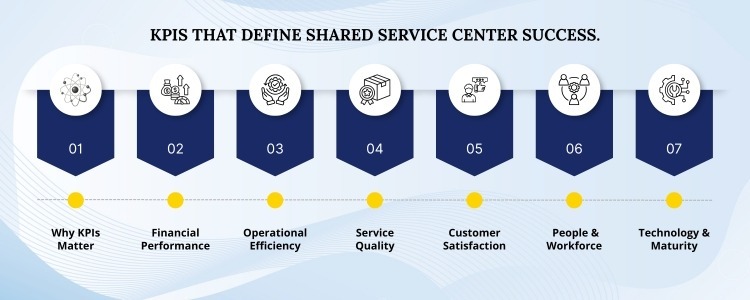
1. Financial Performance
Cost per Transaction
The total operating cost of the SSC divided by the number of transactions processed in a given period. Enables direct comparison over time and against external benchmarks.Cost Savings vs. Baseline
The reduction in cost compared to the pre-SSC operating model or a distributed service model. Typically expressed as a percentage or absolute value.
Budget Variance
The difference between the SSC’s budgeted operational costs and actual costs incurred. Signals whether the center is being managed within its financial plan.Return on Investment
Total benefits realized from the SSC relative to the total investment, including setup, technology, and ongoing operations. Typically measured annually.
Financial KPIs are most useful when tracked alongside volume data. A reduction in cost per transaction is meaningful only when the volume of transactions is stable or growing. For example, a decrease in cost per transaction is only relevant when it is due to increased efficiency and not a lower workload or inferior service delivery. Highly efficient SSCs measure cost, transaction volume, and quality of output simultaneously using an integrated dashboard.
In the end, the objective is not just cutting costs but achieving economies of scale. The best-performing Shared Services Centers can consistently manage higher volume processing at lower incremental cost, demonstrating that their economies of scale are both sustainable and systematic.2. Efficiency
KPI
What It Measures
Typical Reporting Frequency
Cycle Time
Time taken to complete a transaction from receipt to resolution
Daily or Weekly
First Pass Yield
Percentage of transactions completed correctly without rework
Weekly
Throughput Rate
Volume of transactions processed per FTE
Monthly
Backlog Rate
Percentage of transactions not completed within committed timelines
Daily / Weekly
SLA Compliance Rate
Percentage of transactions completed within the agreed service level timelines
Monthly
Process Automation Rate
Share of transactions processed without manual intervention
Monthly or Quarterly
The most critical success factor behind strong operational performance is process standardization before and during SSC implementation. Highly performing SSCs work in a different order: They standardize, then automate, and finally scale up.This ensures that there is a systematic improvement in the operational KPIs that make for sustained efficiency.3. Service Quality
4. Customer Satisfaction
Internal Customer Satisfaction Score (iCSAT): Measures whether internal clients would recommend the SSC’s services within the organization. Results in a single figure that is easily measurable over time. Number of issues found out through internal or external audits concerning the operation of the SSC. Measures control environmental quality over time.
Query Resolution Time: Average time required to address a request or escalation from an internal client. Unlike regular cycle time for transactions, this measures response in case of problems.
5. People and Workforce
KPI
What It Measures
Attrition Rate
Percentage of SC staff who leave over a given time period. Higher turnover leads to increased costs for recruiting and training and creates disruptions in service delivery.
Absenteeism Rate
Average number of days lost by each employee due to unexpected absence. Directly affects available capacity.
FTE Utilization Rate
percentage of working hours that are actively spent to productive activities. Low utilization could be a sign of process bottlenecks or overstaffing.
Training Completion Rate
Percent of required training modules completed by staff in the designated timeframe. Relevant to both compliance and process standardization.
Internal Promotion Rate
Percent of unfilled positions that have been filled by internal candidates. An indicator of career development and workforce planning maturity
6. Technology and Process Maturity
Automation Coverage: The percentage of in-scope transactions managed through automated processes using techniques like robotic process automation (RPA) or workflow software. An increase in the proportion of transactions handled by automated processes reflects lower reliance on manual handling.
Self-Service Adoption Rate: The proportion of requests initiated through self-service platforms rather than direct interaction with SSC personnel. Increased usage leads to decreased operational burden, faster resolution time, and increased user independence.
System Downtime: Total hours of unplanned system unavailability that affected SSC operations during the period. Reflects the reliability of the technology infrastructure.
Process Standardization Index: This is an index that indicates the degree to which the processes have been carried out using one standardized document. Standardization allows for automation of processes and high-quality output, and it is especially important when dealing with GCCs around different geographical locations.Selecting the Right KPIs for Your SSC

frequently asked questions (FAQs)
1.What cost advantages do GCCs in India offer?
2.How do GCCs in India support AI and innovation?
3.What is the future outlook for GCCs in India?
4.What makes India a top destination for GCC expansion?
5.What are Global Capability Centers (GCCs) in India?

Babita Gangwar









Error: Contact form not found. Error: Contact form not found.Subscribe to our Newsletter
Subscribe to our Newsletter