Recent Posts






Medical technology sits at the intersection of engineering precision and human health outcomes. Unlike conventional technology sectors, MedTech combines physical devices, embedded software, connected ecosystems, and clinical decision-making into a single value chain. From diagnostic imaging systems and implantable devices to remote patient monitoring platforms and AI-enabled healthcare applications, every innovation directly influences patient care. Equally important, every device generates, stores, or processes healthcare data while operating within a highly regulated environment. In MedTech, innovation cannot be separated from governance because every product impacts either a diagnosis, treatment pathway, or patient outcome. As complexity continues to increase, global MedTech companies are rethinking how regulatory and compliance responsibilities are managed, fueling the rise of specialized Global Capability Centers (GCCs).
GCCs are taking on more responsibility for regulatory affairs, quality assurance, compliance operations, clinical documentation support, data governance, and vigilance-related processes. The healthcare and medical technology industries have emerged as a focused growth vertical in the ecosystem, with more than 2100 GCCs in India, and the market is projected to be at ~USD 99-105 billion by 2030. Today, when a MedTech company establishes a GCC, it is not merely transferring administrative workloads. It is entrusting the center with responsibilities that carry legal accountability, regulatory scrutiny, and direct implications for patient safety across global markets.
Few industries operate under the level of scrutiny faced by medical technology companies. A software defect may inconvenience a user; a MedTech failure can influence a diagnosis, delay treatment, or impact patient health. The consequences extend beyond operational disruptions into clinical and legal territory. MedTech is still one of the most highly regulated industries in the world, with overlapping regulatory regimes such as the European Union Medical Device Regulation (EU MDR), In Vitro Diagnostic Regulation (IVDR), United States FDA pathways, and India’s CDSCO requirements. At the same time, cybersecurity risks have become a top compliance issue as connected devices have become increasingly targeted by ransomware attacks and unauthorized data access. The commercial implications are just as important. Violations of regulations may result in delays in product launches, product recalls, suspension of certifications, barriers to market access, or even license revocation. These results impact revenue, investor confidence, and brand reputation. So compliance is no longer a back-office obligation. It has become a strategic differentiator, determining how fast MedTech companies can scale innovation while gaining the trust of regulators, healthcare providers, and patients.
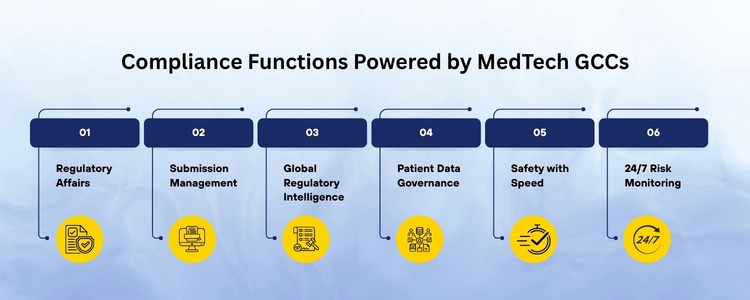
For MedTech companies operating in India, compliance begins with the Central Drugs Standard Control Organisation (CDSCO), India’s national regulatory authority functioning under the Directorate General of Health Services and the Ministry of Health & Family Welfare. Medical devices are governed under the Medical Device Rules, 2017, which establish a risk-based classification framework ranging from Class A (low risk) to Class D (high risk). CDSCO’s digital SUGAM portal serves as the primary platform for registrations, approvals, and regulatory submissions. Foreign manufacturers seeking market access are also required to appoint an Indian authorized agent to facilitate regulatory interactions. This is where MedTech GCCs increasingly create value. Rather than building large standalone regulatory teams within India, multinational organizations leverage GCCs to prepare submission dossiers, maintain Plant Master Files and Device Master Files, track licensing obligations, monitor five-year renewal cycles, and coordinate regulator-facing documentation. In practice, the GCC becomes the operational backbone supporting regulatory compliance and market access within India. A MedTech company rarely operates within a single regulatory jurisdiction. Devices sold globally must simultaneously comply with CDSCO requirements in India, FDA pathways in the United States, EU MDR and IVDR obligations in Europe, and internationally recognized quality standards such as ISO 13485. Managing these overlapping frameworks creates significant operational complexity. MedTech GCCs increasingly function as centralized regulatory intelligence hubs that maintain submission calendars, track certification renewals, monitor changing regulatory requirements, and coordinate market-specific documentation. This centralized approach prevents organizations from managing dozens of disconnected compliance schedules across geographies while improving visibility into global regulatory readiness. One of the most intractable problems in MedTech is the conflict between the speed of innovation and requirements to ensure patient safety. Regulatory agencies around the world continue to update standards, reporting requirements, and evidence expectations at an accelerated pace. To tackle this challenge, GCCs are increasingly turning to automated Regulatory Information Management Systems (RIMS), which act as repositories for compliance evidence and feature digitalized documentation workflows. These systems allow speeding up the preparation of the submission while keeping the safety checkpoints. MedTech GCCs view compliance not as a bottleneck, but as a structured process that allows them to accelerate product commercialization while maintaining regulatory rigor. Regulatory compliance is not standing still. Requirements are changing all the time, sometimes even after the product is launched in the market. To succeed, MedTech organizations need dedicated teams that can quickly respond to this change. A recent example of CDSCO’s initiatives is the risk-based reclassification of hundreds of cardiovascular and neurological devices. Such changes almost immediately change documentation requirements, approval pathways, and compliance obligations. Dedicated regulatory monitoring capabilities are another GCC advantage, helping them identify reclassifications, vigilance reporting requirements, recall notifications, and emerging regulatory changes faster than decentralized headquarters teams. Proximity to ongoing compliance operations enables faster adaptation and less regulatory exposure. Data governance is therefore one of the key compliance responsibilities of a MedTech GCC. Increasingly, patient data is becoming the basis for healthcare innovation. In India’s Digital Personal Data Protection Act, 2023 (DPDP Act) and its evolving implementation framework and rules impose duties concerning consent management, lawful processing, data storage, and accountability mechanisms. Healthcare organizations that handle sensitive data should implement formalized governance processes to encourage breach reporting, risk assessments, data minimization, and privacy-by-design principles. Failure to comply can lead to heavy financial penalties and damage to an organization’s reputation. For multinational MedTech organizations, the challenge becomes even greater because Indian requirements often coexist with international obligations such as HIPAA in the United States and GDPR-linked obligations in Europe. GCCs frequently serve as the centralized governance layer responsible for consent management systems, cross-border data controls, incident response workflows, privacy impact assessments, and compliance monitoring across multiple jurisdictions simultaneously. One of the strongest business cases for a MedTech GCC is risk consolidation. Instead of dividing up regulatory, quality, and compliance responsibilities across several regional offices, organizations consolidate expertise into one operating model. It reduces compliance fragmentation, provides 24/7 monitoring coverage across time zones, and delivers significant operational efficiencies—often in the range of 30% to 50% against equivalent structures in North America or Europe. GCCs are totally owned extensions of the enterprise, unlike third-party outsourcing deals, allowing companies to optimize costs without sacrificing oversight, governance, or accountability.
The question is not about whether a MedTech GCC can handle compliance functions. Given that, the real question is how much strategic value can a GCC create. Medical Technology GCCs have evolved from traditional support roles into compliance command centers. Now, they are a confluence of regulatory intelligence, quality governance, patient data protection, and operational execution under one roof. The MedTech organizations that will lead the next decade will not be the ones who are trying to navigate regulation around the edges. They will be the ones building GCCs that turn compliance into scalable infrastructure—efficient, auditable, and designed for the global stage.
I write where strategy meets storytelling. As a passionate writer and literary enthusiast, I craft GCC-focused content that transforms industry insights into compelling narratives. Drawn to global business ecosystems, I enjoy turning research, innovation, and ideas into content that informs, connects, and inspires. With an analytical mind and a creative soul, I bring curiosity, collaboration, and a sharp eye for detail to every project. Adaptable and growth-driven, I believe the right words do more than communicate – they leave an impression.
Understanding MedTech in GCC ecosystem
Why should compliance and regulatory measures be considered in medical technology?
Ways in which MedTech GCCs abide by Compliance and regulatory frameworks

Conclusion-

Pratibha Soni










Error: Contact form not found. Error: Contact form not found.Subscribe to our Newsletter
Subscribe to our Newsletter