Recent Posts







A silent revolution is taking place in the control rooms and the centers of innovation throughout the globe: Global Capability Centers (GCCs) are becoming not back-office drivers, but front-line green-tech incubators, which design, simulate and scale renewable solutions. The renewable energy sources accounted for more than 30% of global power in 2023 and investments in clean energy are creating new worlds in 2024–2025. So, businesses are concentrating technical talent in GCCs in order to meet both the economic and environmental demands of the energy transition.
The pace of renewable rollout is unparalleled: the addition of capacity each year all over the world has been increasing into the hundreds of gigawatts and is expected to skyrocket by 2030, topped by solar PV and wind. Corporates are reacting by being more focused on GCCs by placing R&D, cloud engineering, simulation and data science teams to reduce the time taken between the lab and the field. This conglomeration reduces the cost of unit development, reduces the time to market and concentrates subject-matter expertise, which would otherwise be costly and disaggregated.
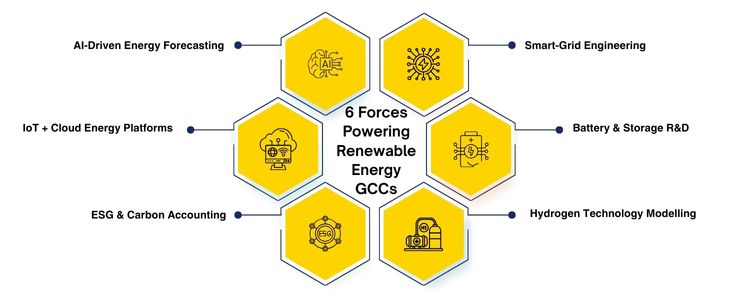
Renewable GCCs bring together small groups of specialists, including energy data scientists who optimise generation forecasts, grid engineers who create digital twins of network stability, battery and materials modellers who improve storage economics more quickly, cloud and IoT architects who reverse real-time plant telemetry, and sustainability analysts who automate carbon accounting. The personas work together to determine storage capacity, which in turn determines inverter algorithms, which in turn determine procurement and compliance. This is what distinguishes GCCs as catalytic agents.
A brief perspective on the process of transforming GCC capabilities to quantifiable business effects: This value chain structure explains why centralising these capabilities in GCCs yields returns that are disproportionate.
Investors and CEOs are concerned about returns: Global investment in the energy transformation is at record levels (more than USD 2.0 -2.1 trillion in 2024), and capital is chasing after the locations with rich engineering resources and cost-effectiveness. GCCs in India and other hubs took advantage of these tailwinds by offering high-value engineering at scale, which enabled businesses to lower R&D expenditures, shorten pilot cycles, and localise manufacturing roadmaps, all of which have a major impact on lowering project-level costs and raising IRRs. There is a need for localised design and compliance teams within GCCs due to active industrial policy nations (like those with new domestic needs for solar cells).
There are two simultaneous trends that are important currently. These indications point to GCCs being not merely supportive of deployment but the architects of the next generation of turbines, inverters, batteries and trading algorithms.
An increasing number of European and North American renewable energy companies are operating predictive-maintenance and grid-optimization stacks out of South Asian GCCs; hydrogen and storage modelling pods are emerging within GCCs to de-risk commercial pilots; and operator control rooms are implementing digital twins to decrease outages and increase yield.
In the next five years, expect Renewable GCCs to: Concisely, GCCs will become capital accelerators of green tech instead of centres of capability.
Renewable Energy GCCs are strategic engines that convert intellectual capital into lower costs, faster deployment, and measurable sustainability effects; they are not cost centres. Businesses would compete in the green-tech race if they could find the right talent, model, and incorporate GCC outputs into capital planning. In case your organisation is laying a renewable roadmap, Contact Inductus GCC to create or enlarge a Renewable Energy GCC specialised in prediction, storage research and carbon analytics. Early collaboration with a devoted advisory firm has the potential to reduce pilots, enhance project economics and realise all the benefits of green innovation.
Hyderabad, Bangalore and Pune have become significant pharma innovation centres with global delivery centres of major biotechnological and pharmaceutical firms such as Novartis, Pfizer, AstraZeneca and GSK. They offer an economic benefit of calculation, a variety of scientific and technical human resources, and speedy time-to-market. On average, businesses reduce between 25-40 percent of the operational costs and increase the rate of innovation. The next-generation operations of Pharma GCC focus on advanced molecular modelling, AI/ML-based drug discovery, cloud supercomputing, and data integration platforms, as well as quantum-ready simulations. Pharma GCCs use AI to screen molecules, predict the efficacy of drugs, optimise clinical trials and aid in making data-driven decisions, resulting in smarter, faster and safer drug pipelines. Pharma GCCs will be global innovation ecosystems that are a combination of computational chemistry, generative AI, and quantum computing. They will turn into the hubs linking data science, discovery and regulatory intelligence in the global arena. Aditi, with a strong background in forensic science and biotechnology, brings an innovative scientific perspective to her work. Her expertise spans research, analytics, and strategic advisory in consulting and GCC environments. She has published numerous research papers and articles. A versatile writer in both technical and creative domains, Aditi excels at translating complex subjects into compelling insights. Which she aligns seamlessly with consulting, advisory domain, and GCC operations. Her ability to bridge science, business, and storytelling positions her as a strategic thinker who can drive data-informed decision-making.
The Significance of Renewable GCCs.
Green-Driving Innovation Personas
The Value Engine Green Technology
Capability
GCC activity
Global impact
Business benefit
Forecasting & ML
Solar/wind generation models
Fewer curtailments
Lower OPEX, higher yield
Battery R&D
Chemistry & system simulation
Improved storage economics
Reduced LCOE for projects
Smart-grid platforms
IoT + edge analytics
Better balancing & resilience
Lower outage costs
Carbon analytics
Automated Scope 1–3 reporting
Faster compliance
Reduced audit time
Hydrogen modelling
Electrolyser optimisation
Scalable green H₂ supply
Lower production costs
Economic Benefits
Signs Of The Next Phase
Relevant Illustrations
Future Perspective
Conclusion & CTA

frequently asked questions (FAQs)
1.Who are the Pharma GCC development leaders in India?
2.Which economic benefits do Pharma GCCs have?
3.Which technologies are influencing Pharma GCC operations nowadays?
4.What is the role of AI in Pharma GCC processes?
5.How will Pharma GCCs look in five years to come?

Aditi









Error: Contact form not found. Error: Contact form not found.Subscribe to our Newsletter
Subscribe to our Newsletter