Recent Posts






The Global Delivery Model didn’t just stay a way to cut costs; it’s become the backbone for how big companies run things across the world. With GDM, a business spreads out its talent, technology, and processes over several countries, keeping services running smoothly and around the clock. Companies use this setup not just to save money, but to tap into skilled workers, reduce risk, move faster on new ideas, and build business setups that can weather almost anything. Peter Drucker said it well: “The greatest danger in times of turbulence is not the turbulence—it is to act with yesterday’s logic.” Businesses get this. They know that sticking to old ways won’t keep them afloat now, so they’re turning to global delivery models to stay sharp and flexible. You can’t talk about GDM without mentioning India. The country has become a powerhouse, packed with global capability centers, tech hubs, and shared service offices. These days, it’s not just about having the people or the cost advantage; India’s value now comes from its edge in innovation, digital transformation, and working with teams worldwide. Of course, things aren’t simple. Companies have to juggle efficiency, ever-changing rules, cultural differences, and long-term strategy, especially as global politics and business borders keep shifting. Succeeding with GDM now means getting all those pieces to work together instead of just focusing on cheap labor.
A Global Delivery Model is basically a blueprint for spreading work across multiple countries while keeping everyone on the same page when it comes to governance and service quality. In India, companies have really leaned into GDM lately. The country’s strong technology scene, robust digital networks, and booming Global Capability Centers (GCCs) have all played a huge part, especially in fields like banking, healthcare, manufacturing, and retail. GCCs themselves aren’t just back-office hubs anymore. They’ve turned into real strategic partners, driving innovation, product launches, analytics, cybersecurity, and shaping customer experiences. That shift has put India squarely on the map, not just as a place for support functions, but as a key player in everything from enterprise strategy to global service delivery. One has to figure out which business processes actually make sense to split up geographically. Then, you set up tight governance, assign crystal-clear ownership, and build operating models that work for each location. Getting all the different technology platforms on the same wavelength and holding teams everywhere to the same performance standards is non-negotiable. Beyond that, companies need to invest in the right collaboration tools, map out their workforce plans, lock in strong cybersecurity, and put leadership in place who can handle the realities of running projects across borders. The best GDMs aren’t obsessed with saving money on talent; they focus on business results. Every site, no matter where it is, pulls its weight and adds real, strategic value.
Rolling out a global delivery model sounds great on paper, but honestly, one can run into plenty of challenges, both operational and strategic. When a company spreads operations across multiple countries, decision-making ends up scattered. You’ve got all kinds of reporting lines, local rules, and management styles, and suddenly your governance structure goes haywire. Multinationals are notorious for running into messy overlaps and unclear ownership just because their governance models weren’t planned well enough. Working across countries means people are dealing with different languages, habits, and ways of getting things done. If expectations aren’t aligned, projects stall, productivity tanks, and stakeholders start losing faith quickly. Even big, seasoned companies keep pouring money into programs just to bridge these cultural gaps; it’s a never-ending effort. Each country brings its own pile of legal rules, think labor laws, taxes, privacy, and all sorts of industry requirements. Take financial firms operating globally: they’re constantly juggling complex compliance checks and need to keep an eye on shifting regulations everywhere they do business. Expansion through acquisitions or new regions dumps a bunch of different tech stacks onto the team. Now you’re dealing with systems that don’t talk to each other, inconsistent data handling, and real security risks. Trying to get everyone on the same cloud platform? Good luck, especially when infrastructure maturity and regulations vary so much from region to region. Hiring globally is the easy part. Keeping people around is where things are mishandled, especially where talent is in short supply. High turnover is a real threat to delivery consistency, plus there’s always a shortage of leaders with the chops to run global, distributed teams well. Running around the clock sounds impressive, but it’s tricky. Constant service means you’re always juggling approvals, waiting out decision cycles, and trying to get stakeholders on the same page, often at odd hours. Without proactive management, international projects can get stuck fast.
Create a central operating council with clear roles, direct lines for escalation, and measurable goals. Strong governance cuts down on redundancy, holds people accountable, and keeps diversified teams on the same page. Build a single digital setup that lets teams collaborate easily, see all the data they need, and follow the same processes everywhere. Using the same tech stack across the business makes cloud issues easier to manage and keeps service reliable at every location. Successful global delivery models focus just as much on cultural understanding as technical skills. Leadership training, cross-team assignments, and clear global communication protocols help teams work together smoothly, no matter where they’re based. Don’t treat compliance like a local checkbox exercise. Set up a company-wide risk framework, and back it up with local regulatory experts. This way, you build stronger governance and lower the chances of legal or operational trouble.
The Global Delivery Model isn’t just about cutting costs anymore. Now, it’s a real driver for innovation, growth, and keeping a business strong when things get tough. But let’s be honest, rolling it out isn’t easy. Companies have to deal with tangled governance, cultural differences, tough regulations, tech headaches, and making sure their teams stay focused. If you treat GDM as a long-term overhaul, rather than just a question of where to set up an institute, you’re much more likely to get lasting value out of it. These days, as global operations keep changing, the winners are the companies that put real effort into governance, leverage the smartest tech, and have leadership that knows what it’s doing. That’s how you get the most out of global service delivery and sidestep the risks.
I write where strategy meets storytelling. As a passionate writer and literary enthusiast, I craft GCC-focused content that transforms industry insights into compelling narratives. Drawn to global business ecosystems, I enjoy turning research, innovation, and ideas into content that informs, connects, and inspires. With an analytical mind and a creative soul, I bring curiosity, collaboration, and a sharp eye for detail to every project. Adaptable and growth-driven, I believe the right words do more than communicate – they leave an impression.
How to implement the Global Delivery Model (GDM)?
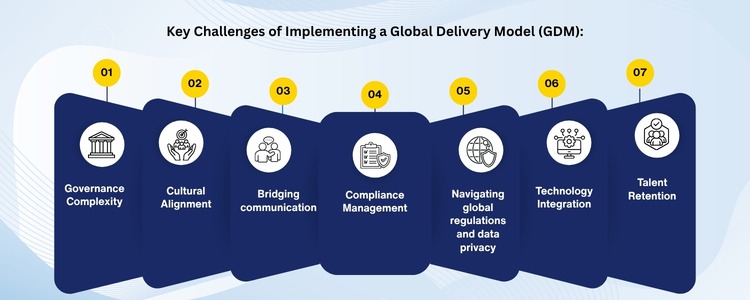
Key challenges faced in GDM:
How to mitigate these challenges?

Conclusion—

Pratibha Soni










Error: Contact form not found. Error: Contact form not found.Subscribe to our Newsletter
Subscribe to our Newsletter