Recent Posts







What started as back-office support setups for cost arbitrage has evolved into global in-house centers of digital innovation, or, better said, Global Capability Centers (GCCs), which provide guidance and groundwork for multinational corporations. To expand worldwide. In the 2026 narrative, Fortune 500 organizations are no longer building GCCs merely to “save costs.” They are architecting enterprise-grade strategic capability ecosystems designed to accelerate innovation, de-risk operations, improve digital resilience, and create global execution agility. For this expansion, organizations are thriving on ‘trial-and-test’ methods on GCC models, among which the hybrid delivery model of GCC stands as the best alternative in 2026. A digitalized world needs a similar setup, from around-the-clock productivity hours to a skilled labor force. The hybrid model delivers customization tailored to needs. One may ask, “What are these Fortune 500 companies?” Or why should they choose hybrid GCC models? Or what are the pros and cons? So, let’s have a look at this!
The Fortune 500 companies are literal economic superpower business setups that make their way to the Fortune 500 list, released annually, ranked by their gross revenue. The list serves as a premier barometer of corporate size, economic influence, and business stability in the United States. FORTUNE says,
Expanding with GCCs is like tapping into innovation avenues, increasing the chances of revenue, and staying ahead of the curve in this complex business landscape. GCCs become guardians here, strengthening the abilities of their parent organisations and redefining global benchmarks. These companies are expanding with modern GCCs due to multi-layered reasons such as
Therefore, Hybrid GCCs give companies a future-proof way to build smart, resilient, and scalable global centers. It’s the new standard for ambitious growth.
It brings the best of both worlds: strategic flexibility and the capacity to scale operations fast. What sets it apart is how it blends in-house control with outside expertise. Companies can move more quickly on innovation, ease up on the hiring crunch, and keep their global delivery costs in check at the same time. With a hybrid setup, businesses don’t have to build everything from scratch; instead, they can scale up AI, cybersecurity, cloud modernization, and automation projects in record time. But it’s not a smooth ride every step of the way. Juggling multiple vendors, keeping governance tight, staying on top of cybersecurity, and making sure different cultures mesh well, these are tough jobs that demand solid leadership. Companies are seeing that the hybrid model isn’t just about flexibility; it calls for sophisticated operational management and clear KPIs. Still, the payoffs, more agility, faster innovation, and stronger resilience, are making hybrid GCCs the go-to approach for enterprises aiming at 2026 and beyond.
Hybrid GCC models aren’t just another passing phase; they’re reshaping how global businesses run. Right now, Fortune 500 companies are dealing with constant uncertainty, rapid advances in AI, and nonstop competition. The old ways of working just don’t cut it anymore. They’re too stiff, too time-consuming. That’s where hybrid GCC models come in. They help companies move quicker, scale on their own terms, manage risk, and tap into the best talent. Plus, these models let organizations keep control while pushing for real innovation. Looking ahead to 2026, the winners in global transformation won’t be the companies with the largest GCCs. The real edge goes to those building smarter, tightly coordinated GCC networks.
I write where strategy meets storytelling. As a passionate writer and literary enthusiast, I craft GCC-focused content that transforms industry insights into compelling narratives. Drawn to global business ecosystems, I enjoy turning research, innovation, and ideas into content that informs, connects, and inspires. With an analytical mind and a creative soul, I bring curiosity, collaboration, and a sharp eye for detail to every project. Adaptable and growth-driven, I believe the right words do more than communicate – they leave an impression.
What are FORTUNE 500 companies?
Why are these companies expanding with GCCs?
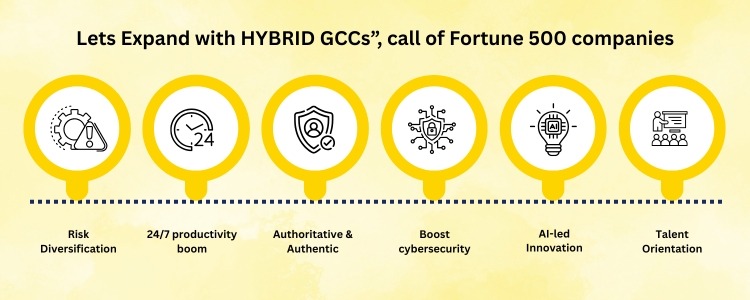
Why Do Companies Prefer Hybrid GCC Models?
What are the pros and cons of hybrid GCC models: trends analysis?
Step into the Future!


Pratibha Soni







Error: Contact form not found. Error: Contact form not found.Subscribe to our Newsletter
Subscribe to our Newsletter