Recent Posts







The offshore development landscape is evolving rapidly, driven by talent shortages and rising digital demand. These key metrics illustrate the scale, value, and challenges shaping this global shift. Major international technology companies like Google, Microsoft, and Amazon have long used distributed engineering methods to speed up delivery and scale innovation. They save 40–70% on costs compared to internal teams by utilizing global talent hubs, which also allow for quicker time-to-market and ongoing development across time zones.
Offshore development services were viewed as a procurement decision throughout the majority of the previous 10 years, often assigned to the CFO or IT leadership with a primary focus on cutting engineering expenses. That viewpoint is no longer relevant. Offshore outsourcing has developed into a strategic capacity that facilitates access to worldwide talent, innovation, and quick execution. Companies are more likely to succeed and grow if they see offshore development as a way to save money rather than as a way to cut costs. The problem is structural. Despite the number of developers worldwide increasing, it continues to fall short of the demand created by AI adoption, cloud transformation, and product digitalization. Building a specialized offshore staff is therefore now necessary for businesses trying to keep up their momentum. Selecting the best partner among software outsourcing firms in this setting involves more considerations than just price. It involves choosing a team whose engineering discipline, culture, and long-term incentives complement your company’s objectives over a period of three to five years. This offshore outsourcing guide provides a systematic framework that helps confirm that your offshore strategy produces long-term competitive advantage rather than short-term savings with long-term risk. It covers everything from evaluation criteria and red flags to governance models and regional insights.
Offshore software development means engaging engineering talent in a country geographically distant from your headquarters, typically where specialized skills are available at a significant cost advantage. Done well, offshoring provides: • Access to a global talent pool, including niche AI, cybersecurity, and cloud specialists
Most failed offshore engagements stem from a model mismatch, not a geography issue. Before evaluating vendors, define the right engagement model for your needs. Model 1: Fixed-Price Project A scope-defined deliverable with a pre-agreed cost and timeline. Ideal for requirements that are steady and well-documented. However, when requirements change, as they frequently do in software development, there is a significant danger of scope creep, quality gaps, and cost overruns. Best for: One-off features, MVP builds, defined integrations Model 2: Staff Augmentation (Time & Material) Engineers are embedded in your team and billed on an hourly or monthly basis. You retain full control over direction, architecture, and priorities. This model aligns best with organizations that have a strong internal product manager, technical lead, or CTO who can manage the team directly. Best for: Series A–B companies, teams needing to scale quickly with full control. Avoid when you lack the internal management capacity to direct and review work daily Model 3: Dedicated Offshore Centre (ODC) A fully dedicated team operates as your extended R&D division—with your tools, your culture, and your processes. This is the highest-integration, highest-investment model, but it delivers the deepest long-term value for enterprises running multi-year digital roadmaps. Best suited for: Series B+ companies, enterprise units, and long-term product development.
Although it is not the primary selection factor, geography is still important. The true differentiators are talent depth, English proficiency, time zone alignment, geopolitical stability, and regulatory compatibility, even though rate arbitrage is a given. Regional Comparison Strengths: AI, cybersecurity, fintech, strong engineering culture Timezone Fit: Excellent for EU Risk: Moderate (geopolitical) Strengths: Large talent pool, wide tech stack, strong enterprise experience Timezone Fit: Good for US (async) Risk: Low Strengths: US timezone alignment, agile culture, strong mobile capabilities Timezone Fit: Excellent for US Risk: Low–Moderate Strengths: Arabic localisation, government digital expertise, EU nearshore advantage Timezone Fit: Strong for EU/UK Risk: Low Enterprises operating in Europe often prefer Eastern Europe or MENA for regulatory alignment, while US-based companies may choose Latin America for real-time collaboration. However, India continues to be the most attractive offshore location for businesses looking for the ideal mix of cost effectiveness, skill depth, and scalability.
Hidden operational models, rather than poor code, bring on the majority of offshore problems. The following warning signs frequently show up in follow-ups but rarely throughout sales cycles. 1: No Direct Developer Access 2: Suspiciously Low Attrition Claims 3: Vague IP Ownership Language 4: No Access to Engineering Leadership 5: Long-Term Lock-In Without Performance Clauses
Guides from international advising firms on offshore development services consistently indicate that long-term value is developed during the first 90 days through governance rather than during vendor selection. The majority of offshore outsourcing guide failures are not due to poor implementation. They are failures in governance. ✓ Appoint a single accountable executive on both sides. Shared ownership models fail more often. ✓ Establish a shared product roadmap with quarterly reviews — not just sprint tracking. ✓ Track delivery metrics from Day 1: velocity, defect rate, code review time, deployment frequency. ✓ Conduct a formal 90-day review with a structured retrospective to identify early risks. ✓ Make knowledge management mandatory: documentation, ADRs, and runbooks as contractual deliverables. ✓ Perform annual benchmarking on cost, talent quality, and geopolitical risk. ✓ Integrate offshore teams into company culture: include them in all-hands, demos, and recognition. ✓ Implement zero-trust security before onboarding: controlled access, VPNs, and regular audits.
The offshore development model is being rewritten by AI tools. Tools like GitHub Copilot, automated testing, and ML-driven code review are reducing labor arbitrage and raising engineering standards. For executive decision-makers, two questions matter: Leading vendors are evolving into AI-augmented engineering teams that amplify productivity instead of replacing it. ✓ Development velocity increases significantly “By 2025, over 81% of global IT leaders are expected to offshore next-generation technologies and niche skills. The organizations that will win are not those who decide to offshore but those who build the governance and partner selection discipline to make it compound.”
Disciplined sequencing is necessary to turn this structure into a workable procedure. The selecting procedure is shown below. For businesses in the enterprise and development stages, Inductus suggests: Step 1: Define your requirements architecture Step 2: Create a vendor list Step 3: Issue a structured RFP Step 4: Conduct technical screening Step 5: Verify references independently Step 6: Legal and compliance review Step 7: Negotiate governance terms Step 8: Build your 90-day onboarding plan
Offshore development is now an essential part of competitive strategy rather than only a means of cutting costs. Faster innovation, access to specialized personnel, and scalable execution in line with expansion are all made possible by taking the proper approach to offshore development services and establishing a committed offshore team.
Hyderabad, Bangalore and Pune have become significant pharma innovation centres with global delivery centres of major biotechnological and pharmaceutical firms such as Novartis, Pfizer, AstraZeneca and GSK. They offer an economic benefit of calculation, a variety of scientific and technical human resources, and speedy time-to-market. On average, businesses reduce between 25-40 percent of the operational costs and increase the rate of innovation. The next-generation operations of Pharma GCC focus on advanced molecular modelling, AI/ML-based drug discovery, cloud supercomputing, and data integration platforms, as well as quantum-ready simulations. Pharma GCCs use AI to screen molecules, predict the efficacy of drugs, optimise clinical trials and aid in making data-driven decisions, resulting in smarter, faster and safer drug pipelines. Pharma GCCs will be global innovation ecosystems that are a combination of computational chemistry, generative AI, and quantum computing. They will turn into the hubs linking data science, discovery and regulatory intelligence in the global arena. Aditi, with a strong background in forensic science and biotechnology, brings an innovative scientific perspective to her work. Her expertise spans research, analytics, and strategic advisory in consulting and GCC environments. She has published numerous research papers and articles. A versatile writer in both technical and creative domains, Aditi excels at translating complex subjects into compelling insights. Which she aligns seamlessly with consulting, advisory domain, and GCC operations. Her ability to bridge science, business, and storytelling positions her as a strategic thinker who can drive data-informed decision-making.
Introduction: Why This Decision Belongs in the Boardroom
What Is Offshore Development—and What It Is Not
• 40–70% cost reduction compared to equivalent in-house teams in developed markets
• Around-the-clock development velocity through time zone distribution
• The ability to scale engineering capacity without lengthy local hiring cycles
• Dedicated teams that operate with your quality standards, tools, and culture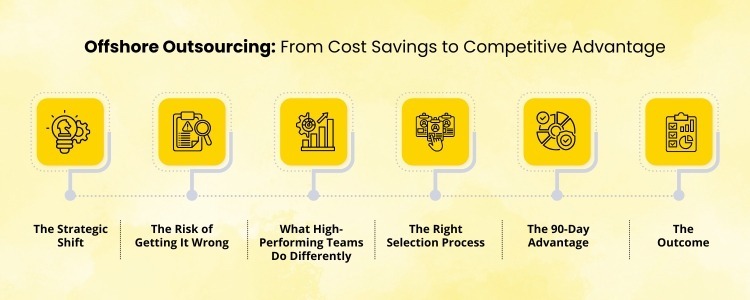
The Three Engagement Models — Know Which One You Need
Avoid when: Requirements are exploratory, complex, or likely to evolve
Avoid when your product roadmap is uncertain or you need maximum flexibility to pivot.The Eight-Dimension Due Diligence Framework
Dimension
What to Evaluate
Technical Depth & Stack Alignment
Examine proven ability rather than just claims. Examine GitHub repositories, proof-of-concepts, and cloud certifications (AWS, Azure, GCP). Verify your familiarity with comparable systems.
Business Model Transparency
Recognize whether the seller is a body shop or a staff augmentation company. High attrition (30–40%) can undermine product continuity and knowledge.
Security & Compliance Posture
Ensure ISO 27001, SOC 2, GDPR-ready practices, MFA, and encryption. This is critical for regulated sectors such as BFSI, healthcare, and public institutions.
Communication Infrastructure
Require direct developer access. Avoid PM-only communication. Establish daily stand-ups, sprint reviews, and strong documentation practices.
Cultural & Organisational Fit
Assess decision-making approach, ambiguity management, feedback culture, and proactive issue reporting. Cultural differences may impact long-term success.
Sector Track Record
Validate experience in your industry. Request case studies and speak directly with engineering leads. Verify timelines and delivery quality where possible.
Engagement Flexibility
Review exit clauses, ramp-down options, and IP transfer terms. Flexibility often matters more than upfront cost savings.
Strategic Contribution Orientation
Look for partners who act as advisors—contributing to architecture, identifying technical debt, and aligning with your product strategy
Where to Build — A Regional Decision Matrix
Region / Countries
Key Evaluation Factors
Eastern Europe (Poland, Romania, Ukraine)
Rate: $40–70/hr
South & Southeast Asia (India, Philippines, Vietnam)
Rate: $15–45/hr Strengths
Latin America (Colombia, Argentina, Mexico)
Rate: $35–65/hr
Middle East & North Africa (UAE, Egypt, Morocco)
Rate: $30–60/hr
Red Flags Every Executive Must Know
Consider moving on from a vendor that requires a project or account manager to handle all correspondence. This layer hides poor developer communication, adds $10–15 per hour in hidden costs, and distorts technical clarity.
Impact: You pay more while understanding less.
The average annual attrition rate in the industry is between 30 and 40%. Without a clear retention policy, vendors who claim single-digit turnover are lying.
Impact: Knowledge resets repeatedly — and you pay to rebuild context every time.
If specifically reallocated, intellectual property in many offshore jurisdictions is defaulted to the developer or provider. You might not own what you paid to build if your contract does not explicitly and legally transfer all intellectual property to your organization under local law.
Impact: Legal exposure that can undermine valuation, funding, or acquisition.
Solid suppliers will put you in touch with senior engineers and real architects. If discussions restrict themselves to sales or account personnel, the suggested team probably doesn’t exist as stated.
Impact: You are buying a promise, not a capability.
All risk is transferred to you when discounts are linked to 12-month commitments without legally binding SLAs. Contractual definitions, not verbal assurances, are required for quality, delivery speed, and retention.
Impact: You have no leverage and are forced to perform poorly.The Governance Framework That Makes Partnerships Compound
This executive checklist separates compounding partners and transactional vendors.How AI Is Reshaping the Offshore Value Equation
✓ Roadmaps compress from multi-year to 12–18 months.
✓ Competitive advantage compounds over timeA Step-by-Step Selection Process
Before engaging with any vendor, it is imperative to document the project scope, required technology stack, timeline, budget, preferable team structure, and engagement model. Clarity at this stage determines the quality of every downstream decision.
Make use of resources like Clutch, G2, and Gartner Peer Insights in addition to reliable recommendations from your network. Aim for eight to twelve vendors in at least two different regions. Optionality is a strategic advantage; therefore, avoid concentrating alternatives in one area.
Distribute a detailed request for proposal that includes technical specifications, expectations for compliance, preferences for participation, and a request for three in-depth case studies with engineering leadership contacts.
Create a paid proof-of-concept interaction and shortlist 3 to 4 vendors. Compared to references alone, a 1-2 week technical evaluation paid at regular rates yields a much more dependable indication of competency.
Engage directly with product managers and engineering leads from reference clients, not just executives. Ask questions on post-launch assistance, transparency during difficulties, developer continuity, and response to quality issues.
Review IP assignment clauses, data processing agreements, confidentiality clauses, and departure terms within the vendor’s territory by hiring knowledgeable legal counsel. This is a non-negotiable stage that people often disregard, leading to significant consequences.
Establish contractual SLAs for team stability, delivery quality, communication standards, and security compliance prior to signing. Include systems for quarterly reviews and explicit repair requirements for SLA violations.
Create the integration program before Day 1, taking into account governance rhythm, knowledge transfer sessions, tool access, and cultural alignment. A key predictor of the success of long-term cooperation is the high standard of onboarding.Conclusion: From Cost Tactic to Competitive Architecture
However, the results differ significantly. Resilient, high-performing engineering ecosystems are created by organizations that use a structured offshore outsourcing strategy and choose from reputable software outsourcing firms. Those who optimize just for cost commonly encounter delivery risk, technological debt, and operational friction.
Success depends on how carefully the partner is chosen and how well the partnership is managed from the start.
frequently asked questions (FAQs)
1.Who are the Pharma GCC development leaders in India?
2.Which economic benefits do Pharma GCCs have?
3.Which technologies are influencing Pharma GCC operations nowadays?
4.What is the role of AI in Pharma GCC processes?
5.How will Pharma GCCs look in five years to come?

Aditi









Error: Contact form not found. Error: Contact form not found.Subscribe to our Newsletter
Subscribe to our Newsletter