Recent Posts







The arrival of the Digital Age has revolutionized the world, from AI automation to the expansion of multinational enterprises across the globe; the ever-evolving times require the same dynamic in global capability centers. What started as a back-office operation has now deeply rooted its reach to a global audience. With sectors across technology, trading, logistics, automation, and project management being introduced, GCCs have been leading worldwide. India is home to 2100+ global in-house centers, blessed with an advanced skill pool, robust infrastructure, quality education, and research operations; GCCs’ market entry in India is a desirable priority for institutions looking for expansion. One curious self would definitely question, “Why should an enterprise expand?” Well, the answer is the changing dynamics of the world, the shaking of countries’ economies, and, most importantly, the inherent risk of financial isolation that could be hit at any time by a pandemic, and, lastly, state corruption & unfair taxes. To overcome these, an enterprise could distribute its centers and minimize damage, with India becoming the 4th largest economy in the world, infused with abundant resources, making it a favorable expansion model.
“What started as a basic support desk has now evolved into an innovation powerhouse, driving research, design, and development. Global Capability Centers (GCCs) are offshore units set up by companies to deliver a range of services for their parent organizations. Functioning as integral parts of the global corporate structure, they provide specialised expertise in areas such as information technology, research and development, customer support, and other business operations.” Govt. of India The govt. Itself proposes and promotes GCCs development, and this isn’t just a scenario of India but rather every country. Capitalism at its core, GCCs is an open invitation to an innovation hub for MNCs to set up strategy in offshore expansion, benefiting their organization and, as stated, flourishing in IT, research, customer support, R&D, HR management, and business operations.
Step 1: Define the Enterprise Expansion Thesis Before entering India, enterprises must first define the strategic purpose of their GCC. The biggest mistake global organizations make is treating GCC expansion as a hiring initiative instead of a long-term business transformation strategy. A future-ready GCC market entry India plan should clearly establish business outcomes, innovation goals, capability ownership, operational resilience, and revenue impact expectations. Successful global capability center setup models are built around a structured vision, including a 3-year transformation roadmap, leadership maturity plans, enterprise integration frameworks, and global governance structures. A GCC should never function as a disconnected offshore unit. Instead, it must operate as a strategic extension of the enterprise, contributing directly to innovation, scalability, and global growth. Step 2: Select the Right GCC Archetype Not every GCC follows the same operational structure. The right enterprise GCC expansion model depends on industry, business maturity, innovation priorities, and operational complexity. Organizations may establish: The GCC structure must align with long-term enterprise strategy rather than short-term cost optimization. Step 3: Choose the Right Indian City Location strategy plays a critical role in GCC success. Enterprises must evaluate talent quality, infrastructure, leadership availability, ecosystem maturity, regulatory ease, and scalability before selecting a city. A poor location decision can create long-term talent and scalability challenges. Step 4: Establish the Right GCC Operating Model A scalable GCC operating model requires clear governance, reporting structures, decision-making authority, budget ownership, compliance mechanisms, and performance accountability. Leading enterprises now adopt agile, product-centric, and AI-first operating models that balance global accountability with local autonomy. The most successful GCCs focus on enterprise integration and innovation ownership while avoiding approval-heavy structures that slow execution. Step 5: Build Leadership and Future-Ready Talent If you want to succeed with offshore expansion, leadership maturity matters a lot. You can’t just scale up your teams; you need solid GCC leaders, good oversight for transformation, and a real push for cultural integration. India stands out with top-notch talent in AI, cloud, cybersecurity, data science, and platform engineering. The thing is, everyone wants those people, so competition’s fierce. That means modern GCCs aren’t just fixated on hiring. They pour effort into keeping their best folks, building learning environments, growing leadership potential, rewarding innovative ideas, and making it easy for employees to move internally. It’s all about balancing retention with growth.
India isn’t just a budget destination for Global Capability Centers anymore; it’s where the world’s biggest companies want to grow. Over 2,100+ centers are here now, handling everything from technology and banking to healthcare and more. And let’s face it, companies are staying because India offers a lot more than just cost savings. The talent pool is massive. You’ve got engineers, scientists, and tech whizzes; basically, there is no shortage of smart people with serious credentials. On top of that, there are plenty of leaders who’ve spent time working across the globe, teams that are comfortable with the latest technology, and systems built to keep big companies running smoothly. Cities like Bengaluru, Hyderabad, Pune, and Chennai, along with Gurugram and Mumbai, have carved out their own niches. Think of them as expert zones: AI, data, cloud, cybersecurity, launching new products—you just pick a city, and you’ll find what you need. And when it comes to policies, India actually makes it easier for companies to branch out internationally. You see practical support on the ground: incentives for new infrastructure, special corridors just for innovation, less red tape, and reliable IT systems that can actually handle scale.
The evolution of GCCs marks one of the most important structural shifts in global enterprise strategy. India has emerged as the world’s most mature destination for enterprises seeking scalable innovation, digital transformation, operational resilience, and strategic capability expansion. To really make it in the GCC market, companies from India need a solid plan, not just a desire to expand. They demand:
So, what’s ahead for GCCs in India isn’t just about cutting costs anymore. The real story is about building new strengths, leading with innovation, and transforming the way companies work. The organizations that’ll really take off in the next ten years are the ones creating smart, globally connected, AI-powered systems that can adapt and grow for the long haul. With more global businesses shifting to digital-first and innovation-driven ways of working, India’s GCCs will keep playing a huge role in changing how multinationals run, invent, and grow across the world.
I write where strategy meets storytelling. As a passionate writer and literary enthusiast, I craft GCC-focused content that transforms industry insights into compelling narratives. Drawn to global business ecosystems, I enjoy turning research, innovation, and ideas into content that informs, connects, and inspires. With an analytical mind and a creative soul, I bring curiosity, collaboration, and a sharp eye for detail to every project. Adaptable and growth-driven, I believe the right words do more than communicate – they leave an impression.
What are global capability centers?
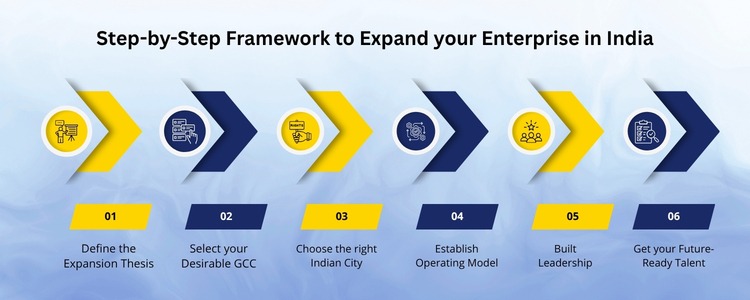
A Step-by-Step GCC Market Entry Framework for Global Enterprises Expanding Into India
Why do global enterprises choose Indian GCCs?
Into the Advanced Reality of GCCs

Conclusion:

Pratibha Soni








Error: Contact form not found. Error: Contact form not found.Subscribe to our Newsletter
Subscribe to our Newsletter