Recent Posts







“More than ever before in human history, we share a common destiny.” Kofi Annan (Former United Nations Secretary-General)
The world’s economies aren’t just connected; they’re woven together. That’s where Global Capability Centers, or GCCs, really come into play. GCCs have evolved more than back-offshore offices; they are now leading the front and center in international relations. Right now, governments are pushing hard for cross-border investments. They’re cutting trade deals, promoting digital policies, teaming up on innovation, and making it easier to share technology. In this climate, India stands out. The country has really made itself a hub for GCCs, opening the door for companies from the US, the UK, Japan, and all over to tap into skilled talent, move faster on innovation, and run global operations that actually feel global.
Back in the late ’90s, global companies started setting up captive technology and support centers in India. At first, it was all about cutting costs and tapping into the country’s huge pool of engineers. But things changed. Those basic back offices grew into full-fledged innovation hubs. Now, you’ll find more than 2100 GCCs in India, giving jobs to over 1.9 million people. This boom didn’t just happen; it was pushed by fast-growing digital infrastructure, cheap and reliable internet, cloud tech, AI adoption, and business-friendly policies that made it easy for international firms to scale up quickly. GCCs in India aren’t just about IT support anymore. These days, you’ll see teams working on everything from product engineering and cybersecurity to analytics, finance, AI research, supply chain, legal ops, customer experience, and digital transformation projects. Most of the action happens in IT hotspots like Bengaluru, Hyderabad, Pune, Chennai, Mumbai, and NCR, and now Tier-2 cities are jumping in, too. The result? These cities have formed talent clusters that fuel global business needs. One big reason companies choose India: flexibility. Firms get to pick what fits: fully owned in-house centers, Build-Operate-Transfer models, managed partnerships, hybrid frameworks, or even offshore capability centers run with local partners. This range means businesses from any industry or region can set up shop in a way that matches their own growth plans, governance style, and how much risk they want to take on. India has become the top spot for countries like the US, UK, Japan, Germany, Australia, Singapore, and the Nordics to build their GCCs. Multinational companies keep doubling down here because India delivers a strong business environment, a deep talent pool ready to scale, and a proven track record for transforming GCCs from simple execution shops into true global innovation powerhouses.
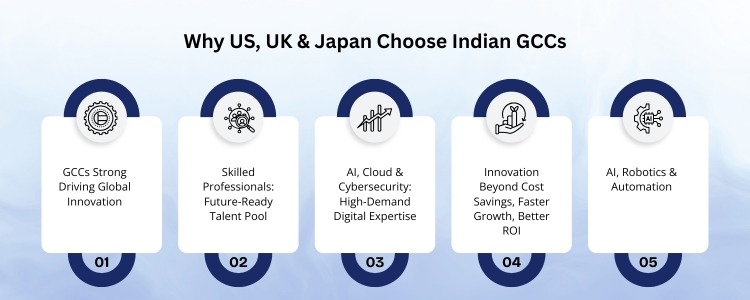
US and UK companies struggling to find experts in areas like software engineering, cybersecurity, cloud, data science, or AI can really count on India. The talent’s there, and it’s skilled, experienced, and available in numbers you just can’t find elsewhere. With Indian GCCs, you can ramp up specialized teams fast, keep quality strong, and stay up and running, even as the market shifts. Japan pushes the envelope in robotics, automation, semiconductors, AI, and smart manufacturing. India excels in digital engineering. Together, they’re a powerful mix. Indian GCCs help Japanese firms step up R&D, co-create next-gen tech, and kickstart innovation programs where Japanese attention to detail meets Indian software depth. It’s a combination that turns ambition into actual results. Here’s what’s interesting: big names from the US, UK, and Japan now use their Indian GCCs as more than back offices. They’re turning them into core hubs for decision-making and technology innovation. Whether it’s banking, healthcare, retail, manufacturing, or automotive, companies are using these centers for new product development, business transformation, and reimagining customer experiences. The investment keeps flowing in because the business value delivered goes well beyond just cost-cutting. Let’s be clear, it’s not just about lower costs. Companies with operations in India speed up innovation, boost productivity, cut their time-to-market, unlock new digital tools, and fine-tune the way their global operations work. Many leaders will tell you they see stronger returns on their transformation efforts when key strategic work happens out of Indian GCCs. The US, UK, and Japan keep betting big on Indian expansion. Why? India brings together scale, a steady business environment, deep pools of talent, digital advancement, and a real appetite for innovation. As AI, automation, and digital platforms reshape how business works everywhere, Indian GCCs are stepping up as the go-to centers for global excellence, giving enterprises the edge they need to compete for the long haul.
Indian GCCs come with some serious perks. You get immediate access to specialized talent, people who know their stuff. Need to grow fast? No problem; these centers help you scale up operations in no time. They also push innovation and keep the lights on with continuous service delivery. With the right setup, you can build cross-functional teams that back up global operations while speeding up your digital transformation and tech modernization projects. Growing fast is great, until you hit a wall with governance. If you don’t lay down the right structures early on, things start slipping through the cracks. Reporting gets messy, decisions take forever, and communication breaks down. But if you set up clear operating models, make leaders accountable, and track performance carefully, you can avoid a lot of these headaches. Let’s be honest, not every GCC partner meets the mark. There’s a big difference between the best and the rest. If you want the partnership to work, dig deep into their governance style, industry experience, security standards, hiring chops, and ability to scale. Doing your homework here means fewer surprises later and much better results. Here’s what actually works: finding an operating model that fits what you want to achieve. Whether you go with a global in-house center (GIC), a managed GCC, or some sort of hybrid offshore option, don’t just go with the flow. Lay out clear KPIs, insist on transparency, set up airtight legal safeguards, and make sure they get your culture. That’s how you cut down on risk and ramp up the value.
The next wave of digital transformation in GCCs will be all about AI-driven automation, smarter operations, advanced analytics, cybersecurity, and bold product ideas. Indian GCCs aren’t just back offices anymore; they’re turning into hotbeds of enterprise innovation, building and testing new tech that scales worldwide. With ongoing investment in AI, cloud engineering, machine learning, digital twins, and automation, India is staking its claim as a leader in global business change.
Global Capability Centers (GCCs) have totally changed the way big companies around the world grow, innovate, and work together. India’s GCC scene is a game-changer for countries like the US, UK, and Japan. These organizations get immediate access to top-notch talent, boost their transformation efforts, cut out a lot of the operational headaches, and set themselves up for whatever comes next. Whether it’s traditional GICs, specialized offshore centers, or the latest in digital transformation GCCs, India delivers the infrastructure, know-how, and scale businesses need to stay ahead for the long haul. As competition heats up and tech-driven business models take center stage, companies that tap into India’s GCC power aren’t just keeping pace; they’re leading the charge in innovation and building a rock-solid, competitive edge.
I write where strategy meets storytelling. As a passionate writer and literary enthusiast, I craft GCC-focused content that transforms industry insights into compelling narratives. Drawn to global business ecosystems, I enjoy turning research, innovation, and ideas into content that informs, connects, and inspires. With an analytical mind and a creative soul, I bring curiosity, collaboration, and a sharp eye for detail to every project. Adaptable and growth-driven, I believe the right words do more than communicate – they leave an impression.
Welcome to Indian GCCs: A Multinational Setup
Key Opportunities: USA, UK, and Japan-centric
Compelling Advantages & Risks Involved—
Into the Future of GCCs' Innovation in India—

Conclusion

Pratibha Soni










Error: Contact form not found. Error: Contact form not found.Subscribe to our Newsletter
Subscribe to our Newsletter