Recent Posts







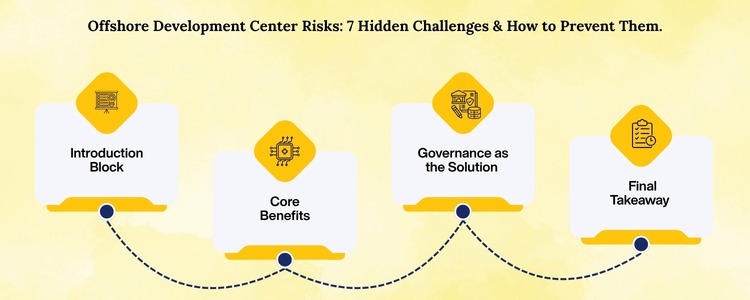
Offshore development centers (ODCs) have financed some of the most amazing engineering scale-ups in the last two decades. ODCs have become one of the common structures for large companies in their software delivery model. It is known and analyzed that there are cost savings and availability of talented engineers when offshore development centers are set up. However, not as much research has been done on the risks and their management in the case of ODCs. This blog covers the most significant offshore development center risks, supported by industry data, and outlines the steps organizations take to address them before they affect program outcomes.
Delivery problems in offshore engagements are often not due to any technical issues. When teams are separated by time zones, language differences, and organizational culture, information gaps accumulate faster than most organizations anticipate. Some reports found that poor communication is cited as the primary cause of project failure in 30% of cases globally. This number increases in distributed team settings, especially when documentation standards and handoff processes are not established up front. The practical consequences show up as misunderstood requirements, delayed issue escalation, and decisions made without the full context needed to make them well. Over a six-to-twelve-month contract period, all these deficiencies result in rework that negates the benefits intended from using offshoring services. How organizations address this: Establishing a structured communication framework before work begins is the standard approach. This involves holding stand-ups on a daily basis, with clear roles and responsibilities assigned to both onshore and offshore project leads, keeping detailed records of any requirement changes, and having one point of contact on each end for escalation purposes. Companies that take this route tend to experience far less miscommunication than those that do not.
Intellectual property threats can be considered one of the most serious types of problems associated with outsourcing work to another country. This means that intellectual property such as source code, product specifications, customer information, or algorithmic data provided to the foreign team may have limited protection outside its native jurisdiction. The International Chamber of Commerce estimates that businesses around the world lose between 225 billion and 600 billion dollars every year due to intellectual property issues. While not all of this involves offshore software development, the report identified cross-border technology engagements as a high-exposure category. Some common examples of intellectual property issues that may arise in an offshore environment are illegal access to repositories of source codes, improper management of information by subcontractors, and unclear ownership of contractual work products. How organizations address this: The starting point is the contract. IP ownership of all work products must be explicitly assigned to the contracting organization, not left to default terms. The signing of non-disclosure agreements by both the vendor entity and all team members is recommended. Apart from the contract, limiting access to source codes to only the particular modules handled by each team member, along with endpoint monitoring of all access devices to the production system, helps minimize the risks. Choosing vendors from countries that have strong IP laws, such as signatories to WIPO’s copyright treaty, would also help.
Issues related to offshore outsourcing may arise from quality variations in the output, especially during the initial phase of the project. The teams that are geographically distant may not have the same definition regarding when something is considered completed, the required testing coverage, and the level of documentation. Research done in 2023 revealed that 61% of companies experienced quality problems at the beginning stage of offshore development projects. According to the same report, firms using clearly defined quality gates along with common test frameworks experienced a 38% decrease in defects relative to those lacking these systems. The challenge does not stem from technical proficiency. Engineering expertise available offshore, in many cases, matches that of domestic expertise in quality. The challenge is about standards, not technical proficiency. How organizations address this: The quality management must be described in the statement of work rather than leaving it in the hands of the vendor. Some of these include the minimum test coverage, code reviews, defect fixing timeframes, and the static analysis tools to use. Code reviews on a regular basis, involving onshore architects, will set the standards from the start.
Offshore outsourcing presents a distinct set of problems for companies operating within industries subject to regulation when it comes to securing their data. Sharing customer data, financial records, or health information with teams in different regulatory jurisdictions creates compliance obligations that many organizations underestimate at the contracting stage. According to the report, the cost of an attack through third parties averaged at $4.55 million, which was 16.3% higher than attacks on internal infrastructure alone. Engagements abroad where access to sensitive data is given without proper security measures amount to a significant liability in addition to any fines that might be incurred under GDPR, HIPAA, or similar regulations. How organizations address this: Minimization of data collection is the first principle. Offshore vendors must always use data masking or anonymization where possible. In cases where actual data is required, it must be managed under role-based access control systems with logging and periodic audit reviews. Any compliance obligations must be specified in vendor contracts that allow for audits by the contract holders. Third-party security assessments are common practices in the finance and healthcare industries when working with vendors.
Organizations can eventually become structurally dependent upon their one offshore vendor over time. If the vendor increases costs, replaces management, or suffers an operational upset, there is not much that the organization will be able to do about it. According to the survey results, 53% of companies that faced substantial disruption due to offshore engagement said that they were too dependent on one vendor only, without having any exit plan. Offshore Development Center risks and contingency planning must take into consideration this scenario right from the onset of an engagement, rather than when vendor lock-in has already occurred. Vendor lock-in is one of those ODC risks that gets the least amount of consideration in pre-contract negotiations and the most attention post-facto. How organizations address this: Contracting must also address knowledge transfer, documentation, and transitional responsibilities. Those companies that internally control architecture decisions, source codes, and documentation have more advantage in transferring work where required. Certain organizations may purposefully choose to allocate work amongst two vendors operating within the same geographic location to ensure competition remains intact.
High attrition in ODC is a factor that presents continuity risk. Whenever engineers who are conversant with the program code and requirements leave the vendor company, those who replace them take time to understand what needs to be done. According to LinkedIn Talent Insights statistics of 2023, the annual turnover rate for software engineers in India, the Philippines, and Eastern Europe was between 18 and 25%, compared to the average of 13% observed in the United States. How organizations address this: Having the vendor keep detailed onboarding documentation and codebase documentation helps offset the expense associated with turnover. Agreements could contain clauses regarding attrition notices and minimum bench depths for crucial positions. Organizations that treat the offshore team as a long-term partner rather than an interchangeable resource pool report lower effective attrition than those that do not invest in team continuity.
The pattern across these risk categories is consistent. The risks associated with offshore development centers are exacerbated by the lack of governance, the vagueness of the agreements between companies, and unclear accountability for results. They are mitigated if companies regard ODC risks as a formal discipline rather than a checklist to be considered at contract closing. Companies with the most stable offshore initiatives have some common traits. These include performing due diligence on the service provider prior to selection, ensuring that compliance and quality are written into the contract as opposed to being based on trust, and having sufficient technical ownership internally to control the outputs of the offshore team. Organizations that had formal offshore governance structures suffered 42% fewer program disruptions compared to those lacking such structures.
The risks associated with offshore development centers do exist, and they may involve serious implications for both finances and operations. First of all, getting an idea about the risks involved and knowing about them before signing the contract must be considered the minimum requirement. Furthermore, risks are normally manageable as well. The companies that experience some major issues tend to overlook such important aspects as governance, IP protection, and quality alignment until the contract has been signed already. Those that address them in advance operate offshore programs that perform consistently over time.
Companies can cut their costs by 30-50% due to the availability of high-quality but inexpensive labor from India. The low cost of property and infrastructure investments also adds to the efficiency of operations. A favorable currency position also assists multinational corporations in managing their expenditures and maximizing benefits. Most significantly, all these economies are achieved without sacrificing quality, innovation, or speed of delivery. India is home to a massive resource pool of skilled professionals in AI and data science, making innovation easier. Over 500 GCCs with an emphasis on AI are available for technologies such as machine learning and GenAI. These GCCs assist firms in developing their own proprietary platforms and IP. .Thus, Indian GCCs are crucial in the context of global AI innovation and transformation. India is expected to have 2,100-2,500 GCCs by 2030 due to high growth. These centers will become more important for international business, innovation, and product development. GCCs will be at the forefront of innovation, including AI, digitization, and decision-making. In general, they will make a significant contribution to India’s economy and international business. India boasts an enormous reservoir of STEM professionals, which allows firms to expand their workforce rapidly. It has a robust digital infrastructure, which fosters innovation and international business. Its cost efficiencies make it extremely effective as opposed to other international destinations. A developed environment in AI, cloud computing, and data science ensures constant innovation and development. Global Capability Centers (GCCs) in India are enterprise-owned hubs that deliver end-to-end services like product development, R&D, AI, and digital transformation. They go beyond traditional outsourcing to drive innovation and business strategy. With a keen analytical mindset and a passion for data-driven insights, Babita Gangwar brings expertise in research, analysis, and strategic evaluation. As a Research Analyst, she focuses on transforming complex data into actionable intelligence that supports informed decision-making. She collaborates across teams to deliver high-quality research outputs, ensuring accuracy, relevance, and impact. Her interests span market research, data analytics, and emerging industry trends. A detail-oriented professional, she actively contributes to knowledge development through reports, presentations, and research initiatives.
1. Communication and Coordination Failures
2. Intellectual Property Risks
3. Quality and Standards Inconsistency
4. Data Security and Compliance Exposure
5.Vendor Dependency and Transition Risk
6.Talent Attrition at the Vendor Level
7. Addressing ODC Risks and Mitigation as a Program Discipline
Summary:

frequently asked questions (FAQs)
1.What cost advantages do GCCs in India offer?
2.How do GCCs in India support AI and innovation?
3.What is the future outlook for GCCs in India?
4.What makes India a top destination for GCC expansion?
5.What are Global Capability Centers (GCCs) in India?

Babita Gangwar










Error: Contact form not found. Error: Contact form not found.Subscribe to our Newsletter
Subscribe to our Newsletter