Recent Posts







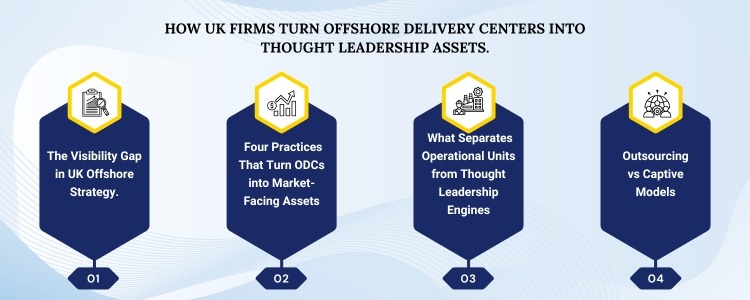
Most UK multinationals that operate an offshore delivery center treat it as a cost management instrument. A smaller group sees it as something that gives them a place in discussions about the sector. There is no structural difference. It depends on how the organization chooses to employ the talent, productivity, and institutional knowledge that the center generates. In the context of an offshore delivery center strategy, thought leadership is the intentional use of work generated overseas to enhance the parent organization’s external credibility. This includes writing policy views on subjects where the offshore center has amassed applied expertise, publishing research created by offshore teams, and presenting at industry conferences using data produced from ODC operations. This transforms an operational asset into one that faces the market when done regularly.
UK companies have been running offshore delivery centers for over 25 years. There are HSBC, Lloyds Banking Group, BP, GlaxoSmithKline, and Rolls-Royce, which have their captive offshore centers mainly located in India, Poland, and the Philippines. As at 2024, the total number of employees working in offshore delivery centers owned by UK companies in India is more than 320,000, per NASSCOM estimates. However, the positioning of these offshore centers in UK firms’ corporate messaging is minimal. According to FTSE 350 organizations, “low to none” was the term used by 67 percent of the respondents to describe the external visibility of their offshoring facilities. The visibility issue is a unique gap in offshore delivery center management because offshoring facilities possess valuable information and analysis capabilities paid for but not utilized by the parent company. The amount spent by companies in the UK on offshore outsourcing and captive delivery centers amounted to an estimated £28 billion in 2024. Less than 4 percent of that spend was directed toward producing market-facing content from offshore teams.
The offshore delivery centers that contribute to the external credibility of their parent organizations have one thing in common: they regard their offshore work as source material for organizational stances within the marketplace. It’s not the same as issuing a press release announcing the establishment of a new center or mentioning employee figures in the annual report. Three practices define how UK companies that have done this well approach their offshore delivery center strategy. The first is that they allocate research and analytical tasks rather than implementation tasks to ODC teams. The second is that they establish a publication stream for moving content out of the ODC and publishing it externally in the form of articles, consultations, or even presentations at professional industry associations. The third is that they recognize their offshore staff members in these publications.
Global delivery model strategy, in essence, involves decision-making regarding what work needs to be done at what location and how the delivery sites will be managed. For the majority of companies based in the UK, such a strategy will be defined inside the company and approved by the management of operations or procurement. A global delivery model strategy is, at its core, a set of decisions about which work gets done where and how delivery locations are governed. For most UK firms, this strategy is articulated internally and reviewed by operations or procurement leadership. It seldom appears as a point of organizational differentiation in the marketplace.
The global capability centers, especially the ones established by UK financial and professional service providers in India, have been the most dynamic with respect to this realignment. Whereas the output ownership has always rested with the vendor under outsourcing deals, global capability centers hold on to the intellectual property, process, and discovery within their organizational structure. As such, they have been able to position their output externally more easily than outsourcing deals have allowed. Organizations with headquarters in the UK like Barclays, Standard Chartered, and Aon have released sector insights that have been produced at least partially by the global capability center of these firms located in India. For instance, the global capability center of Standard Chartered based in Chennai has more than 16,000 employees and has helped release positions by the company concerning trade finance, sustainable lending principles, and risks associated with emerging markets. According to a 2023 NASSCOM talent study covering 240 global capability centers in India, organizations where offshore teams contribute to externally published research report 3.2 times higher five-year retention among senior offshore staff compared to those where offshore teams work exclusively on internal delivery.
The distinction between outsourcing and captive delivery is directly relevant to thought leadership because it determines who owns the work. In a managed outsourcing setup, unless there is an agreement stipulating otherwise, all intellectual property rights will vest with the vendor. Conversely, any work carried out in an ODC or GOC will vest with the parent company. As such, any intellectual property produced will automatically belong to the parent company. UK companies that used outsourcing as a method for offshore delivery in the past are reconsidering this classification when developing an offshore delivery center strategy. The trend of moving from outsourced models to captive models and BOTs where ownership is transferred to the company parent is partially related to this issue, as an organization needs to use its own products when creating an external position.
The most common entry point for UK organizations repositioning their offshore delivery center strategy around thought leadership is the annual benchmark. There are quite a few UK-headquartered organizations who have recently started putting out their annual statistics related to their offshore delivery centers. This includes metrics such as cost per function, talent numbers, productivity benchmarks, and location comparison. The benefits of doing this are dual in nature. First, the organization gets to position itself as being mature enough to conduct and share these metrics, and second, there is a regular publishing cycle created. The second opportunity is regulatory participation. UK financial service companies with offshore delivery centers in India and/or Poland will be uniquely suited to provide input into the FCA and PRA consultations regarding third-party risks, operational resilience, and cross-border data transfer based on direct experience in their own ODCs. Responding to the consultations from an organization that has direct offshore operations experience, as opposed to simply offering comments to policymakers from a firm that does not have such experience, has far greater influence with the regulators and within the industry. In the UK market, the use of offshore delivery centers as a way of reducing costs is giving way to an operational and marketing strategy issue. The companies that understand this change early on and establish the procedures necessary to make the ODC’s output useful externally are going to benefit from a cumulative advantage in the way they are seen by their customers, regulatory bodies, and potential employees.
The global capability centers, especially the ones established by UK financial and professional service providers in India, have been the most dynamic with respect to this realignment. Whereas the output ownership has always rested with the vendor under outsourcing deals, global capability centers hold on to the intellectual property, process, and discovery within their organizational structure. As such, they have been able to position their output externally more easily than outsourcing deals have allowed. Organizations with headquarters in the UK like Barclays, Standard Chartered, and Aon have released sector insights that have been produced at least partially by the global capability center of these firms located in India. For instance, the global capability center of Standard Chartered based in Chennai has more than 16,000 employees and has helped release positions by the company concerning trade finance, sustainable lending principles, and risks associated with emerging markets. According to a 2023 NASSCOM talent study covering 240 global capability centers in India, organizations where offshore teams contribute to externally published research report 3.2 times higher five-year retention among senior offshore staff compared to those where offshore teams work exclusively on internal delivery.
Companies can cut their costs by 30-50% due to the availability of high-quality but inexpensive labor from India. The low cost of property and infrastructure investments also adds to the efficiency of operations. A favorable currency position also assists multinational corporations in managing their expenditures and maximizing benefits. Most significantly, all these economies are achieved without sacrificing quality, innovation, or speed of delivery. India is home to a massive resource pool of skilled professionals in AI and data science, making innovation easier. Over 500 GCCs with an emphasis on AI are available for technologies such as machine learning and GenAI. These GCCs assist firms in developing their own proprietary platforms and IP. .Thus, Indian GCCs are crucial in the context of global AI innovation and transformation. India is expected to have 2,100-2,500 GCCs by 2030 due to high growth. These centers will become more important for international business, innovation, and product development. GCCs will be at the forefront of innovation, including AI, digitization, and decision-making. In general, they will make a significant contribution to India’s economy and international business. India boasts an enormous reservoir of STEM professionals, which allows firms to expand their workforce rapidly. It has a robust digital infrastructure, which fosters innovation and international business. Its cost efficiencies make it extremely effective as opposed to other international destinations. A developed environment in AI, cloud computing, and data science ensures constant innovation and development. Global Capability Centers (GCCs) in India are enterprise-owned hubs that deliver end-to-end services like product development, R&D, AI, and digital transformation. They go beyond traditional outsourcing to drive innovation and business strategy. With a keen analytical mindset and a passion for data-driven insights, Babita Gangwar brings expertise in research, analysis, and strategic evaluation. As a Research Analyst, she focuses on transforming complex data into actionable intelligence that supports informed decision-making. She collaborates across teams to deliver high-quality research outputs, ensuring accuracy, relevance, and impact. Her interests span market research, data analytics, and emerging industry trends. A detail-oriented professional, she actively contributes to knowledge development through reports, presentations, and research initiatives.
The current state of UK offshore delivery center strategy
What positions an ODC as more than an operational unit?
Give research responsibilities to offshore teams
Create a clear publishing process
Give credit to offshore team members
Use offshore data in industry events
How global delivery model strategy connects to market positioning
The role of global capability centers in this shift
Outsourcing versus captive: what this means for content ownership
Model
Control level
Setup time
Capital outlay
Adoption share (2024)
Pure Captive
Full
18 to 24 months
$4M to $8M
52%
Build-Operate
Transitional
12 to 18 months
$2M to $5M
27%
Joint Venture / Hybrid
Shared
9 to 15 months
$1.5M to $4M
11%
GCC-as-a-Service
Governance only
3 to 6 months
$0.5M to $2M
10%
Where UK companies are starting
The role of global capability centers in this shift

frequently asked questions (FAQs)
1.What cost advantages do GCCs in India offer?
2.How do GCCs in India support AI and innovation?
3.What is the future outlook for GCCs in India?
4.What makes India a top destination for GCC expansion?
5.What are Global Capability Centers (GCCs) in India?

Babita Gangwar








Error: Contact form not found. Error: Contact form not found.Subscribe to our Newsletter
Subscribe to our Newsletter