Recent Posts







Modern operating models and emerging capabilities centers are driving the future of finance. What once took ten days to close the books now takes just two. In 2010, fewer than one in five GCCs handled automation or analytics. Today, more than 65% are leading enterprise-wide digital initiatives. The transformation isn’t approaching — it’s already here. And CFOs who have not repositioned their GCC as a strategic finance engine are already falling behind—missing the opportunity to optimize costs, pricing strategies, and working capital, directly strengthening the bottom line and driving measurable improvements.
For many years, the processing of invoices, payroll, reconciliations, and basic reporting defined finance GCCs as trustworthy but not particularly strategic. That model is no longer in use.
AI-driven forecasting, which provides CFOs with real-time scenario planning and forward-looking intelligence, is replacing manual financial planning and analysis. The use of AI in finance is rapidly increasing; 72% of finance executives currently use AI tools, compared to just 34% the year before. FP&A used to be independent tasks, but CFOs are changing it into collaborative, technologically advanced procedures using high-quality data for more intelligent forecasting and dynamic scenario planning. Finance GCCs in India are at the center of this shift—building the models, running the data, and delivering the intelligence that drives global boardroom decisions. Inside GCCs, routine financial tasks like invoice processing, reconciliations, and compliance reporting are being automated at scale, freeing up senior finance expertise for tasks that genuinely call for judgment. AI is becoming more common in basic financial systems such as enterprise performance management, ERP, and accounting, along with specific processes like treasury, order-to-cash, accounts payable, and accounts receivable. 82% of businesses utilizing AI in AR processing claim productivity increases. For a CFO managing global finance operations, the goal is not just efficiency—it is the elimination of an entire layer of operational risk. One of the toughest and most costly problems facing finance today is managing rules like GDPR, Basel III, AML, and international data protection legislation across several nations. Leading GCCs in finance are transforming this difficulty into a strategic asset. Instead of responding to problems after they arise, they make sure firms are always audit-ready by creating specialized compliance teams, utilizing real-time monitoring, and automating reporting procedures. This transformation is an important shift that many CFOs are still in the process of adopting. Seven in ten CFOs estimate that their GCCs will take charge of AI and digital finance initiatives by 2026. The GCC is now the link between ambition and execution, where financial innovation is a habit rather than a goal. GCCs for finance are no longer support roles. They operate innovation pods, develop AI models, and control the enterprise’s digital finance plan, making them strategic engines.
According to RGP’s CFO Perspectives Survey 2025, 93% of CFOs report having substantial influence over strategy, and 74% of CFOs now have enterprise-wide impact. This represents a dramatic shift from protecting financial discipline to designing business change. But influence without infrastructure is just ambition. Most CFOs are trying to implement the 2026 strategy using finance systems built in 2015. These systems contain mixed data, lengthy reporting cycles, and delayed insights, resulting in a three-day delay in real-time decision-making. It is hardly strategic leadership when the CEO requests scenario analysis on Monday morning and receives a spreadsheet on Wednesday. That is a problem with credibility. The speed gap exacerbates the issue. Traditional financial teams are unable to keep up with the rapid pace of global business. The market has already changed by the time monthly reports arrive, and rivals with rapid financial visibility have already taken action. A finance GCC designed for 2026 directly resolves both issues. CFOs have the infrastructure their strategic influence truly needs thanks to AI-powered forecasting, automated reporting, real-time dashboards, and 24/7 operations across time zones. Indian teams create a never-ending financial intelligence engine by closing books, running analytics, and reporting risks when headquarters is resting. The cost argument further strengthens this position. In markets where expertise is difficult to come by and costs are high, developing this capability onshore involves competing for costly data scientists and finance technology specialists. A finance GCC in India offers the same capability at a 40–60% lower cost, allowing for expansion rather than infrastructure overhead. Building this capability today will provide the CFOs more than simply a competitive edge. Competitors will have to spend years trying to model their financial intelligence engine.
Although many firms view financial GCCs from a short-term perspective, their true value lies in their long-term strategic influence. Over time, it becomes evident how a strategic approach differs from a lasting competitive advantage. Leading companies invest in systems that become stronger every year rather than just developing skills for the present. The comparison below highlights how this shift in perspective fundamentally changes outcomes.
GCCs are becoming an essential agent of the ongoing evolution of finance.
Hyderabad, Bangalore and Pune have become significant pharma innovation centres with global delivery centres of major biotechnological and pharmaceutical firms such as Novartis, Pfizer, AstraZeneca and GSK. They offer an economic benefit of calculation, a variety of scientific and technical human resources, and speedy time-to-market. On average, businesses reduce between 25-40 percent of the operational costs and increase the rate of innovation. The next-generation operations of Pharma GCC focus on advanced molecular modelling, AI/ML-based drug discovery, cloud supercomputing, and data integration platforms, as well as quantum-ready simulations. Pharma GCCs use AI to screen molecules, predict the efficacy of drugs, optimise clinical trials and aid in making data-driven decisions, resulting in smarter, faster and safer drug pipelines. Pharma GCCs will be global innovation ecosystems that are a combination of computational chemistry, generative AI, and quantum computing. They will turn into the hubs linking data science, discovery and regulatory intelligence in the global arena. Aditi, with a strong background in forensic science and biotechnology, brings an innovative scientific perspective to her work. Her expertise spans research, analytics, and strategic advisory in consulting and GCC environments. She has published numerous research papers and articles. A versatile writer in both technical and creative domains, Aditi excels at translating complex subjects into compelling insights. Which she aligns seamlessly with consulting, advisory domain, and GCC operations. Her ability to bridge science, business, and storytelling positions her as a strategic thinker who can drive data-informed decision-making.
From Back Office to Boardroom
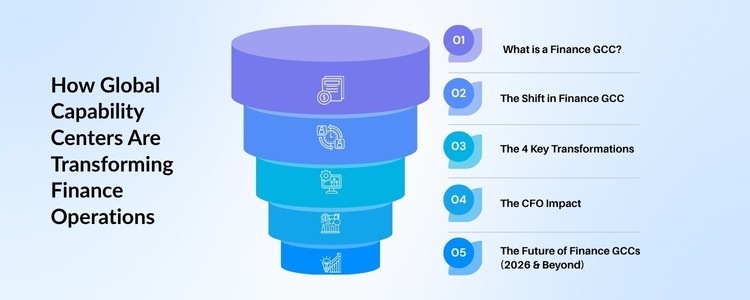
By 2026, GCCs will manage all aspects of value-chain finance, including financial We are focusing on planning and analysis, tax, treasury, controls, and analytics, moving away from “close and report” and toward “predict and advise.” This includes statistical BPM. Initial users of this change are currently operating autonomous closing systems, real-time fraud detection, and AI-powered forecasting from their India GCCs. Those who continue to handle their GCC as a shared services center have no clue as to why their finance department seems to be operating slowly.The 4 Transformations Every CFO Should Understand
The CFO Opportunity Right Now
The Long-Term Value of Finance GCCs
From Short-Term Gains to Long-Term Advantage
Dimension
BEFORE — Short-Term Lens
AFTER — Long-Term Strategic View
Outcome
Value Perception
GCC seen primarily as a cost-saving initiative
GCC positioned as a compounding strategic capability
Drives sustained competitive advantage
Capability Building
Limited focus on long-term talent and skill development
Structured talent pipelines through academies and rotational programs
Creates a self-sustaining finance ecosystem
CFO Role Alignment
No clear link to CFO’s evolving strategic responsibilities
GCC enables CFOs to lead technology, analytics, and enterprise transformation
Strengthens leadership impact
Time Horizon
Focused on immediate or near-term (2026) outcomes
Built with a decade-long perspective on growth and scalability
Positions organization for long-term success
Conclusion
They offer the infrastructure needed to make decisions more quickly, intelligently, and strategically. Early detection of this change will put organizations in a better position for long-term success.
CFOs have a clear choice: either build now or adapt later.

frequently asked questions (FAQs)
1.Who are the Pharma GCC development leaders in India?
2.Which economic benefits do Pharma GCCs have?
3.Which technologies are influencing Pharma GCC operations nowadays?
4.What is the role of AI in Pharma GCC processes?
5.How will Pharma GCCs look in five years to come?

Aditi










Error: Contact form not found. Error: Contact form not found.Subscribe to our Newsletter
Subscribe to our Newsletter