Recent Posts







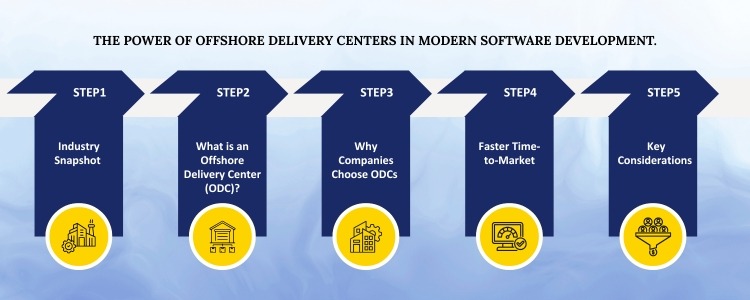
Global software spending is projected to reach approximately $1.08 trillion by 2025, reflecting the continued expansion and strategic importance of digital transformation across industries. A growing portion of that spend is being managed through dedicated offshore delivery centers, as organizations look to control costs, fill skill gaps, and keep development programs moving without expanding domestic headcount beyond what is operationally sustainable. This blog highlights the proven value of offshore delivery centers in software development, reinforced by actionable data.
Offshore delivery centers are specialized setups established in another country to carry out software development activities on behalf of organizations. The major difference between an offshore delivery center and outsourced software development services is that an offshore delivery center operates as an integral extension of the home company rather than as an independent contractor. This difference influences the process of work, accountability arrangements, and how much institutional memory an organization retains throughout its operations.
The offshore delivery centers allow businesses to balance costs, leverage worldwide talent, and expedite software development without overwhelming their own internal resources. It gives companies a streamlined way of delivering their software development projects.
Cost reduction is usually the main motive behind the exploration of this model. According to the Global Outsourcing Survey, 70% of organizations use cost savings as the primary driver of their outsourcing decisions. The labor cost differential explains why. A senior software engineer in the United States gets paid anything from $130,000 up to $160,000 annually. On the other hand, in India or Eastern Europe, a software engineer having the same level of expertise as his American counterpart gets paid anything from $25,000 up to $55,000 annually. Beyond salaries, organizations also reduce expenses related to office facilities, benefit administration, and hiring costs. Offshore development companies normally include all these factors under one package deal, thus reducing the overhead for the parent firm.
Local labor shortages are an actual barrier in many significant markets. For example, according to the estimates from the Bureau of Labor Statistics of the USA, there will be a shortage of more than 1.2 million software developers in the United States by 2026. An offshore delivery center provides organizations with access to engineering labor in countries where demand is less restricted. The country of India generates roughly 1.5 million engineering graduates each year. Outsourcing strategies that leverage offshore development services make it possible for companies to hire people whose skills fit their needs, not just whoever is nearby. This becomes especially important when it comes to highly technical positions like machine learning engineers, embedded software developers, and cloud security experts, as domestic recruitment may take up to six months.
Scaling a domestic engineering team takes time. For each engineer, hiring, onboarding, and achieving maximum productivity usually take between 3 and 6 months. This latency increases scheduling risk in systems where requirements vary every quarter. The global delivery model takes care of this issue. Teams can be expanded or reduced depending on the need for the project, without going through the cumbersome process of changing staff count legally and from an HR perspective. The Outsourcing Index found that there was a rise in demand for scalable offshore development of 22% in one year, and the demand was mostly from companies in the finance, healthcare, and retail industries. This capacity flexibility is one of the structural differences between building internally and operating through a well-governed delivery center.
An effectively organized team under the offshore delivery framework allows for nearly constant development cycles. If teams from North America, Europe, and Asia operate on shift work, then actual development time can exceed eight hours per day. In order to make this strategy work, an organization must be able to plan its handovers, documentation, and communications. This results in a significant decrease in release times. Research indicates that companies using a global delivery model for software development to reduce it implement global software development and cut down their time to market by 20 to 30 percent. For product companies where release frequency is tied directly to revenue and competitive position, those reductions have a concrete financial impact
IT outsourcing that is based on a distributed work group also works as operational risk management. When software development activities are done in one geographical location, the risks associated with any disruptions in that location become possible. The diversification of labor through multiple locations in accordance with a cohesive global delivery strategy minimizes this risk factor and provides backup for institutional knowledge. According to one survey, 64% of firms with advanced offshore delivery strategies experienced better business continuity results than companies with single-location developers.
As internal engineering groups are busy with maintenance activities, old system support, or mass routine development, it becomes difficult for top engineers to concentrate on other aspects. Strategic outsourcing of activities that do not distinguish the organization allows internal teams to focus on architecture, innovation, and features related to customer interaction. According to Accenture’s Technology Vision survey, about 58% of technology executives in large corporations have been outsourcing their software engineering to offshore vendors for this purpose.
The decision to establish an offshore delivery center requires attention to a few operational areas. Governance and accountability Without clear reporting lines and escalation paths, remote teams can drift from organizational priorities. The majority of effective implementations designate a specific program lead who is responsible for ensuring that onshore and offshore teams are in sync. Location and vendor selection Data security and compliance
IT outsourcing is projected to reach $617.69 billion globally by 2030, growing at a compound annual growth rate of 8.07%. Companies with established global delivery model structures report 35% higher developer productivity compared to fully onshore teams. Time to hire for specialized roles through offshore development services is 60% shorter than equivalent domestic hiring, according to LinkedIn Talent Insights.
The offshore delivery center may not be a good choice for every company or at every point along its development path. For businesses where scalability, speed, and costs are important, there is abundant proof of the benefits of such centers. What needs to be decided for most firms is not whether or not to use an offshore delivery center, but rather how to do so.
Companies can cut their costs by 30-50% due to the availability of high-quality but inexpensive labor from India. The low cost of property and infrastructure investments also adds to the efficiency of operations. A favorable currency position also assists multinational corporations in managing their expenditures and maximizing benefits. Most significantly, all these economies are achieved without sacrificing quality, innovation, or speed of delivery. India is home to a massive resource pool of skilled professionals in AI and data science, making innovation easier. Over 500 GCCs with an emphasis on AI are available for technologies such as machine learning and GenAI. These GCCs assist firms in developing their own proprietary platforms and IP. .Thus, Indian GCCs are crucial in the context of global AI innovation and transformation. India is expected to have 2,100-2,500 GCCs by 2030 due to high growth. These centers will become more important for international business, innovation, and product development. GCCs will be at the forefront of innovation, including AI, digitization, and decision-making. In general, they will make a significant contribution to India’s economy and international business. India boasts an enormous reservoir of STEM professionals, which allows firms to expand their workforce rapidly. It has a robust digital infrastructure, which fosters innovation and international business. Its cost efficiencies make it extremely effective as opposed to other international destinations. A developed environment in AI, cloud computing, and data science ensures constant innovation and development. Global Capability Centers (GCCs) in India are enterprise-owned hubs that deliver end-to-end services like product development, R&D, AI, and digital transformation. They go beyond traditional outsourcing to drive innovation and business strategy. With a keen analytical mindset and a passion for data-driven insights, Babita Gangwar brings expertise in research, analysis, and strategic evaluation. As a Research Analyst, she focuses on transforming complex data into actionable intelligence that supports informed decision-making. She collaborates across teams to deliver high-quality research outputs, ensuring accuracy, relevance, and impact. Her interests span market research, data analytics, and emerging industry trends. A detail-oriented professional, she actively contributes to knowledge development through reports, presentations, and research initiatives.
1. What an Offshore Delivery Center Actually Is
2. Core Benefits of an Offshore Delivery Center for Software Development
Cost Efficiency at Scale:
Access to Technical Talent
Scalability Without Structural Overhead
Faster Development Cycles Through Time Zone Distribution
Operational Risk Distribution
Internal Capacity Reallocation
3. Key Considerations Before Setting Up
Not every offshore location has equal depth in every skill area. In terms of enterprise software and cybersecurity, Eastern Europe often has good capabilities. Scale and cost advantages are available in full-stack and QA functions in South and Southeast Asia. The program’s particular technological requirements should guide the selection process.
Organizations in regulated industries need to ensure that offshore development services contracts address sector-specific compliance requirements. Data handling protocols, IP ownership terms, and access controls should be defined before work begins.
4. The Numbers in Summary
Summary

frequently asked questions (FAQs)
1.What cost advantages do GCCs in India offer?
2.How do GCCs in India support AI and innovation?
3.What is the future outlook for GCCs in India?
4.What makes India a top destination for GCC expansion?
5.What are Global Capability Centers (GCCs) in India?

Babita Gangwar










Error: Contact form not found. Error: Contact form not found.Subscribe to our Newsletter
Subscribe to our Newsletter