Recent Posts






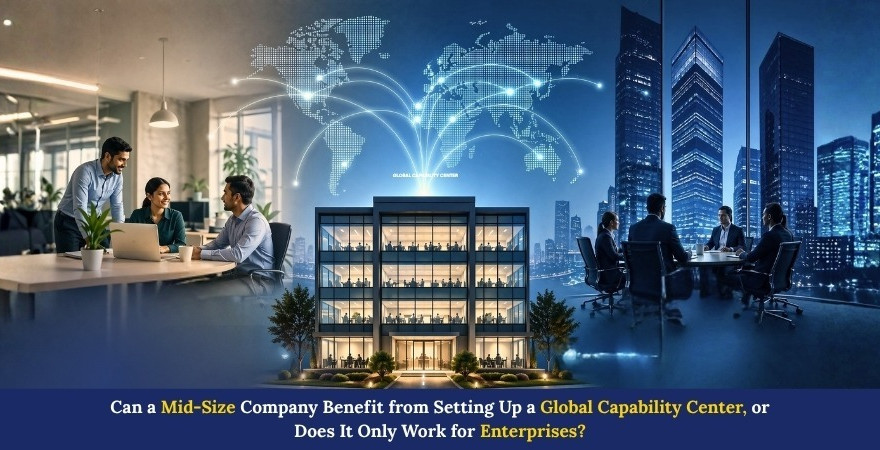
The assumption that a global capability center is only viable for large multinationals has persisted for years. It was largely true when setting up an offshore capability center required significant capital, a dedicated legal entity, substantial HR infrastructure, and a long ramp period before the center produced any useful output. This is no longer the case, and mid-sized businesses are increasingly running global capability centers with significantly less friction than the traditional model necessitated. The more relevant question is not whether a mid-size company can do it. It is whether the specific company has the right conditions to make it work.
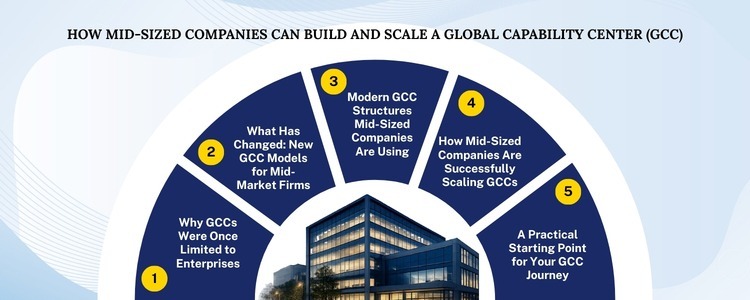
The GCC model was first implemented by large multinational corporations that had the necessary resources to establish their own offshore setup. The shared services center or the global in-house center worked well if there were enough employees who could use the work done by the center. However, for businesses that had between 300 and 2000 employees, the approach was not easily justified by any means. There were several reasons behind such an opinion, including the high cost and long period necessary to get the process working. Many mid-size firms found the concept of a global capability center unsuitable for them. What has been altered is the possibility of other structures that enable the mid-sized company to enter into the same structure from another starting point.
Mid-sized organizations do not have to establish a wholly owned business enterprise in the new country. Many organizational structures today give organizations the opportunity to conduct their Global Capability Center operations without bearing the expenses of setting up a typical business organization.
Captive lite models: In this model, the company owns the team and the work. A third-party organization handles the legal entity, payroll, compliance, and infrastructure. The offshore capability center functions as an independent body without the need for the corporation to manage local incorporation and staffing issues. The center is initially built and run by a vendor, who eventually gives the parent company complete ownership, often in 18 to 36 months. This works effectively for companies that seek long-term ownership but also require quicker execution. Build-Operate-Transfer Model The local partner establishes and runs the facility for a period of two to three years after which the company acquires the operation. This allows the medium-sized businesses sufficient time to ensure that the model is working before taking over full control. In this model, common infrastructure like office space, compliance procedures, and support systems are used by many firms. Each company employs its own exclusive workforce in this setup. This cuts down on fixed expenses but allows control of the workforce. These structures have developed over time as service providers adjusted their offerings. Global Capability Centers are no longer exclusive to the largest firms. Service providers can help mid-sized businesses access their services through more flexible and cheaper means. The Conditions That Determine Fit A Global Capability Center (GCC) is not something that can be used universally for every midsize business. The results achieved through it depend a lot on specific factors under which they have been carried out. Businesses fulfilling these requirements will find stability through it. Volume and Nature of Work The Global Capability Center works effectively only when there is adequate volume of repeatable work. This is also applicable to those fields where the skills required for carrying out the tasks are scarce or expensive within the domestic market. However, when the work involves specialization and variability, then it cannot be sustained. Leadership Alignment and Ownership Characteristics of a successful GCC implementation include positioning it as a capability and not an external relationship. This necessitates continued involvement on the part of the senior leadership in terms of governance, decision-making, and performance monitoring. Lack of such participation after the setup stage contributes to poor performance. Organizations should plan for a defined ramp-up period. A global capability center usually takes between six and twelve months to be fully operational depending on its function and size. The expectations of quick financial gains may not correspond to the actualities of its creation, implementation, and transition to new processes.
Each function transitioned to the Global Capability Center should have a clearly defined owner within the parent organization. This would include the owner from functions like technology, finance, customer service, data, and compliance. The clear assignment of owners will enhance performance and coordination for the onshore-offshore teams.
It has been argued that mid-sized companies have the ability to establish a global capability center in a manner more efficient compared to big organizations in certain aspects. The explanation for this is that big organizations will introduce a lot of bureaucracy to the process of setting up their off-shore centers. This results in long decision-making processes and complicated change management programs. Organizational structure in a mid-sized firm is relatively simple. There are fewer functions of the center, the management takes a more active role, and decision-making is quicker. As a consequence, there will be a closer working association between the head office and the center, thereby ensuring higher quality output and quick turnaround.
These two terms are sometimes used interchangeably, but they describe different things in practice. “Shared Services Center” usually refers to the centralization of back-office activities, like accounting, HR management, and purchasing. Its main purpose is cost reduction and process standardization.
In cases where medium-sized organizations feel that they have too much to lose by trying out the GCC structure compared to a big organization, they might shy away from such a venture. In truth, both ventures face risks, but they are different rather than greater. A big organization can cope better with the loss resulting from the failure of GCC structure implementation. A medium-sized company is vulnerable to bad GCC structures. This explains why medium-sized companies should take time to choose an appropriate structure. Those organizations adopting the above process, applying the model in real terms, defining the scope of their center properly, and managing their relationship properly all report success with the model. Firms that apply it on the basis of its being a cost consideration without the appropriate governance structures always experience problems.
The first step for a mid-size business looking to establish a GCC will be to identify which internal functions need analysis, including the scope of work involved, skill sets required, and availability of offshore resources at competitive costs. The analysis should yield two or three functional areas that can benefit from GCC implementation.
Companies can cut their costs by 30-50% due to the availability of high-quality but inexpensive labor from India. The low cost of property and infrastructure investments also adds to the efficiency of operations. A favorable currency position also assists multinational corporations in managing their expenditures and maximizing benefits. Most significantly, all these economies are achieved without sacrificing quality, innovation, or speed of delivery. India is home to a massive resource pool of skilled professionals in AI and data science, making innovation easier. Over 500 GCCs with an emphasis on AI are available for technologies such as machine learning and GenAI. These GCCs assist firms in developing their own proprietary platforms and IP. .Thus, Indian GCCs are crucial in the context of global AI innovation and transformation. India is expected to have 2,100-2,500 GCCs by 2030 due to high growth. These centers will become more important for international business, innovation, and product development. GCCs will be at the forefront of innovation, including AI, digitization, and decision-making. In general, they will make a significant contribution to India’s economy and international business. India boasts an enormous reservoir of STEM professionals, which allows firms to expand their workforce rapidly. It has a robust digital infrastructure, which fosters innovation and international business. Its cost efficiencies make it extremely effective as opposed to other international destinations. A developed environment in AI, cloud computing, and data science ensures constant innovation and development. Global Capability Centers (GCCs) in India are enterprise-owned hubs that deliver end-to-end services like product development, R&D, AI, and digital transformation. They go beyond traditional outsourcing to drive innovation and business strategy. With a keen analytical mindset and a passion for data-driven insights, Babita Gangwar brings expertise in research, analysis, and strategic evaluation. As a Research Analyst, she focuses on transforming complex data into actionable intelligence that supports informed decision-making. She collaborates across teams to deliver high-quality research outputs, ensuring accuracy, relevance, and impact. Her interests span market research, data analytics, and emerging industry trends. A detail-oriented professional, she actively contributes to knowledge development through reports, presentations, and research initiatives.
Where the Enterprise Assumption Came From
What Mid-Size Companies Are Actually Running Today
Captive lite models:
Shared Infrastructure Model
Why These Models Are Now Available
Time to Operational Stability
Clarity in Functional Accountability
What Mid-Size Companies Gain That Enterprises Often Cannot
A number of mid-sized organizations that have set up their own global service centers in countries such as India, Poland, and the Philippines claim that they integrated their centers into their business processes and started providing services to their customers within 18 months of setting up the centers.Shared Services Center vs Global Capability Center for Mid-Size Companies
A Global Capability Center takes it even further by developing true capabilities for the offshoring site in areas such as product development, analytics, engineering, and domain expertise. When it comes to a mid-size firm, this difference is significant since both strategies necessitate distinct managerial skills and yield different results.
A mid-size company that needs to reduce the cost of transactional work is better served by a shared services center model. A company that needs to build a function it cannot hire for at home, or that wants to scale a capability faster than the local talent market allows, is better served by the Global Capability Center approach.
Both are accessible at a mid-market scale. The choice depends on what the company is trying to achieve.The Risk Profile Is Different, Not Higher
Big companies generally have the capacity to tolerate high investments in the beginning and some level of variability in operations. Google, Microsoft, JPMorgan Chase, and HSBC have created Global Capability Centers that require substantial capital expenditures, usually costing around USD 10 to 20 million or even more. These companies can absorb performance fluctuations, reallocate budgets, and modify operating scope without compromising overall business stability because their annual revenue sizes range from tens of billions to over USD 500 billion.
Most mid-sized firms follow a phased approach to minimize this risk. Organizations like Freshworks and Chargebee have established offshore units in countries like India, which have a specific scope in terms of product development, customer management, and support services. The expansion of such arrangements takes place progressively depending on the performance.A Practical Starting Point
By focusing on those areas initially, adopting a lower-risk approach like the captive lite model or build-operate-transfer strategy, and scaling up after successful deployment of the GCC, mid-size businesses will have a framework for implementing their GCC initiatives without having to assume full enterprise risks upfront.
The model works at a mid-market scale. The conditions for success are the same as at enterprise scale. What is different is the entry point.
frequently asked questions (FAQs)
1.What cost advantages do GCCs in India offer?
2.How do GCCs in India support AI and innovation?
3.What is the future outlook for GCCs in India?
4.What makes India a top destination for GCC expansion?
5.What are Global Capability Centers (GCCs) in India?
Babita Gangwar





Error: Contact form not found. Error: Contact form not found.Subscribe to our Newsletter
Subscribe to our Newsletter