Recent Posts







India has been a primary destination for offshore delivery centers for over two decades. The fundamentals that made it attractive remain intact. What has changed is how organizations recruit, screen, and hire talent to staff those centers. AI in talent acquisition has moved beyond early adoption in technology firms and is now embedded across offshore delivery centers in India, spanning finance, IT services, customer operations, legal processing, and analytics.
Offshore delivery centers in India collectively employ millions of professionals across IT services, business process management, engineering, and knowledge services. The Global Capability Centers contribute significantly to this number of employees, with India having the highest number of GCCs globally. AI in talent acquisition is gaining momentum within this context, driven by operational necessity rather than innovation alone. The use of AI allows companies to deal with large volumes, accelerate the process of hiring, and ensure consistency in quality.
AI for recruitment does not operate as a single system, but it is part and parcel of different stages of recruiting that vary in terms of development from one organization to another. Its effects are especially noticeable during high-volume, process-intensive phases where decision quality, speed, and consistency are crucial.
Resume screening powered by artificial intelligence (AI) is currently the most popular primary entry point to AI in the recruitment process. Using these automated tools, recruiters can score candidate resumes based on their suitability for the job and produce a sorted list of candidates without having to assess each resume manually. This reduces the time recruiters spend on initial screening and allows them to focus on candidates who have already met a defined threshold of relevance. For offshore delivery centers in India, where a single job posting may receive hundreds or thousands of applications, automated screening reduces the time from posting to shortlist from days to hours. Companies who use these solutions claim a significant decrease in their recruitment teams’ administrative burden. The quality of the job description and the model used to train the screening tool determine how effective AI-based screening is. The shortlists generated by organizations using generic job descriptions or inadequately calibrated screening technologies are frequently found to be no better than the results of manual screening.
AI sourcing tools scan public professional networks, job boards, and internal applicant tracking systems to identify candidates who match a defined profile. This is especially significant when it comes to offshore delivery centers in India looking to recruit for rare positions where no one is necessarily applying to such roles. The AI sourcing strategy sources passive talent that would not respond to a typical job listing.
The AI-driven assessment platforms are extensively used in offshore delivery centers in India. The test and response analysis result in a skill score, which is then used as an additional screening measure before the candidate gets interviewed. The kind of test given may be domain-related tests for finance or law jobs or coding tests for technology jobs.
Automated testing of domain-specific testing of knowledge for finance, technology, legal, and analytics roles.Generates a scorecard that is used to rate the candidates before interviews. Language Proficiency Testing Video Interview Analysis
One operational challenge in high-volume employment is scheduling. By interacting with calendar systems and issuing confirmations without human interaction, AI-powered scheduling applications automate the scheduling of interviews between hiring managers and candidates. This is especially helpful for Indian offshore delivery centers that hire in huge cohorts because it saves recruiters time on logistics.
In high-volume hiring, candidate engagement is a crucial pressure point. Throughout the hiring process, AI-powered chatbots and messaging apps handle inquiries, provide reminders, and gather candidate data without requiring constant recruiter intervention. This increases responsiveness, lowers candidate attrition, and guarantees a more uniform candidate experience in offshore staffing models that operate at scale.
AI has evolved from a pilot approach in talent acquisition to become the operational infrastructure itself. AI-enabled recruiting platforms are shortening hiring times, lowering reliance on staffing middlemen, and radically changing the economics of large-scale employment throughout India’s offshore delivery centers.
The table below indicates where AI is having its biggest impact within the recruitment process. The greatest successes are seen in early stages and high volumes. AI adoption in talent acquisition is driving a measurable shift in recruiter productivity.The cost structure of the recruitment function in offshore delivery centers is significantly changed by organizations operating at scale, which report increased demand loads per recruiter without a matching rise in manpower.
AI adoption for talent acquisition in the offshore delivery centers of India is still inconsistent, with many issues determining its success.
AI effectiveness is directly dependent on the training data used. Many companies use historical employee data for hiring purposes, which may have some flaws and may be based on outdated job specifications. This means that AI can reproduce the same problems rather than enhance decision-making. In competitive talent pools like technology and analytics, candidate experience emerges as a crucial factor. Poorly designed AI-based systems that fail to respond or personalize could cause higher attrition rates. Companies need to strike a fine balance between efficiency and interaction. Many offshore delivery centers in India run old recruitment management software or human resource management software that was never meant to be integrated into AI-based hiring tools. The lack of integration leads to data isolation and necessitates manual transfer of data between software, thus diminishing the effectiveness that AI implementation is expected to achieve. This remains an issue for many businesses that have begun their journey towards AI-based hiring practices.
AI in talent acquisition is transforming the large-scale hiring, screening, and recruitment processes used by Indian offshore delivery centers. Applicant sourcing, resume screening, skills evaluation, scheduling, and applicant communication are all included in the applications. In high-volume hiring contexts, each applicant tackles a distinct operational difficulty. When it comes to Global Capability Centers and other types of off-shore delivery centers based in India, artificial intelligence in the hiring process is not a prospect but a necessity in an environment where speed and accuracy play critical roles in building a capable workforce
Companies can cut their costs by 30-50% due to the availability of high-quality but inexpensive labor from India. The low cost of property and infrastructure investments also adds to the efficiency of operations. A favorable currency position also assists multinational corporations in managing their expenditures and maximizing benefits. Most significantly, all these economies are achieved without sacrificing quality, innovation, or speed of delivery. India is home to a massive resource pool of skilled professionals in AI and data science, making innovation easier. Over 500 GCCs with an emphasis on AI are available for technologies such as machine learning and GenAI. These GCCs assist firms in developing their own proprietary platforms and IP. .Thus, Indian GCCs are crucial in the context of global AI innovation and transformation. India is expected to have 2,100-2,500 GCCs by 2030 due to high growth. These centers will become more important for international business, innovation, and product development. GCCs will be at the forefront of innovation, including AI, digitization, and decision-making. In general, they will make a significant contribution to India’s economy and international business. India boasts an enormous reservoir of STEM professionals, which allows firms to expand their workforce rapidly. It has a robust digital infrastructure, which fosters innovation and international business. Its cost efficiencies make it extremely effective as opposed to other international destinations. A developed environment in AI, cloud computing, and data science ensures constant innovation and development. Global Capability Centers (GCCs) in India are enterprise-owned hubs that deliver end-to-end services like product development, R&D, AI, and digital transformation. They go beyond traditional outsourcing to drive innovation and business strategy. With a keen analytical mindset and a passion for data-driven insights, Babita Gangwar brings expertise in research, analysis, and strategic evaluation. As a Research Analyst, she focuses on transforming complex data into actionable intelligence that supports informed decision-making. She collaborates across teams to deliver high-quality research outputs, ensuring accuracy, relevance, and impact. Her interests span market research, data analytics, and emerging industry trends. A detail-oriented professional, she actively contributes to knowledge development through reports, presentations, and research initiatives.
Adoption remains unevenly distributed and is influenced by three primary factors: organizational scale, functional domain, and hiring intensity. However, the overall trajectory across offshore staffing models is consistent, with increasing integration of AI into core recruitment workflows.
This article examines how AI is being deployed within talent acquisition, the operational changes it is driving, and the implications for organizations operating or scaling offshore delivery models in India.
The Scale of Hiring in India’s Offshore Delivery Centers
The increasing scale of hiring across India’s offshore delivery centers is creating structural pressure on recruitment processes. This is due to the high number of applicants combined with tight deadlines, which highlight the weaknesses of the traditional methods.
1,800+
Global Capability Centers operating in India as of 2026~2.1M
Professionals employed across GCCs in India60%+
Of GCCs report volume hiring as a primary operational challenge
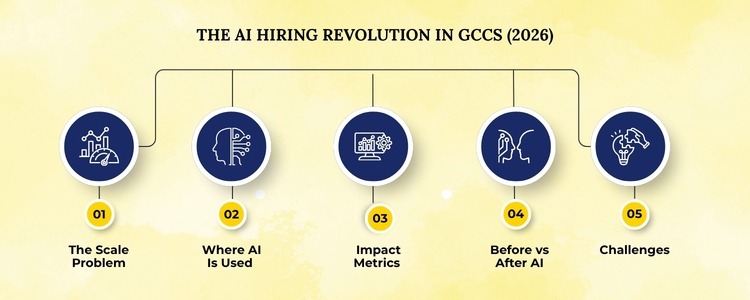
Where AI Is Being Applied in the Hiring Process
Resume screening and candidate shortlisting process
Candidate sourcing
Several Global Capability Centers in India have adopted AI for recruiting to cut their reliance on the use of third-party staffing firms for such skilled jobs. It allows them to create a talent pipeline that will help lower costs in the hiring process of these technical personnel.
Assessments and skills testing tools
Some platforms include behavioral assessments that analyze communication patterns, response consistency, or situational judgment through recorded video responses. These methods provide an additional layer of assessment that goes beyond technical proficiency, which is pertinent for positions requiring cross-functional cooperation or customer involvement.Technical Skills Assessment
AI-driven evaluation of written and spoken language capability. This is especially important for Indian-based offshore delivery centers targeting English-speaking markets in North America, Europe, and Australia.
Cognitive Ability Screening
Tests that are adaptive and evaluate thinking and problem-solving skills. used more often in GCCs for graduate hiring in order to reduce manual review during the initial stages of hiring.
Video responses recorded and analyzed for communication and response clarity. This served as a screening process before conducting actual interviews with the recruitment team.Interview Scheduling and Coordination
Candidate Engagement and Communication
Impact on Offshore Staffing Models in India
The shift is quantifiable. Recruiter-to-requisition ratios have improved by 40–60% in organizations that have implemented AI at scale in their recruitment processes, without a corresponding increase in manpower. This is more than just an increase in efficiency; it’s a structural realignment of hiring outcomes and how recruitment processes function.
Operational Transformation: Before and After
Function
Pre-AI State
Post-AI State
Resume Review
A recruiter’s manual review of each application is prone to bias and inconsistency
Automated ranked shortlisting, recruiter reviews only top-scored candidates
Time to Shortlist
3 to 7 business days for high volume positions, a major bottleneck for offer generation
Same day or next day for standard positions,cycle time advantage is material at scale
Candidate Assessment
Manually scheduled, results collated and interpreted by the hiring team with lag
Automated delivery, machine-scored, reported through integrated dashboards in real time
Recruiter Role
60–70% of time spent on administrative tasks: screening, scheduling, data entry
Shifting from low-value tasks to high-value tasks: candidate experience, stakeholder alignment, offer negotiations
Vendor Dependency
Heavy reliance on staffing agencies for sourcing and screening; cost and control trade-off
Partial reduction through AI-driven direct sourcing and proprietary talent pipeline development
Hiring Analytics
Limited structured data on funnel conversion; decisions made on experience rather than evidence
Real-time dashboards covering source quality, funnel drop-off, offer acceptance, and diversity metrics
Additionally, automation is helping create consistency during early recruiting stages. By using standardized procedures for screening and assessment, it becomes possible to evaluate all applicants based on the same set of criteria.
Challenges Organizations Are Managing
Data Quality and Model Accuracy
Over-reliance on Automated Filtering
Automated screening introduces efficiency but can exclude qualified candidates who do not align with predefined patterns. This is especially important for positions that call for non-linear or transferable experience. To prevent the systematic exclusion of high-potential individuals, periodic human inspection is still essential.
Human Judgment in Final Evaluation
AI technology may save time during the early stages of the evaluation process. However, when it comes to assessing how well a candidate will integrate into an organization’s culture, human analysis remains indispensable.
Candidate Experience in a High-Volume Market
Integration with Existing Systems
What This Means for Global Capability Centers
For Global Capability Centers in India, AI is transitioning from point solutions to an integrated recruitment operating model. Leading companies are implementing AI throughout the entire employment process, from sourcing to offer management, going beyond discrete use cases. Adoption usually takes place in phases. As integration capabilities and confidence in AI outputs grow, most GCCs start with high-impact applications like resume screening and assessments before expanding into more general workflow automation and pipeline management.
This shift has clear competitive With increasing adoption of AI technology, the capability to recruit effectively, reliably, and efficiently is becoming a decisive advantage for offshore service centers. In the context of competing for talent, the speed and quality of the recruitment process can significantly influence the candidate’s experience and employer brand image.
However, adoption is not the only factor that determines results. Organizations are more likely to experience significant benefits if they approach AI as an operational capacity that is backed by robust data quality, system integration, and continuous oversight. Those who use AI technologies without these fundamental components, on the other hand, frequently observe only modest improvements over current procedures.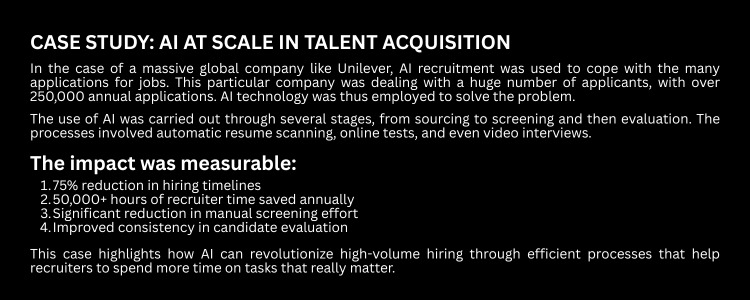
In summary
Faster hiring times, reduced hiring costs, more consistent candidate evaluations, and a quantifiable change in the time spent by recruitment teams are among the results for companies that have implemented these tools. Data quality, interaction with current systems, and the requirement to retain some degree of human judgment in the process are the key obstacles.
frequently asked questions (FAQs)
1.What cost advantages do GCCs in India offer?
2.How do GCCs in India support AI and innovation?
3.What is the future outlook for GCCs in India?
4.What makes India a top destination for GCC expansion?
5.What are Global Capability Centers (GCCs) in India?

Babita Gangwar








Error: Contact form not found. Error: Contact form not found.Subscribe to our Newsletter
Subscribe to our Newsletter