Recent Posts






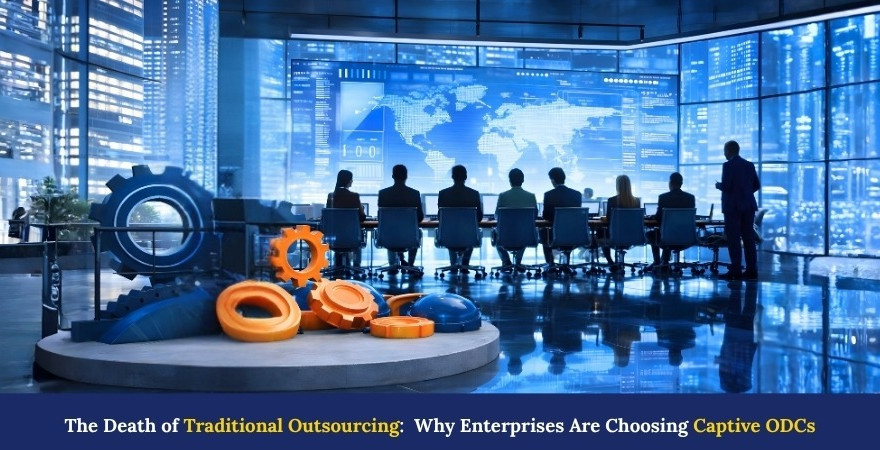
How the global delivery model is changing and why in-house global capability centers are becoming the new strategic imperative for Fortune 500s and high-growth enterprises a like.
The logic was brutally straightforward 20 years ago: locate a third-party vendor in a low-cost nation, give them a scope of work, and pay invoices when deadlines were met. For a generation of businesses, traditional IT outsourcing was adequate because it was transactional by nature. That era is over. These days, captive Offshore Development Centers (ODCs) and Global Capability Centers (GCCs) are taking the place of vendor-based outsourcing agreements for some of the biggest companies in the world, such as JPMorgan Chase, Microsoft, and SAP. These centers are owned and operated by the parent company. These centers are wholly owned and managed by the parent firm and are established in countries where qualified technical staff is available. The core shift: Enterprises are no longer asking These are totally different questions, and as a result, totally different responses will follow. The reasons for this shift are structural, not cyclical. Intellectual property risks, the loss of talent from managed vendor pools, loss of organizational knowledge once the work is done, cultural mismatches, and even the vulnerability of being reliant on someone else for the essential engineering skills have all made outsourcing seem less of an advantage than a disadvantage.
“Offshore Development Center” refers to a remote team consisting of software developers, quality assurance testers, DevOps engineers, product managers, UI and UX designers, and other IT staff. It is established in another country and carries out software development and associated IT tasks on behalf of its parent company. A captive offshore development center extends this model. The enterprise establishes a legal corporation in the offshore site, employs people directly, and oversees all aspects of operations, including hiring, equipment, procedures, and intellectual property. The team is not managed by a third party. Key distinction Offshore Development Center teams are not hired for individual projects. They are established as long-term engineering teams that frequently work for five years or longer. They maintain operational knowledge, align with business procedures, and develop topic expertise over time. Their position within the company is supported by this continuity.
Traditional outsourcing: You give a project to a vendor → vendor assigns a team → they build & deliver → project ends → team may change next time. Captive ODC / GCC You build your own offshore team → hire developers under your brand → manage them daily → they become a permanent extension of your company. Traditional Outsourcing Captive ODC / GCC Key Insight: Despite the traditional approach to outsourcing ensuring fast and cheaper results initially, it ends up being a cycle that generates cost in the future without proper control. On the other hand, the Captive ODC involves an initial investment but guarantees future success as a result of having full control over everything while fostering creativity and growth. The best option comes down to the objectives of the business.
The most significant development of the ODC concept is the emergence of the Global Capability Center (GCC). What once started as a back-office support function has transformed into the intellectual and innovation backbone of global enterprises. Today, India alone has more than 1,800 GCCs, which earn revenue of over $64 billion and employ more than 2.1 million people a clear indication that GCCs are no longer peripheral units but central to global business strategy.
What began as a cost-saving initiative has evolved into a strategic imperative for multinational corporations worldwide.
The GCC evolution has unfolded in four distinct phases: Cost Arbitrage Late 1990s – Early 2000s Basic IT, data entry, call center operations. Pure cost play. Quality & Efficiency 2005–2012 Complex software dev, QA, process optimization. Advanced Analytics & R&D 2013–2020 Data science, AI/ML, core R&D, product engineering. Transformation Hubs 2021–Present Strategic GenAI, global product ownership, enterprise digital transformation leadership. The GCCs’ strategic maturity is shown by the growth of leadership arbitrage. A shift from operational assistance to global leadership impact is seen in the growth from 115 to 5,000+ leadership jobs, with a predicted 20,000 by 2030.
The rise of GCCs and offshore development is a significant worldwide change supported by undeniable scale, investment, and demand. Global IT Outsourcing Market Size (2025) Global Offshore Software Development Market (2024) Projected Offshore Development Market by 2034 Active GCCs in India (2026) Professionals Employed by GCCs in India GCC Revenue Contribution – India FY2024 GCC Revenue Target by 2030 sq ft Office Space Leased by GCCs in India (2024)—+29% YoY New GCCs Prioritizing Digital Capabilities (AI/ML/Cloud) GCC Share of Total India Grade-A Office Demand (2026) New GCCs Established in India (Early 2024 – Late 2026) Global Offshore Development Work Handled by India (2026) It is not about leveraging cost differentials anymore; it is about global capability consolidation. GCCs are increasingly emerging as the main drivers of innovation, talent, and digitalization for companies around the world. The Cost Math: Why Captive ODCs Win Financially Over Time The financial advantage of captive ODCs becomes clear when viewed over the long term. Due to high median compensation, a U.S.-based team of five engineers might cost up to $895,000 annually; in contrast, a comparable captive team in India usually costs about $330,000, resulting in yearly savings of 60–70%. ODCs offer much greater cost efficiency, even when compared to nearshore options like Mexico or Eastern Europe, which only offer 30–55% cost reductions. More significantly, captive ODCs eliminate vendor margins and lower rehiring or ramp-up costs, resulting in a stable and scalable cost structure as opposed to outsourcing models where costs repeat with each project. This increases long-term capabilities and operational continuity while eventually resulting in significant cumulative savings.
The captive delivery landscape is not one-size-fits-all. Enterprises today can choose from four distinct models, each offering a different balance of control, speed, cost, and risk. A captive ODC provides the greatest degree of ownership and control, with the parent company managing all aspects of operations. Although it usually takes from 6 to 12 months to set up, this model is perfect for businesses with long-term growing goals and strong IP protection demands. The Build-Operate-Transfer (BOT) model provides a middle path. The center is initially built and run by a vendor, who eventually gives the parent company complete ownership, often in 18 to 36 months. This works effectively for companies that seek long-term ownership but also require quicker execution. A fully managed ODC is the quickest to start, frequently in a matter of weeks, and all operations are managed by the vendor. This model is more appropriate for startups and businesses with short-term or exploratory needs since, despite its speed and flexibility, it has little control and no ownership. The Hybrid ODC combines elements of both captive and managed models. Non-core activities are managed by vendors, but core functions are kept in-house. For businesses that wish to test offshore capabilities before committing fully, this strategy works effectively. Strategic heuristic: “Partner-run for early-stage firms; with volume and confidence, graduate to BOT or full captive.” (ODC Report, Attention Insight, 2025). For the majority of businesses, the optimum route is BOT to Captive, which leverages the vendor’s operational know-how to increase speed while maintaining the long-term objective of complete ownership.
Today’s enterprises can select from a variety of offshore locations, each of which offers a special combination of strategic advantage, cost effectiveness, and skill. Offshore Captive Destinations Comparison
Intellectual Property Protection In traditional outsourcing, there is much grey area in terms of intellectual property ownership because of the involvement of vendor-led teams. However, for corporations that are working on creating their own proprietary AI, platforms, and technology, this becomes a matter of great risk. In captive ODCs, there is none of that grey area since all teams are led by the corporation itself. Institutional Knowledge Retention One of the most overlooked costs of outsourcing is the loss of institutional knowledge. The knowledge that comes with working on a project becomes lost each time the vendor team leaves. This process will continue to affect the cost and productivity. In-house development teams, however, accumulate the knowledge over time and create strategic value. The AI & Innovation Imperative Strategic innovation cannot be outsourced effectively. GenAI, advanced analytics, cybersecurity architecture, and product experimentation are examples of initiatives that call for teams that are highly aligned with business objectives and have decision-making authority. While captive teams concentrate on results and creativity, vendors concentrate on delivery. Digital capabilities like AI/ML, cloud, and advanced analytics were emphasized by 78% of newly formed GCCs in 2024, indicating a strong trend toward innovation-led mandates. Talent Ownership in a Competitive Market With 74% of organizations citing talent scarcity as a major barrier, access to skilled talent has become a competitive differentiator. Captive ODCs help businesses construct long-term career pathways, attract top personnel, and establish strong employer brands in international tech hubs—all of which are challenging to accomplish with vendor-led models. Long-Term Cost Efficiency Despite the captive’s demand for an initial investment, there are substantial long-term financial advantages. For about $330,000, a five-developer team that would cost close to $895,000 a year in the United States may be run abroad, resulting in significant annual savings. In addition to pay disparities, captives lower onboarding inefficiencies, remove recurrent vendor expenses, and boost overall efficiency.
Will you need this team in 18 months? Outsourcing is most suitable when dealing with short-term projects with well-defined objectives such as MVPs and migrations.Captive ODC/GCC becomes more appropriate when there is a long-term engagement and changing requirements. In case one wishes to engage in offshore development for the first time, a full-fledged or hybrid ODC can be a good choice.Bot Model can be used when immediate speed is needed and ownership is required at a later stage, whereas AI/ML, core technology-related tasks can be outsourced through a captive model.
The Mega GCC Wave By 2030, India is expected to host 2,400–2,550 GCCs, a 30–40% increase from today, with annual revenue crossing $100 billion. Nearly half of the GCC workforce will be employed by these enormous, sophisticated “Mega GCCs,” which will increase from 88 to over 230. GCCs are expected to add $0.5 trillion to India’s gross value added (GVA) over the next 10 years, highlighting their macroeconomic influence. Tier-2 City Emergence As costs and talent competition intensify in Tier-1 metros, governments are offering tax holidays to attract GCCs to Tier-2 cities. Guadalajara in Mexico, Da Nang in Vietnam, and Čódň in Poland are becoming high-potential cities that provide robust talent pools at far reduced rates. AI-Augmented ODC Teams AI is changing how offshore teams are organized. Traditional developers will give way to hybrid positions that integrate engineering, analytics, and AI orchestration in the future. Instead of relying on outside contractors for crucial innovation, businesses that are creating captive teams today are positioning themselves to own and control AI capabilities. The Dual-HQ Model Leading firms are increasingly embracing a dual headquarter approach, whereby decisions are made collaboratively between their global headquarters and GCCs. GCCs are no longer execution centers; they are co-creators of strategy, with ownership of products, platforms, and even global P&L responsibilities.
While traditional outsourcing is still viable, it is gradually losing its position as the standard for significant corporate technology development. A deeper recognition that technology is no longer a support function is reflected in the move toward captive ODCs and Global Capability Centers. It is the business itself. Traditional outsourcing is, however, becoming increasingly irrelevant in terms of serving as the go-to approach to business technology development. The emergence of captive ODCs and GCS demonstrates more than just cost effectiveness; rather, it shows that companies are finally waking up to the fact that technology is no longer merely a supporting function—it is the business itself. Enterprises who identify this early on may find that it is one of the most important choices that shapes their competitive advantage over a decade.
Companies can cut their costs by 30-50% due to the availability of high-quality but inexpensive labor from India. The low cost of property and infrastructure investments also adds to the efficiency of operations. A favorable currency position also assists multinational corporations in managing their expenditures and maximizing benefits. Most significantly, all these economies are achieved without sacrificing quality, innovation, or speed of delivery. India is home to a massive resource pool of skilled professionals in AI and data science, making innovation easier. Over 500 GCCs with an emphasis on AI are available for technologies such as machine learning and GenAI. These GCCs assist firms in developing their own proprietary platforms and IP. .Thus, Indian GCCs are crucial in the context of global AI innovation and transformation. India is expected to have 2,100-2,500 GCCs by 2030 due to high growth. These centers will become more important for international business, innovation, and product development. GCCs will be at the forefront of innovation, including AI, digitization, and decision-making. In general, they will make a significant contribution to India’s economy and international business. India boasts an enormous reservoir of STEM professionals, which allows firms to expand their workforce rapidly. It has a robust digital infrastructure, which fosters innovation and international business. Its cost efficiencies make it extremely effective as opposed to other international destinations. A developed environment in AI, cloud computing, and data science ensures constant innovation and development. Global Capability Centers (GCCs) in India are enterprise-owned hubs that deliver end-to-end services like product development, R&D, AI, and digital transformation. They go beyond traditional outsourcing to drive innovation and business strategy. With a keen analytical mindset and a passion for data-driven insights, Babita Gangwar brings expertise in research, analysis, and strategic evaluation. As a Research Analyst, she focuses on transforming complex data into actionable intelligence that supports informed decision-making. She collaborates across teams to deliver high-quality research outputs, ensuring accuracy, relevance, and impact. Her interests span market research, data analytics, and emerging industry trends. A detail-oriented professional, she actively contributes to knowledge development through reports, presentations, and research initiatives.
1. The Turning Point: Why Traditional Outsourcing Is Losing Ground
2. What Is a Captive Offshore Development Center (ODC)?
Unlike traditional outsourcing, where a vendor owns staffing, tooling, and often the architectural roadmap, in a captive ODC, the parent company manages the backlog, repositories, and daily stand-ups. The offshored team works under the parent company’s Jira system, commits code to their GitHub, and attends their town hall meetings, just like the on-site employees.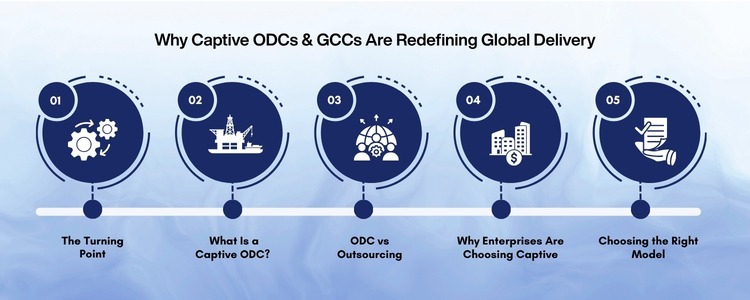
3. ODC vs. Traditional Outsourcing: A Head-to-Head Comparison
4. The GCC Revolution: From Cost Centers to Innovation Engines
1.
2.
3.
4.
5. The Numbers Don't Lie: Market Data & Growth Statistics
$661B
$160.9B
$458.8B
1,800+
2.1M+
$64.6B
$100B+
29.2M
78%
40%
~110
55%
6. Choosing Your Model: Captive, BOT, Managed, or Hybrid?
7. Where the World Builds: Top Offshore Captive Destinations
Country
Key Cities
Strengths
Notable Industries
Workforce Highlights
Weaknesses
India
Bangalalore, Hyderabad, Pune, Chennai
Large talent pool, cost efficiency, strong GCC ecosystem
IT, AI/ML, Product Engineering, BFSI
5M+ tech professionals, 1,800+ GCCs
Talent competition, rising salaries in Tier-1 cities
Poland
Warsaw, Krakow, Wroclaw
EU compliance, strong IP laws, skilled workforce
Analytics, Cybersecurity, Fintech
1.7M+ tech talent
Rising labor costs, high competition
Vietnam
Ho Chi Minh City, Hanoi
Low cost, growing talent pool, government incentives, software Development
Software Dev, Fintech, Digital Transformation
50,000+ IT grads/year
Limited senior talent, evolving regulations
Mexico
Guadalajara, Monterrey, Mexico City
Nearshore to U.S., timezone alignment, trade benefits
IT Services, Product Dev
Innovation Labs Large engineering graduate base
Security concerns, regional skill gaps
Philippines
Manila, Cebu
Strong English skills, cultural alignment, mature BPO sector
Customer Support, IT Services, Finance Ops
1.3M+ BPO/KPO professionals
Infrastructure gaps, natural disaster risks
8. Five Core Drivers Pushing Enterprises Toward Captive Models
9. The Decision Framework: Should You Go Captive?
A captive ODC is nearly always the best option if the response is yes or even likely. Onboarding outsourced teams on a regular basis slows down innovation, erodes institutional expertise, and eventually raises expenses.10. Future Outlook: What 2026–2030 Holds
Conclusion

frequently asked questions (FAQs)
1.What cost advantages do GCCs in India offer?
2.How do GCCs in India support AI and innovation?
3.What is the future outlook for GCCs in India?
4.What makes India a top destination for GCC expansion?
5.What are Global Capability Centers (GCCs) in India?

Babita Gangwar








Error: Contact form not found. Error: Contact form not found.Subscribe to our Newsletter
Subscribe to our Newsletter