Recent Posts







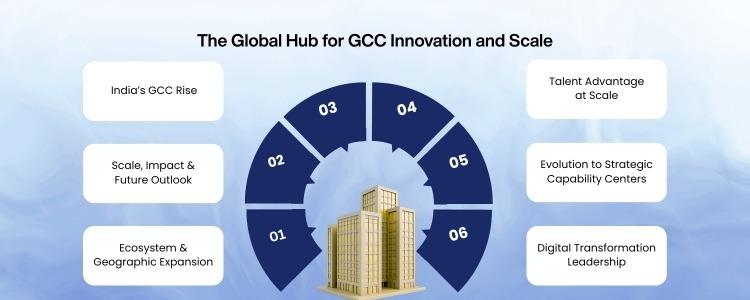
India’s Global Capability Centers no longer measure themselves by cost savings alone. Business impact, AI-led innovation, speed-to-market, and quantifiable ROI are now the performance metrics in 2026. There are currently around 1,800 Global Capability Centers in India, which employ between 1.9 and 2.1 million people and bring in between $65 and $75 billion a year. By 2030, analysts predict the ecosystem will reach 2,100–2,500 centers and will make a significant contribution to the country’s GDP, indicating ongoing robust growth. For example, since its establishment in 1998, Microsoft’s India Development Center has grown to become one of its biggest R&D centers, employing more than 18,000 engineers in ten cities. Similar to this, Amazon has established a significant footprint. Its Hyderabad complex, which spans 9.7 acres and employs about 15,000 people, is the company’s largest office outside of the United States. GCC expansion in India will focus on depth rather than just size. These centers are now in charge of product roadmaps, AI Centers of Excellence, and end-to-end digital initiatives that directly and quantifiably affect the success of international businesses.
India’s most decisive advantage lies in its unparalleled talent engine. The nation produces more than 2 million STEM graduates annually, including 1.5 million engineers, making it one of the world’s largest and most dynamic pools of technological talent. This story explores talent density, where volume matches capability, ambition, and global readiness. Today’s Global Capability Centers (GCCs) in India are strategic innovation centers run by highly qualified experts in advanced product engineering, cloud computing, cybersecurity, artificial intelligence, and data science. Senior executives with worldwide mandates are increasingly in charge of these centers, influencing enterprise-wide strategy and achieving mission-critical results. India offers a rare combination of depth, diversity, and scalability. The impact is already visible. Leading tech firms use India for core innovation as well as support. Cities like Bengaluru and Hyderabad are home to engineering clusters that directly contribute to iconic global products, create next-generation platforms, and advance AI capabilities for global markets.
India’s reputation as a location for offshore development centers (ODCs) that prioritize back-office execution and cost arbitrage is now essentially outdated. What started out as an efficiency and labor-saving approach in the late 1990s has undergone a structural change to become a capability-driven, innovation-led paradigm. Today’s Global Capability Centers (GCCs) represent the next stage of enterprise globalization. GCCs are fully integrated, enterprise-owned hubs that provide end-to-end value across product development, R&D, analytics, and digital transformation, in contrast to old ODCs that functioned as vendor-driven execution engines. This evolution reflects a deeper strategic shift: India-based GCCs now have important responsibilities. They build intellectual property, lead global engineering programs, and drive company-wide transformation efforts. In many For For organizations, these centers are no longer just extensions of their headquarters. They are equal innovation hubs that influence global strategy and decision-making. This transition helps companies move faster and work smarter. By combining product, engineering, and data skills in one place, GCCs provide the following: The new model is showing not only capability but also control and continuity. Companies are no longer sending work to India; they are developing global capabilities from India. This change has turned GCCs into long-term strategic assets. It allows companies to scale innovation, cut down on reliance on outside vendors, and build a lasting competitive edge.
India has emerged as the hub for digital transformation in global organizations, with GCCs not only aiding but spearheading strategic initiatives. They foster GenAI adoption, cloud migration, and data-driven business models on an enterprise-wide scale. They function at the nexus of technology, analytics, and business strategies, facilitating end-to-end transformation. GCCs in India are producing demonstrable returns, speed of innovation, and operational excellence, going well beyond cost efficiency. It represents a definite move away from labor arbitrage toward capability arbitrage. Businesses capitalize on India’s strengths in AI, platform engineering, and digital product innovation. A robust ecosystem, including talent, startups, and technology partnerships, accelerates transformation results. GCCs based in India are now taking charge of global digital imperatives and initiatives. This ensures swift time-to-market and scalable, future-proof solutions. For the enterprise, India is a delivery destination but a transformation engine.
The GCC business model of India is still producing significant gains in economics, achieving a 30 to 50 percent cost reduction compared to established markets. However, the story has moved beyond the mere concept of cost advantage to that of value maximization. Cost arbitrage in India happens on three fronts: talent (30-70% cost savings), real estate, and currency advantages. India allows non-linear scalability, whereby businesses are able to scale up big teams without incurring additional costs. Lower cost is not only about saving; it is about reinvestment and transformation through the leverage gained. Large businesses such as banks and technology companies deploy Indian operations for running their most important processes. Most importantly, the benefit of cost efficiency does not come at the expense of effectiveness and quality. India is the second-biggest source of AI talent in the world, with a booming workforce. An abundance of AI and data-science talent drives innovation in enterprises. There are already more than 500 GCCs specialized in AI/ML, indicating a clear trend towards advanced competencies. GCCs have moved beyond mere delivery organizations to become R&D and product innovation organizations. MNCs have begun to exploit India for building IP, AI platforms, and next-gen digital products. India provides a unique balance of size + expertise in emerging technologies. Well-developed ecosystems (talent, technology clusters, etc.) create a virtuous cycle of innovation. GCCs are increasingly driving global AI-driven transformation efforts rather than simply being involved in them.
India’s GCC environment enjoys solid governmental backing, with numerous state governments offering favorable conditions to lure international companies. India boasts of 1,800+ GCCs, which have created employment for around 2.1 million people. A paradigm shift is happening: more than ~30% of the new GCCs that are being established are in Tier-II and Tier-III cities. These cities are attracting attention owing to their cost advantages (~25%) and improving infrastructure. GCC leasing in Tier-II cities has increased two-fold from ~7% to ~15–20% in FY25, reflecting their rapid adoption. What’s more, more than 60% of India’s college graduates hail from non-metro cities, offering an enormous reservoir of untapped talent. Rising stars such as Jaipur, Coimbatore, and Kochi are now providing talent for jobs in AI, engineering, and digital professions—not just support functions. Tier-II cities also have 10–15% less employee turnover, ensuring a more stable workforce. The government-sponsored initiatives, such as state GCC policies, are also driving the decentralized investment strategy. This strategy not only makes India a resilient but also cost-effective and talent-rich multi-location GCC destination.
In 2026, the pace of technological change demands that organizations move faster than ever. Global Capability Centers in India have the size, speed, and specialized knowledge needed to take the lead in AI, cloud, and next-generation digital projects. They make it possible for “follow-the-sun” operations, continuous cycles of innovation, and the ability to experiment on a large scale, which are all hard to copy in other places. India hosts over 1,800 GCC centers, accounting for more than 50% of all global GCCs. The Indian GCC ecosystem has scaled to enormous economic value, contributing to around $68 billion, or about 1.8% of India’s GDP by 2026. Export earnings have increased to reach $64.6 billion during FY24, which amounts to an annual increase of up to 40%. It is becoming the brainpower behind the success of international businesses. As we move towards 2030, India’s importance in driving the technology and operations of the world through GCSs will continue to increase, ensuring that it remains an integral part of the global business ecosystem.
Companies can cut their costs by 30-50% due to the availability of high-quality but inexpensive labor from India. The low cost of property and infrastructure investments also adds to the efficiency of operations. A favorable currency position also assists multinational corporations in managing their expenditures and maximizing benefits. Most significantly, all these economies are achieved without sacrificing quality, innovation, or speed of delivery. India is home to a massive resource pool of skilled professionals in AI and data science, making innovation easier. Over 500 GCCs with an emphasis on AI are available for technologies such as machine learning and GenAI. These GCCs assist firms in developing their own proprietary platforms and IP. .Thus, Indian GCCs are crucial in the context of global AI innovation and transformation. India is expected to have 2,100-2,500 GCCs by 2030 due to high growth. These centers will become more important for international business, innovation, and product development. GCCs will be at the forefront of innovation, including AI, digitization, and decision-making. In general, they will make a significant contribution to India’s economy and international business. India boasts an enormous reservoir of STEM professionals, which allows firms to expand their workforce rapidly. It has a robust digital infrastructure, which fosters innovation and international business. Its cost efficiencies make it extremely effective as opposed to other international destinations. A developed environment in AI, cloud computing, and data science ensures constant innovation and development. Global Capability Centers (GCCs) in India are enterprise-owned hubs that deliver end-to-end services like product development, R&D, AI, and digital transformation. They go beyond traditional outsourcing to drive innovation and business strategy. With a keen analytical mindset and a passion for data-driven insights, Babita Gangwar brings expertise in research, analysis, and strategic evaluation. As a Research Analyst, she focuses on transforming complex data into actionable intelligence that supports informed decision-making. She collaborates across teams to deliver high-quality research outputs, ensuring accuracy, relevance, and impact. Her interests span market research, data analytics, and emerging industry trends. A detail-oriented professional, she actively contributes to knowledge development through reports, presentations, and research initiatives.
1. Access to World-Class Talent at Scale
2. Evolution Beyond Traditional Offshore Development Centers India
3. India as Premier Digital Transformation Hubs
4. Cost-Value Equation That Still Delivers
5. Supportive Ecosystem and Geographic Diversification
6. Strategic Imperative in an AI-First World

frequently asked questions (FAQs)
1.What cost advantages do GCCs in India offer?
2.How do GCCs in India support AI and innovation?
3.What is the future outlook for GCCs in India?
4.What makes India a top destination for GCC expansion?
5.What are Global Capability Centers (GCCs) in India?

Babita Gangwar









Error: Contact form not found. Error: Contact form not found.Subscribe to our Newsletter
Subscribe to our Newsletter