Recent Posts







Global Capability Centers (GCCs) are offshore delivery centers owned and operated by multinational companies. They manage important tasks like customer service, technology, finance, and analytics. These facilities provide access to qualified experts in several areas and help with cost reduction. The scale of Global Capability Centers (GCCs) has increased significantly over the past decade. India now hosts over 1,800 GCCs, representing 55% of the global total. These centers employ 20 million professionals and generate Rs. 5,72,873 crore (US$64.6 billion) in export revenue as of FY25. In total, the GCC sector supports 10.4 million jobs, with average salaries 25 to 30% higher than the national average. The approach is applicable globally in Southeast Asia, Latin America, Eastern Europe, and India. This spread facilitates operations across time zones 24/7. Dependence on Global Capability Centers (GCCs) carries particular dangers during uncertain economic times. These have to do with workforce volatility, cost structures, and regulatory frameworks. When market conditions tighten, senior executives at global corporations keep a careful eye on these risks to safeguard performance and preserve consistent outcomes. Reliance on Global Capability Centers (GCCs) offers unique risks specific to cost structures, labor instability, and regulatory environments during uncertain economic times.
Companies frequently set up Global Capability Centers (GCCs) to control expenses. Economic instability impacts wage fluctuations, currency exchange, and local operating costs. Between 2021 and 2023, some Global Capability Centers (GCCs) in India saw a rise in operational costs due to wage growth in engineering and digital positions. According to industry reports from NASSCOM, compensation for specialized digital skills like cloud, data engineering, and cybersecurity rose by 8% to 15% every year throughout this time. This trend has an impact on anticipated savings for multinational corporations in industries like financial services and technology. Currency fluctuations also impact cost structures. For example, depreciation or appreciation of the Indian rupee against the US dollar directly affects operating expenses for companies managing Global Capability Centers (GCCs) in India. When businesses rely on a small number of locations, they also face risks related to cost optimization. Over 55% of the world’s Global Capability Centers (GCCs) are based in India, making it more vulnerable to changes in location-specific costs. Modifications to tax laws or the removal of incentives may directly impact cost models. For example, some firms’ effective tax costs increased as a result of changes to India’s special economic zone incentives. To effectively manage cost optimization risks, organizations must frequently assess their cost assumptions and match them with the state of the market.
In Global Capability Centers (GCCs), workforce instability is a continuous problem. Even during economic downturns, there is still a significant need for talent in fields like data, cybersecurity, and cloud services. Between 2021 and 2023, when demand was at its highest, attrition rates in Global Capability Centers (GCCs) in India varied from 18 to 25 percent. In several firms, attrition in specialized digital roles was more than thirty percent. Delivery schedules suffered, reliance on contract employment grew, and total recruitment expenses climbed as a result. In certain GCC centers, the hiring process for specialist positions like data engineers and cybersecurity experts now takes 60 to 90 days. This affected service continuity and caused delays in project execution. Due to regional market limitations and rivalry from multinational corporations, the need for technology skills in Poland and other Eastern European countries raised hiring prices by 10 to 20 percent. Economic uncertainty can also lead to hiring controls or restructuring. Restructuring or employment restrictions may also result from economic uncertainty. Some companies cut recruiting by 15 to 25 percent during slowdowns, which resulted in capability shortages when demand rebounded. Operational continuity suffered, and current teams faced increased workloads as a result. Workforce volatility also influences knowledge retention. Frequent employee migration leads to loss of subject expertise, requiring more expenditure in training and transition. Companies need systematic workforce planning, retention initiatives, and internal mobility methods to address workforce instability within Global Capability Centers (GCCs).
“Operational concentration” describes a situation in which critical business functions a single location or a limited number of Global Capability Centers (GCCs) handle. This involves managing several activities from a single main hub, including finance operations, IT services, analytics, and customer care. Any disturbance in a location where operations are concentrated can immediately impact several business functions. Lockdowns, infrastructure malfunctions, legal limitations, and geopolitical concerns disrupt these systems. For example, lockdowns during the COVID-19 epidemic caused restrictions for numerous Global Capability Centers (GCCs) in Eastern Europe and India. Restricted access to offices, connectivity issues, and reliance on physical infrastructure impacted service delivery in financial and technology operations. We refer to the ability of a company to continue essential operations both during and after a disruption as business continuity. Even in cases where primary locations are affected, it guarantees that essential services continue with the least amount of disruption. When business continuity plans are incomplete, operational concentration raises risk. Organizations may experience delays, service interruptions, and financial consequences if backup locations, remote working capabilities, or alternate delivery methods are not in place.
In times of economic turmoil, local regulatory frameworks can change for Global Capability Centers (GCCs). These include data protection regulations, tax laws, and labor laws. Organizations in India had to adjust their data processing and storage procedures due to changing data governance regulations. This required system modifications and raised the cost of compliance. Organizations need to monitor changes in regulations and ensure they comply with both domestic and international standards. Penalties, reputational damage, and operational delays may follow noncompliance.
Economic uncertainties directly impact the provision of services in Global Capability Centers (GCCs). Budget cuts and cost limitations may restrict operational capacity and have an impact on how various functions are carried out. Staff reductions, postponed technology investments, and reduced training expenditures might lead to slower response times and higher error rates. These modifications strongly impact delivery consistency, particularly in large volume and time-sensitive activities. During times of cost reduction, a number of shared service operations in the banking and financial services industry observed delays in transaction processing and reconciliation tasks. In certain instances, staffing shortages and technical limitations caused processing backlogs to increase. Performance particularly affects functions that require specialized abilities and real-time execution. Delays in system updates and restricted access to qualified personnel can lower productivity and impact your service results. Even during times of cost restriction, maintaining service delivery necessitates ongoing attention to labor competency, process efficiency, and system reliability.
As Global Capability Centers (GCCs) grow in size, risk management frameworks must also change. Organizations should build governance structures that allow visibility into performance, cost, and risk metrics. Frequent evaluations, audits, and scenario planning aid in the early detection of any problems. Diversifying across sites and roles can improve resilience. Integrate risk management into the overall operating strategy rather than manage it as a separate function.
To manage key finance activities, a multinational financial services company developed its Global Capability Center (GCC) in India. Reporting deadlines were impacted by increased attrition during a time of worker instability. To stabilize operations, the corporation invested in training programs and raised wages. During the COVID-19 pandemic, a global technology company with a centralized Global Capability Center (GCC) experienced service interruptions. Later, to lower the danger of operational concentration, the company implemented a multi-location approach.
Global delivery models continue to rely heavily on Global Capability Centers (GCCs). During economic uncertainty, firms incur risks connected to labor instability, cost optimization risks, operational concentration, and regulatory changes. A disciplined approach to risk management, supported by personnel planning and site diversification, helps sustain continuity and performance.
Hyderabad, Bangalore and Pune have become significant pharma innovation centres with global delivery centres of major biotechnological and pharmaceutical firms such as Novartis, Pfizer, AstraZeneca and GSK. They offer an economic benefit of calculation, a variety of scientific and technical human resources, and speedy time-to-market. On average, businesses reduce between 25-40 percent of the operational costs and increase the rate of innovation. The next-generation operations of Pharma GCC focus on advanced molecular modelling, AI/ML-based drug discovery, cloud supercomputing, and data integration platforms, as well as quantum-ready simulations. Pharma GCCs use AI to screen molecules, predict the efficacy of drugs, optimise clinical trials and aid in making data-driven decisions, resulting in smarter, faster and safer drug pipelines. Pharma GCCs will be global innovation ecosystems that are a combination of computational chemistry, generative AI, and quantum computing. They will turn into the hubs linking data science, discovery and regulatory intelligence in the global arena. Aditi, with a strong background in forensic science and biotechnology, brings an innovative scientific perspective to her work. Her expertise spans research, analytics, and strategic advisory in consulting and GCC environments. She has published numerous research papers and articles. A versatile writer in both technical and creative domains, Aditi excels at translating complex subjects into compelling insights. Which she aligns seamlessly with consulting, advisory domain, and GCC operations. Her ability to bridge science, business, and storytelling positions her as a strategic thinker who can drive data-informed decision-making.
Changing Cost Structures and Cost Optimization Risks
Workforce Instability and Talent Supply
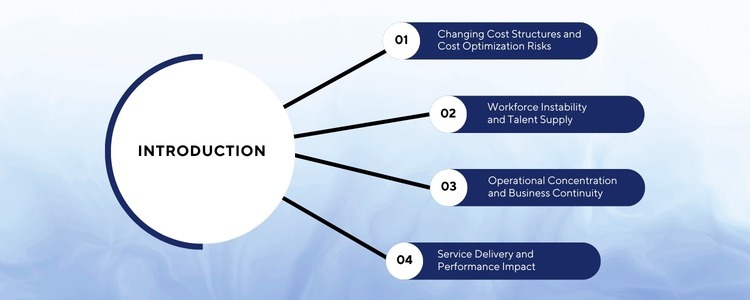
Operational Concentration and Business Continuity
Regulatory and Compliance Exposure
Service Delivery and Performance Impact
Risk Management Considerations
Real Life Examples
Conclusion
frequently asked questions (FAQs)
1.Who are the Pharma GCC development leaders in India?
2.Which economic benefits do Pharma GCCs have?
3.Which technologies are influencing Pharma GCC operations nowadays?
4.What is the role of AI in Pharma GCC processes?
5.How will Pharma GCCs look in five years to come?

Aditi









Error: Contact form not found. Error: Contact form not found.Subscribe to our Newsletter
Subscribe to our Newsletter