Recent Posts







In today’s fast-changing business environment, companies are continuously searching for methods to increase efficiency, cut expenses, and access international talent. The Global Capability Center (GCC) is one model that has been very popular in the past ten years. A Global Capability Center is not merely a support office; it serves as a strategic extension of a company that drives innovation, technology development, and business expansion. This blog breaks it down step by step, from setup to scaling, with real-world insights.
Global Capability Centers (GCCs), which can also be known as captive centers, shared service centers, or global in-house centers, are fully owned and integrated facilities that are strategically positioned in areas abundant with talent. GCCs help organizations in developing a range of capabilities, enhancing operational efficiency, and accelerating significant growth. India has more than 1,700 Global Capability Centers (GCCs) and plans to reach 2,200 by 2030. India has 1.5 million engineers available each year in cities like Bengaluru, Hyderabad, Pune, and Chennai, combining scale; expertise in AI, cloud, and cybersecurity; and developed ecosystems.
In the early 2000s, Global Capability Centers (GCCs) were “captive centers” for IT support and finance. They have developed into strategic assets by 2025.
Location India leads as the top GCC destination—1,700+ centers, 1.5 million engineers annually, and 40–60% cost savings versus the US or Europe. Tier 1 cities like Bengaluru and Hyderabad suit complex tech functions, while Tier 2 cities like Pune and Coimbatore offer lower costs and better retention. The right city depends on what function you are building and what talent it needs. Operating Model Organizations can choose from fully captive, hybrid, or Build-Operate-Transfer (BOT) models depending on their control needs and speed of setup. CoEs focus on specific domains like AI or cloud to drive deep innovation. Most companies start flexible and move toward full ownership as operations mature. Governance Strong governance is what separates a strategic GCC from a glorified cost center. Clear decision rights, leadership accountability, and value-driven KPIs — like innovation output and time-to-market — keep the GCC aligned with global headquarters. Without strong governance, teams drift, duplicate work, and quickly lose their strategic relevance.
Hiring Talent India provides GCC nations a unique advantage with one of the largest talent pools in the world and an annual entry of over 1.5 million engineers. This phase promotes quick expansion, especially in high-impact industries like artificial intelligence, cloud computing, and cybersecurity. An infrastructure strategy that prepares for the future—cloud, cybersecurity, and worldwide connectivity from the start—is essential. Leadership success is defined by strong leadership, which begins with alignment at headquarters and moves to local ownership. A competent GCC Head connects local execution with global strategy. Local leadership eventually generates independence and long-term effects.
Engineering and IT The majority of engineering work takes place in the center of a GCC. India’s excellent and reasonably priced engineering skills make it a favored choice. For this reason, businesses can increase overall profitability and efficiency and achieve ~30% faster time-to-market. It serves as the foundation for both digital transformation and product development. Finance / HR Automating repetitive operational procedures is the main goal of finance and HR. Automation can increase cost efficiency by 40–50%. We decrease payroll, invoicing, and reporting errors. Teams are able to transition to more strategic company positions as a result.
Metrics and ROI Traditional measurements like 20–30% ROI and ~90% stability do not capture the full value of GCC. Advanced GCCs with improved performance frameworks report ROI that is 2-3 times greater. 10 – 30% of enterprise innovation pipelines come from leading centers. Workforce Stability Annual attrition alone does not accurately reflect the actual condition of the workforce. Infant attrition (0–6 months) and regretful attrition (loss of top talent) are important measurements. GCCs using internal talent mobility reduce hiring time by 30–40%. Additionally, they outperform external hiring in terms of retention by up to two times. A strong talent strategy directly impacts stability, quality, and long-term scale. Future-Proofing: Right now, almost 92% of GCC countries are testing or expanding AI projects. But more than 70% lack frameworks to assess the impact of AI, which poses a concern. The difference between ambition and accountability slows the realization of real value. By 2030, we will utilize AI, edge, and ESG-led innovation to assess GCCs. Future-ready GCCs will define enterprise growth, not just efficiency.
Talent: India produces higher numbers of engineers in any other nation, at 1.5 million annually. As a result, businesses have access to a large and growing talent pool. The majority of professionals have international training and speak English. Expertise in in-demand fields like cybersecurity, cloud computing, and artificial intelligence is also expanding. Ecosystem: Government initiatives like PLI programs, SEZ perks, and 100% FDI allowance promote India’s robust business environment. Global businesses find it easier and more attractive to invest as a result. Cities with strong IT hubs include Bengaluru, Hyderabad, and Pune. These cities offer worldwide innovation networks, tech parks, and startups. Maturity: India is no longer an emerging GCC destination—it is already well established. Currently, around 1,700 GCCs are active in India. These centers support businesses from the US, UK, Japan, and other international markets. India has high operational maturity and proven delivery with more than 20 years of expertise. By 2030, the GCC market in India is projected to grow to $100 billion. It is therefore among the fastest-growing international commercial prospects. Today’s businesses establishing GCCs are doing more than merely cutting expenses. They are gaining a sustained edge in growth and innovation.
Risks: Key Metrics: Insight:
Global Capability Centers (GCCs) will take the lead in sustainability, AI, and GenAI by 2030. Businesses will use hybrid strategies that combine growing hubs like Poland and Vietnam with India. GCCs are becoming strategic hubs for innovation rather than just cost-effectiveness. A solid plan-build-operate-scale strategy and utilizing India’s talent advantage are essential for success. To stay competitive, organizations must prioritize innovation, intellectual property, and adaptability.
Global capability centers are now an essential part of modern company operations. They allow businesses to operate more effectively, develop more quickly, and scale with ease using worldwide talent, advanced technology, and simplified procedures.
Hyderabad, Bangalore and Pune have become significant pharma innovation centres with global delivery centres of major biotechnological and pharmaceutical firms such as Novartis, Pfizer, AstraZeneca and GSK. They offer an economic benefit of calculation, a variety of scientific and technical human resources, and speedy time-to-market. On average, businesses reduce between 25-40 percent of the operational costs and increase the rate of innovation. The next-generation operations of Pharma GCC focus on advanced molecular modelling, AI/ML-based drug discovery, cloud supercomputing, and data integration platforms, as well as quantum-ready simulations. Pharma GCCs use AI to screen molecules, predict the efficacy of drugs, optimise clinical trials and aid in making data-driven decisions, resulting in smarter, faster and safer drug pipelines. Pharma GCCs will be global innovation ecosystems that are a combination of computational chemistry, generative AI, and quantum computing. They will turn into the hubs linking data science, discovery and regulatory intelligence in the global arena. Aditi, with a strong background in forensic science and biotechnology, brings an innovative scientific perspective to her work. Her expertise spans research, analytics, and strategic advisory in consulting and GCC environments. She has published numerous research papers and articles. A versatile writer in both technical and creative domains, Aditi excels at translating complex subjects into compelling insights. Which she aligns seamlessly with consulting, advisory domain, and GCC operations. Her ability to bridge science, business, and storytelling positions her as a strategic thinker who can drive data-informed decision-making.
What Is a Global Capability Center (GCC)?
The Development of Global Capability Centers (GCCs)
Phase 1: Plan—Strategy and Location
Phase 2: Build – Setup and Talent Acquisition
However, speed isn’t everything because the first few recruits define culture, quality, and reliability. Making the correct recruiting decisions early on is crucial because it establishes credibility and momentum.
India’s robust tech sector facilitates innovation and deployment. Early spending provides smooth scalability and prevents problems down the road.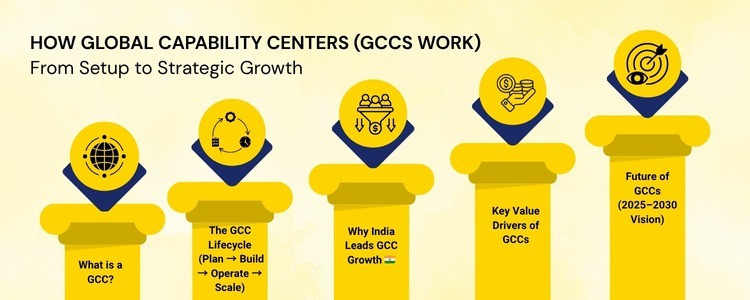
Phase 3: Operate – Day-to-Day Execution
Data and AI: AI and data teams use automation to manage high-volume, repetitive operations. This significantly improves operational accuracy, speed, and efficiency. Teams can concentrate on higher-value tasks as a result of the decreased manual labor. This eventually leads to more intelligent systems and improved decision-making.
R&D The goal of R&D is to create new products and capacities that are ready for the future. Through fast iteration and experimentation, it facilitates ongoing innovation.
Global teams may operate nearly around 24/7, accelerating development processes. Here, we generate IP and a long-term competitive advantage.
Phase 4: Scale – Optimization and Innovation
Metrics such as cycle time, business impact, and innovation throughput should be prioritized. These determine whether a GCC is a growth engine or a cost center.India's Edge for Global Capability Centers (GCCs)
Challenges and Success Metrics for GCCs
Leading Global Capability Centers (GCCs) involve leadership from the beginning and focus on tracking innovation outcomes.
The Future of Global Capability Centers (GCCs)
Conclusion & CTA
GCCs will become even more important as companies enter new markets. In today’s fast-paced, digital-first world, organizations who invest in creating robust, future-ready GCCs will have an additional benefit.
frequently asked questions (FAQs)
1.Who are the Pharma GCC development leaders in India?
2.Which economic benefits do Pharma GCCs have?
3.Which technologies are influencing Pharma GCC operations nowadays?
4.What is the role of AI in Pharma GCC processes?
5.How will Pharma GCCs look in five years to come?

Aditi









Error: Contact form not found. Error: Contact form not found.Subscribe to our Newsletter
Subscribe to our Newsletter