Recent Posts







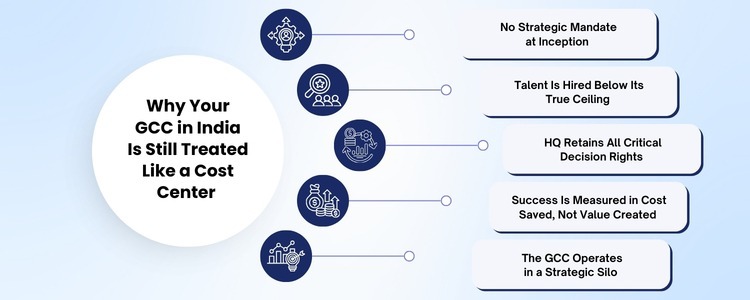
The managing director of a mid-sized European bank’s India center had flown his top engineers to Amsterdam to present a new fraud-detection architecture they had spent eight months building. The global CTO listened politely. Then, near the end of the session, he asked whether the team could also help clear a backlog of testing tickets piling up in the queue. The MD flew home with one question that had no good answer: after six years and 1,400 people, why did Headquarters still think of Bengaluru as a place that runs tests? That question is now the defining anxiety of India’s GCC moment. The country hosts over 1,700 global capability centers employing nearly 1.9 million people, according to NASSCOM’s 2024 GCC Landscape Report. The problem is not capability. It is identity—and the incentives and internal politics that keep locking Indian operations into execution rather than ownership. Start with how GCCs are measured, because that tells you everything about how they behave. Most centers are evaluated on cost per FTE, attrition rates, SLA adherence, and headcount growth. When leadership in Houston or Frankfurt asks the India center for a quarterly review, the slides fill up with efficiency ratios and delivery timelines. Nobody in the room has built a framework to measure how many enterprise problems the India team actually solved or how many product decisions were shaped by insights that came from Pune rather than Palo Alto. The measurement architecture manufactures the identity it claims to be tracking. This phenomenon is not an accident. Most GCCs were set up in the 2000s and early 2010s as arbitrage plays: high-quality engineering and finance talent at a fraction of the cost of equivalent work in the US or Europe. The centers delivered on that promise, and the parent company got comfortable. Then talent costs rose, the rupee moved, and many companies never explicitly updated the mandate. So the GCC continued doing what it had always done—now at a slightly higher cost, with slightly more restless talent, and with a charter that had not been revisited since Obama’s first term.
Deloitte’s 2023 Global Capability Centers survey found that while 67 percent of GCC leaders described their mandate as “strategic,” only 28 percent of their parent company counterparts agreed. That gap is not a communication problem. It is a governance problem. The India center has one definition of its role; the parent has another; and neither side has had the uncomfortable conversation required to resolve the difference. What fills that vacuum is politics. The GCC MD spends energy managing up to a global function head who sees India as a cost line. The engineering lead in Austin guards product ownership jealously because she learned, years ago, that crediting the India team publicly means answering for their mistakes privately. The result: India works and does not own the narrative of the work. “The fundamental issue is that GCCs were designed to be dependent, and dependency became culture,” says Keshav Murugesh, former group CEO of WNS Global Services. “You cannot fix that with a town hall. You fix it by changing what decisions sit where.” When the India center has no budget authority, no customer-facing mandate, and no seat in the product roadmap conversation, it cannot behave like anything other than an execution center — regardless of the talent sitting inside it. Some GCCs have made the transition. Walmart Global Tech, Goldman Sachs Bengaluru, and Citi’s India technology hub run engineering for genuinely global systems, not just support functions. NASSCOM and McKinsey have both documented a subset of centers — roughly 15 to 20 percent by most estimates — that now operate with real product ownership. But that figure also means 80 to 85 percent have not made it, which demands an honest accounting of why. The companies that crossed over share a few uncommon traits. They assigned a global product leader — not a regional one — to be based in India for at least two years. They tied the India center’s budget to business outcomes, not to headcount. And they gave the India leadership team the authority to say no: to decline low-value work and to escalate mandate gaps directly to the global CEO without routing through three layers of functional management first. Every one of those changes required the parent company to give up something it was used to keeping. The talent market is making this urgent in ways that spreadsheets do not yet fully capture. A 2024 report by Aon and People Matters found that GCC attrition in technology roles averaged 18 to 22 percent annually, with the primary reason cited as “lack of meaningful work” — not compensation. The engineers leaving are joining Indian product startups or building their own. A GCC that cannot fix its identity problem will find that the market fixes it another way, through talent flight that is slow enough to deny and fast enough to be fatal. The MD who flew home from Amsterdam did not have a capability problem. He had a mandate problem — and mandate problems do not resolve through better decks or more polished quarterly reviews. The fix requires one thing most GCC leaders are reluctant to demand: an explicit renegotiation of the center’s operating charter with the global CEO, not the regional function head. That conversation needs to cover three things. What decisions does India own, not advise on? What business outcomes is India accountable for, not just contributing to? And what authority does India’s leadership have when the center’s capabilities are being underused? The alternative — another six years of testing tickets and polite Amsterdam meetings — is a far more expensive kind of comfortable.
Most GCCs in India are structured around headcount, hourly output, and operational savings — metrics that define cost centers. When leadership measures success by how much money is saved rather than what value is created, the GCC stays locked in a support role. The fix starts with shifting KPIs from cost reduction to business impact: revenue influenced, innovation delivered, and strategic decisions enabled. A cost center GCC handles delegated tasks, follows instructions from the parent company, and reports on efficiency. A value center GCC owns outcomes, drives product or technology decisions, and contributes directly to business growth. The shift isn’t just operational — it requires giving India-based teams decision-making authority, not just execution responsibility. Start by aligning the GCC’s work to P&L outcomes, not just SLA compliance. Present business cases in the language of revenue, speed to market, and competitive advantage — not FTE counts or cost savings. GCC leaders who speak the CFO’s language and the CEO’s priorities are far more likely to be treated as strategic partners than as offshore support functions. Significant. Cost center GCCs tend to hire for execution; value center GCCs hire for ownership. Repositioning requires investing in senior technical and domain leadership in India — people empowered to set direction, not just follow it. When the GCC has credible, visible leaders with global mandates, the “remote team” perception starts to break down. There’s no single timeline, but most organizations see meaningful progress within 12–24 months when the transformation is intentional. Quick wins come from identifying 2–3 areas where the GCC can take end-to-end ownership and demonstrating measurable impact. Sustained transformation requires structural changes: governance models, reporting lines, and leadership investment that signal long-term strategic intent. With multifaceted experience in Legal, Advisory, and GCCs, Yashasvi weaves law, business growth, and innovation. He leads a cross-functional team across legal, marketing, and IT to drive compliance and engagement. His interests span Law, M&A, and GCC operations, with 15+ research features in Forbes, ET, and Fortune. A skilled negotiator, he moderates webinars and contributes to policy forums.

frequently asked questions (FAQs)
1.Why is a GCC in India still considered a cost center instead of a value center?
2.What's the difference between a GCC cost center and a GCC value center?
3.How can GCC leaders change the cost center perception internally?
4.What role does talent strategy play in repositioning a GCC in India?
5.How long does it take to transform a GCC from a cost center to a strategic hub?

Yashasvi Rathore










Error: Contact form not found. Error: Contact form not found.Subscribe to our Newsletter
Subscribe to our Newsletter