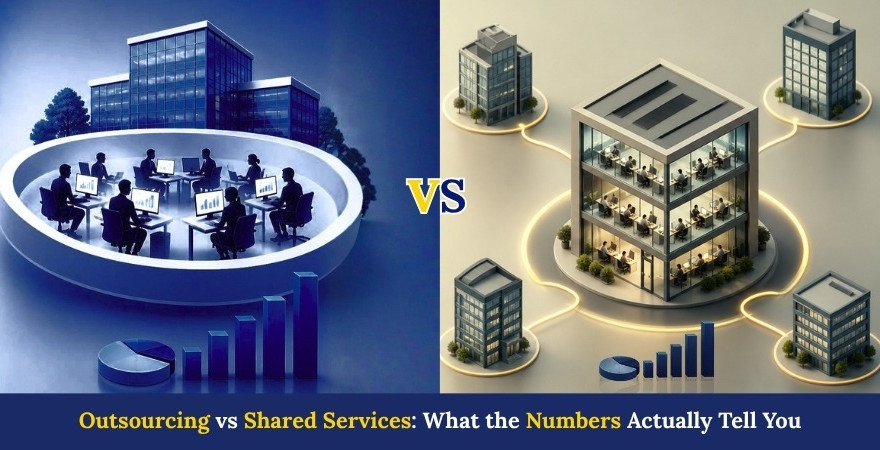
Outsourcing has evolved into a global phenomenon worth $731 billion in 2023 and expected to hit the $1 trillion mark by 2030. Similarly, shared service centers have become the backbone of operations for most multinational corporations, with estimates indicating that 82% of Fortune 500 companies now run at least one.
Yet the decision between outsourcing vs. shared services remains poorly understood at the executive level, often reduced to a cost conversation when the real variables are control, risk, and long-term organizational capability.
This piece sets out what the data shows, where each model breaks down, and what actually determines which service delivery model fits your organization.
$731B
Global outsourcing market size |
82%
Fortune 500 companies with a shared service center |
40%
Average cost reduction reported by mature SSC operations |
The outsourcing definition commonly used by financial and operational managers is simple – another company assumes responsibility for a particular function, employs its personnel, and produces a certain outcome according to an agreement. The firm pays for outcomes, not people.
In practice, outsourcing is most prevalent in IT service provision, business process administration, payroll, and customer processes. The process usually operates outside the entity of the firm. Governance in this case is achieved by using service-level agreements. It is critical to note that this factor affects the speed at which changes may be achieved in case of variations in process requirements or quality.
“What the data shows on outsourcing costs: Based on an industry study on 200 outsourcing agreements made by large enterprises, savings of 15 to 30% in the first two years were usual. After the fifth year, 43% of the contracts underwent scope creep and resulted in losses exceeding 60% of the savings from year one. Renegotiating the contract costs around $4.2 million per agreement.”
Outsourcing works best if the process truly is non-core, measurement is easy, and there is sufficient discipline to manage the contracts for several years. If these factors are not present, then the cost rationale starts to fall apart.
When measuring outsourcing vs. shared services on cost alone, the answer depends on the time horizon. Outsourcing is nearly always less expensive within the first 18 months. The company avoids capital expenditures on hiring and infrastructure, while the provider covers transition costs.
This changes for periods beyond 24 months. According to the 2022 Shared Services and Outsourcing Survey, mature SSCs with operations exceeding three years noted cost savings of 37%, while outsourcing organizations at the same period were only able to achieve 22%. The main reason for this is the ability to control process ownership. Unlike outsourcing arrangements, where change orders have to be negotiated, SSC operators can redesign processes.
Quality and error rates: According to a 2022 research study of 350 shared services centers, SSCs providing financial and accounting transactions experienced an average rate of 0.8% errors per transaction volume. This is compared to the 2.1% rate in outsourced finance transactions. This discrepancy can be attributed to the challenges faced by outsourced providers in maintaining employee tenure and understanding the business environment.
Compliance and Data Control
1. Why Shared Services are better
- Data stays inside the company
- Easier to follow rules and regulations
- Audit records are complete and clear
- The company has full control and responsibility
2. Problems with Outsourcing
- Data is handled by a third party
- Need extra contracts to protect data
- Requires regular monitoring and audits
- Increases cost and management effort
- Real-world risk example
- In some cases (GDPR laws in Europe)
- Both the company and the outsourcing vendor were responsible for the data issues
- Companies had to pay around €3.8 million on average
frequently asked questions (FAQs)
1.
What cost advantages do GCCs in India offer?
Companies can cut their costs by 30-50% due to the availability of high-quality but inexpensive labor from India. The low cost of property and infrastructure investments also adds to the efficiency of operations. A favorable currency position also assists multinational corporations in managing their expenditures and maximizing benefits. Most significantly, all these economies are achieved without sacrificing quality, innovation, or speed of delivery.
2.
How do GCCs in India support AI and innovation?
India is home to a massive resource pool of skilled professionals in AI and data science, making innovation easier. Over 500 GCCs with an emphasis on AI are available for technologies such as machine learning and GenAI. These GCCs assist firms in developing their own proprietary platforms and IP. .Thus, Indian GCCs are crucial in the context of global AI innovation and transformation.
3.
What is the future outlook for GCCs in India?
India is expected to have 2,100-2,500 GCCs by 2030 due to high growth. These centers will become more important for international business, innovation, and product development. GCCs will be at the forefront of innovation, including AI, digitization, and decision-making. In general, they will make a significant contribution to India’s economy and international business.
4.
What makes India a top destination for GCC expansion?
India boasts an enormous reservoir of STEM professionals, which allows firms to expand their workforce rapidly. It has a robust digital infrastructure, which fosters innovation and international business. Its cost efficiencies make it extremely effective as opposed to other international destinations. A developed environment in AI, cloud computing, and data science ensures constant innovation and development.
5.
What are Global Capability Centers (GCCs) in India?
Global Capability Centers (GCCs) in India are enterprise-owned hubs that deliver end-to-end services like product development, R&D, AI, and digital transformation. They go beyond traditional outsourcing to drive innovation and business strategy.
Babita Gangwar
With a keen analytical mindset and a passion for data-driven insights, Babita Gangwar brings expertise in research, analysis, and strategic evaluation. As a Research Analyst, she focuses on transforming complex data into actionable intelligence that supports informed decision-making. She collaborates across teams to deliver high-quality research outputs, ensuring accuracy, relevance, and impact. Her interests span market research, data analytics, and emerging industry trends. A detail-oriented professional, she actively contributes to knowledge development through reports, presentations, and research initiatives.