Recent Posts






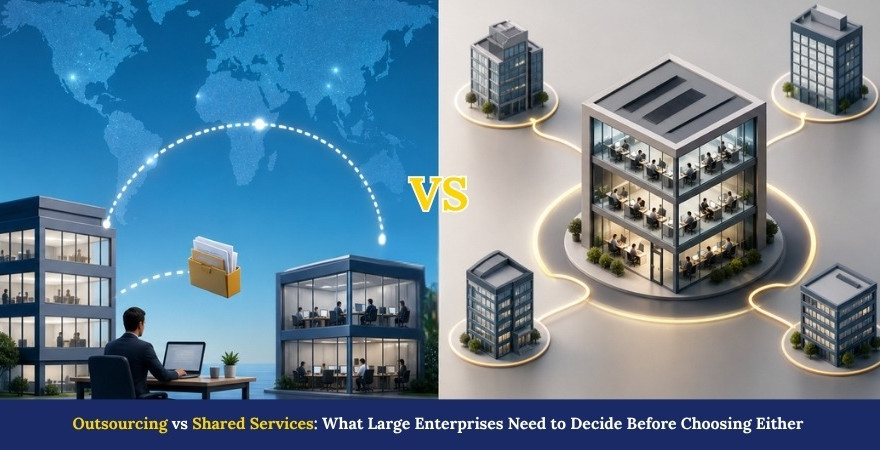
When organizations seek to reduce fixed costs and improve operational efficiency, two models are typically considered: shared services and outsourcing. According to the Shared Services and Outsourcing Network (SSON), the primary drivers for adoption include improving operational efficiency and reducing costs (90%), enhancing service quality and delivery (73%), and enabling measurable outcomes (63%). Every organization reaches a point where its support functions stop keeping pace with growth. Finance teams in separate divisions work on the same tasks with no shared process. IT requests pile up because there is no central point of contact. Procurement happens independently across business units with no visibility into total spend. At this stage, two options usually come up: either hire an outside supplier through outsourcing or create a shared service center to consolidate certain services internally. Although both strategies address the same operational issue, they do so in fundamentally different ways and have distinct long-term effects.
A shared service center refers to a business unit located in one place that provides support services for various business divisions. A shared service center works like any other service provider and has set processes, performance metrics, and accountability structures. What distinguishes a shared service center from a standard corporate department is how it operates. A shared services center is managed through a service delivery arrangement with the operating divisions it serves, measures results, and is expected to enhance its operations continuously. It works more as a business rather than a cost center. Global Capability Centers (GCCs) represent the most advanced form of this model. There are over 1,800 GCCs in operation across the globe, which generate over $64 billion in income and employ nearly 2.1 million people. Almost half of the total GCCs are located in India due to the abundance of expertise that exists in this country.
A shared services model is not universally applicable across all functions. It is most effective for activities characterized by high transaction volumes, standardized and repeatable processes, and consistent demand across multiple business units. Finance and Accounting HR Administration Benefits of centralization: The centralized HR approach will also make it easier for organizations operating in different countries to manage different statutory obligations because a common team can gain local knowledge without individual business units developing their own.
Operations of help desks, software licensing, management of devices, and services of networks can be centrally managed as a single IT function. The requirements of all departments related to technology remain similar. Centralizing the function helps to provide uniform service to every department through a common governance structure Key functions included: Benefits of centralization: Operational advantages: Organizations that consolidate IT support typically see faster resolution times and lower per-user support costs compared to maintaining distributed IT staff across departments.
The centralization of procurement allows the organization to see its total spend from all departments and consolidate purchases from fewer vendors, resulting in improved business deals and lower costs due to reduced administrative efforts in dealing with multiple vendors. Why centralization matters: Business impact: For organizations grown through acquisitions: The establishment of a procurement department will allow for the standardization of sourcing and the simplification of the supplier network. If you are evaluating whether a shared service center or GCC model fits your organization, write to us at gcc@inductusgroup.com, and we can walk you through what that looks like in practice.
The outsourcing definition is straightforward: a company contracts a third-party provider to manage a defined business function on its behalf. This involves the new organization taking care of the hiring process, tooling, and management of the process. Outsourcing is not a one-size-fits-all process since it differs according to place, engagement style, and payment terms. Outsourcing by Geography Where the service provider operates influences cost, time zone coordination, cultural fit, and communication. Nearshore outsourcing Onshore outsourcing Geography is a tradeoff between cost and control, since as cost goes down, the complexity of coordination increases. Organizations choose a mix (hybrid model) to balance efficiency with business continuity.
The way accountability and control are organized between the two parties is equally significant to the location of the service provider. Staff Augmentation Managed Services Project-Based Model The choice depends on how much control vs. accountability the organization wants to retain. As you move from staff augmentation → managed services, provider responsibility increases and client involvement decreases. How the engagement is priced determines the financial risk and flexibility for both parties. Time & Material: Pay for actual work done, more flexible Outcome-Based → Payment tied to results, higher provider accountability Consumption-Based → Pay per usage (common in cloud/IT services)
Comparing outsourcing vs. shared services across practical dimensions makes the trade-offs clear. Cost Structure The shared services center will require an initial investment. There will be costs associated with setting up the infrastructure, recruiting personnel, training, and governing the operation before the delivery of any services takes place. If done efficiently, however, it is possible for the costs per unit of work performed by the shared services center to match those of outsourcing services. Governance and Compliance A shared service center maintains control over governance within the enterprise. The company controls the standards of operation and the process, and also oversees its operations directly. In the case of regulated businesses or firms managing functions with sensitive information, governance must be internal. Outsourcing necessitates that the clients define governance through a contractual relationship. The vendor is governed through its internal policies and guidelines in light of the limits of the service level agreement. In functions where there are many compliance requirements, clients will need to put in a lot of effort in overseeing and managing the contracts to achieve the necessary level of governance. Outsourcing allows for greater flexibility in expanding or reducing capacity. The outsourcing partner can take care of extra volumes during the peak period and cut back on delivery personnel during off periods without requiring the client’s intervention. The institutional knowledge is contained in the shared services center because employees responsible for finance, HR, IT, or procurement become intimately familiar with how things are done within the company. The knowledge remains within the firm even if the contract ends or senior management changes. In outsourcing, the operational knowledge about the function is possessed by the people working for the service provider. In case there comes a situation where the outsourcing deal ends, it is not possible that the organization would get its operational knowledge back. This becomes particularly relevant in cases where an organization makes heavy use of outsourcing in the performance of key organizational functions.
A shared service center makes sense when an organization has enough transaction volume across its business units to justify a dedicated internal team, processes that have reached a level of stability that can be standardized, and when there is a commitment to developing internal capabilities.
Outsourcing is appropriate when the organization is required to handle the function immediately, does not have a sufficient knowledge base or resources to do so internally, or when reducing costs in the short term is important.
Many multinational corporations often use both systems at once. There is nothing mutually exclusive about the two systems, and in practice, what proves to be most effective is often using both systems in the areas where they excel. One popular strategy involves operating core, compliance-critical, or strategic functions using a shared service center while delegating high-volume transaction processing and highly specialized activities that are too costly to handle internally. For example, an organization might maintain an internal shared service center for financial reporting and regulatory compliance while outsourcing tier-one IT helpdesk and payroll services to third parties. Such an approach enables an organization to keep control where it is essential while utilizing external resources where it is cost-effective to do so. The appropriate configuration evolves with growth in the business. For instance, a process that at one point was outsourced due to low volumes might require being offered as an in-house shared service after attaining some level of growth. The service delivery model is not a fixed decision and should be reviewed as the organization’s needs evolve.
Outsourcing vs. shared services is a question about where accountability for a function should sit and what trade-offs the organization is prepared to accept. A shared services approach will help maintain internal accountability. This approach will be beneficial since it will put control of processes, people, and standards within the organization and create knowledge within the institution. It can also be considered an investment, which will pay off in the long run when the organization has sufficient volume and process maturity. Outsourcing involves accountability to an external entity. It ensures low initial cost, provides flexibility, and offers expertise of specialists, but at the same time involves loss of control and reliance on a third-party connection. The organizations that manage support functions most effectively tend to use both. They use outsourcing when speed, flexibility, or specialized expertise are important, and they maintain internal shared services for tasks where control and knowledge retention are important. A comprehensive understanding of what the organization requires from each function, both now and in the future, should serve as the foundation for every decision. To discuss how this applies to your organization, reach out to Nirnya Singh, Client Partner, at nirnya.singh@inductusgroup.com
Companies can cut their costs by 30-50% due to the availability of high-quality but inexpensive labor from India. The low cost of property and infrastructure investments also adds to the efficiency of operations. A favorable currency position also assists multinational corporations in managing their expenditures and maximizing benefits. Most significantly, all these economies are achieved without sacrificing quality, innovation, or speed of delivery. India is home to a massive resource pool of skilled professionals in AI and data science, making innovation easier. Over 500 GCCs with an emphasis on AI are available for technologies such as machine learning and GenAI. These GCCs assist firms in developing their own proprietary platforms and IP. .Thus, Indian GCCs are crucial in the context of global AI innovation and transformation. India is expected to have 2,100-2,500 GCCs by 2030 due to high growth. These centers will become more important for international business, innovation, and product development. GCCs will be at the forefront of innovation, including AI, digitization, and decision-making. In general, they will make a significant contribution to India’s economy and international business. India boasts an enormous reservoir of STEM professionals, which allows firms to expand their workforce rapidly. It has a robust digital infrastructure, which fosters innovation and international business. Its cost efficiencies make it extremely effective as opposed to other international destinations. A developed environment in AI, cloud computing, and data science ensures constant innovation and development. Global Capability Centers (GCCs) in India are enterprise-owned hubs that deliver end-to-end services like product development, R&D, AI, and digital transformation. They go beyond traditional outsourcing to drive innovation and business strategy. With a keen analytical mindset and a passion for data-driven insights, Babita Gangwar brings expertise in research, analysis, and strategic evaluation. As a Research Analyst, she focuses on transforming complex data into actionable intelligence that supports informed decision-making. She collaborates across teams to deliver high-quality research outputs, ensuring accuracy, relevance, and impact. Her interests span market research, data analytics, and emerging industry trends. A detail-oriented professional, she actively contributes to knowledge development through reports, presentations, and research initiatives.
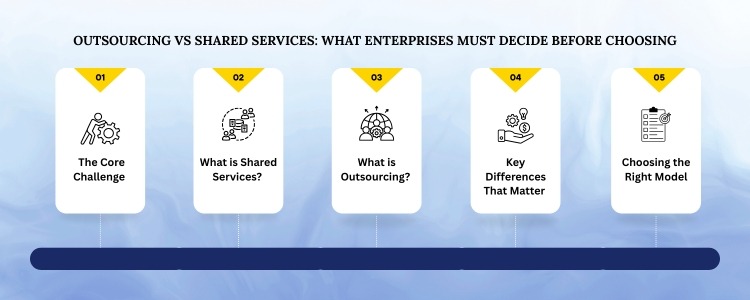
This article breaks down outsourcing vs shared services across structure, cost, governance, and workforce considerations to help enterprise leaders evaluate which model, or combination of both, fits their organization.How Shared Services Work
This model charts out processes that are repetitive across various departments into one department alone. This department will cater to all departments, provide uniformity in processing, and have a centralized responsibility for all support functions.
What Functions Belong in a Shared Service Center
Accounts payable, accounts receivable, reconciliations, and statutory accounting are some of the key activities that are typically centralized within shared service centers. They involve well-defined processes that generate measurable outcomes and are greatly improved by centralization.
Organizations that have multiple entities in various countries can benefit the most by establishing a shared service center. The cost per transaction is minimized, there is a centralized close procedure, and the finance management can get an integrated perspective of the company’s financial situation.
Payroll processing, HR records, benefit programs, and compliance reports can be performed by a shared service center since these activities are process-oriented and are applicable uniformly to all employees. Consolidating HR management eliminates the inconsistency associated with HR processes being handled locally within various business divisions.
Key functions included:
IT Support and Infrastructure
Procurement and Sourcing
Key functions included:
How Outsourcing Works
Offshore outsourcing
Outsourcing by Engagement Type
Outsourcing by Pricing Structure
Fixed Price → Predictable cost, best for a stable scope
The pricing models determine the allocation of risks in transactions—the fixed pricing model transfers risks to the seller, and time-related models transfer risks to the client. The trend of using outcome-based and consumption-based models is growing, as firms increasingly emphasize value creation instead of working hard.Outsourcing vs Shared Services: Where They Differ
Outsourcing transforms fixed costs to variable costs. The organization pays for a specific output without incurring any capital expenditure on hiring employees, renting an office space, and investing in IT infrastructure. Outsourcing lowers risks of financial investments for organizations dealing with short-term demands or seeking expertise they cannot afford to acquire in-house.
Workforce Flexibility
The shared service center cannot provide this kind of flexibility in the short run. If more resources are needed, then hiring and training are required. Conversely, if fewer resources are needed, downsizing must be managed, involving costs and risks. The shared service center is most effective in environments with predictable and relatively constant demand.
Knowledge Retention
When Shared Services Is the Right Choice
It also fits when the function deals with sensitive information, complicated regulations, and strategic processes, whereby the company must have total control over the work done and the measurement of quality. Centralized Services are most ideal when the organization has the resources to set up the right governance, infrastructure, and management framework at the beginning.When Outsourcing Is the Right Choice
It is also suitable for services that need specialist expertise that the business does not require on an ongoing basis, for large volumes of transactions that take advantage of the provider’s economies of scale, and for businesses that want the ability to scale without making any permanent hires.
Can Both Models Work Together?
Conclusion

frequently asked questions (FAQs)
1.What cost advantages do GCCs in India offer?
2.How do GCCs in India support AI and innovation?
3.What is the future outlook for GCCs in India?
4.What makes India a top destination for GCC expansion?
5.What are Global Capability Centers (GCCs) in India?

Babita Gangwar









Error: Contact form not found. Error: Contact form not found.Subscribe to our Newsletter
Subscribe to our Newsletter