Recent Posts






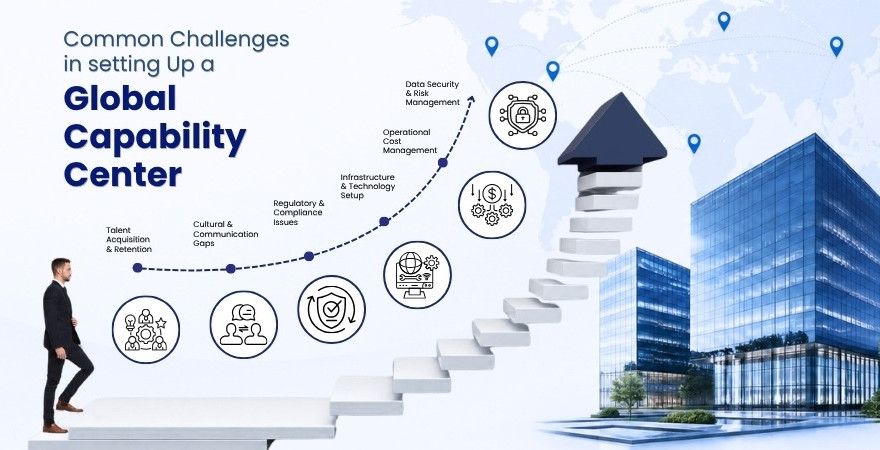
As multinational corporations look to distribute operations across geographies, one of the most structured avenues to accomplish this has been through the establishment of the Global Capability Centers framework. There are over 1,800 such centers located only in India, earning revenues of $64.6 billion in fiscal year 2024. These revenues are expected to exceed $100 billion by 2030. However, these statistics do not capture the operational difficulties involved in establishing the Global Capability Centers framework. International expansion challenges do not disappear when a company selects the GCC model. These problems indeed take on a different form. Regulatory issues, talent wars, logistical needs, and organizational fit all involve decision-making with costs involved and legal implications. This document provides information about the seven most prevalent problems and how they should be addressed.
Each country has different rules for: It does not end there. In some countries, such as India, regulatory requirements differ by state, like Karnataka, Maharashtra, and Telangana. According to a recent global survey on compliance, 85% of the participants indicated that compliance regulations have become increasingly complicated over the last three years. According to a global business complexity index conducted in 2024, 54% of the participating jurisdictions believe that the complexities will continue to rise over the next five years. This means that for any international company operating in the BFSI and healthcare industries, failure to comply could be costly. The risk can be mitigated through a pre-entry compliance audit, which outlines jurisdiction-specific obligations before forming a legal entity. The organization that seeks legal and tax guidance from its advisers before establishment will avoid making costly adjustments.
India has emerged as one of the world’s largest talent hubs for IT, engineering, management, analytics, and AI-driven business operations. Every year, India produces millions of graduates in computer science, engineering, finance, business management, and digital technologies. technologies, creating a vast and highly adaptable workforce. Indian professionals are globally recognized for their technical expertise, problem-solving ability, creativity, and capacity to manage complex global operations at scale. India’s IT and management sectors have evolved far beyond traditional outsourcing. Today, Indian talent powers advanced work in artificial intelligence, cloud computing, cybersecurity, semiconductor design, fintech, automation, robotics, and enterprise transformation. Indian professionals are also increasingly leading global innovation centres, shared service centres (SSCs), and global capability centres (GCCs) for multinational corporations. The country’s startup ecosystem, digital economy, and strong English-language capability further enhance workforce competitiveness. Combined with rapid AI adoption and continuous upskilling, India offers companies a highly skilled, agile, and future-ready talent ecosystem capable of driving global innovation and digital transformation.
Key challenges include the following: Availability of talent has been one of the top reasons why organizations have chosen India for their Global Capability Centers. Each year, India graduates over 1.5 million engineers, while the total number of employees working in all GCCs was around 1.9 million as of FY2024, with Flexible estimating the number to reach 2.4 million by 2025. The numbers speak for themselves. The issue is in the niche and senior roles.
Key challenges include the following: A strategy that serves an organization well within its home environment may not be easily applicable in another geographic location. Norms of work, modes of communication, level of decision-making, and feedback mechanisms vary from one geographic location to another. Ignoring such differences leads to conflicts between the head office and the GCC team, which slows delivery and raises coordination costs. The gap in time zones makes matters worse. The team in Bengaluru working on a nine-to-five work pattern has about two to four hours of overlap with its headquarters in Europe. Without an established process for communication in an asynchronous environment and a clear escalation path, decision-making gets affected. Companies that are successful at this develop their governance models before even opening their center. They decide what functions are fully owned by the GCC, what functions need the headquarters’ approval, and how to measure the performance. Having an onboarding process for new employees, where they are taught about corporate procedures, helps avoid early employee turnover.
Key considerations include the following: A GCC must make decisions about real estate, IT architecture, data security, and business continuity to set up its physical and digital infrastructure. The amount of office space leased by GCCs in India increased to 29.2 million square feet in 2024, indicating the extent of their expansion efforts. Both operating costs and talent availability are impacted by the choice of location within that market. Cybersecurity is a growing concern. In 2025, India’s CERT-In issued 390 vulnerability notes and 1,530 alerts in response to roughly 29.44 lakh cyber events. Compliance with India’s Digital Personal Data Protection Rules 2025 adds another level of infrastructure and operational requirements for GCCs managing cross-border data flows.
Key challenges include: In support of the GCC, one can begin by looking at savings, with estimates of 30-50% cost reduction compared to similar operations in Western countries. This is true, but not unchanging. The cost of doing business in first-tier cities such as Bengaluru and Hyderabad has gone up, along with the increase in real estate costs, pay scales, and infrastructure investments that coincide with GCC operations. Over-budget during startup operations occurs frequently as firms underestimate their one-time costs: forming legal entities, obtaining licenses, hiring people, training employees, and implementing technology are not free operations, and knowledge of the marketplace helps with managing these costs. The build-operate-transfer model addresses this directly. Under this arrangement, the parent organization takes over all operational responsibility once an experienced local provider establishes and runs the center for a predetermined amount of time. This lowers the possibility of first-year cost overruns and enables the parent business to learn about the area before assuming full management responsibilities. This strategy has been utilized by financial services and manufacturing firms to set up centers in India with more predictable cost trajectories.
Key challenges include the following: A good center running well with 100 people does not guarantee that there will be no disturbance when expanding to 500 people. Documentation, management capacity, information technology systems, and physical space will all need to expand along with the increase in numbers. It is common for organizations planning only for the starting number to encounter problems in the future. These cities are becoming more relevant to the discussion. In early 2026, Coimbatore, Kochi, and Ahmedabad contributed to the recruitment of GCC employees at 12%. This was achieved through various state-level policies, such as the Maharashtra GCC Policy 2025. The attrition rate in these cities is lower by 10% to 15% compared to Tier-1 cities.
Key challenges include the following: The quality of leadership within a global capability center will dictate if it operates as an extension of the headquarters or if it acquires the ability to take ownership of some sections of the business. The two outcomes carry different long-term values. According to Inductus’ analysis using the secondary sources, more than 6,500 positions have been created globally in India’s GBCs up to 2024. This also includes over 1,100 women in various leadership positions internationally. This indicates a change in the perspective of organizations regarding the capability of the GCC. Research done by Gartner in 2025 found out that 13 Fortune 500 firms currently derive more than 25% of all their patents globally from India Centers. In this situation, leadership development is not a typical HR endeavor. How much of the organization’s operational authority and intellectual output the GCC will eventually own is a structural choice.
These difficulties that are described in this manual are not exclusive to any particular industry or region; however, their significance depends greatly on how prepared the company was before setting up its foreign office. The issues associated with expanding internationally will not be automatically solved by having a legal entity or signing a lease agreement.
Companies can cut their costs by 30-50% due to the availability of high-quality but inexpensive labor from India. The low cost of property and infrastructure investments also adds to the efficiency of operations. A favorable currency position also assists multinational corporations in managing their expenditures and maximizing benefits. Most significantly, all these economies are achieved without sacrificing quality, innovation, or speed of delivery. India is home to a massive resource pool of skilled professionals in AI and data science, making innovation easier. Over 500 GCCs with an emphasis on AI are available for technologies such as machine learning and GenAI. These GCCs assist firms in developing their own proprietary platforms and IP. .Thus, Indian GCCs are crucial in the context of global AI innovation and transformation. India is expected to have 2,100-2,500 GCCs by 2030 due to high growth. These centers will become more important for international business, innovation, and product development. GCCs will be at the forefront of innovation, including AI, digitization, and decision-making. In general, they will make a significant contribution to India’s economy and international business. India boasts an enormous reservoir of STEM professionals, which allows firms to expand their workforce rapidly. It has a robust digital infrastructure, which fosters innovation and international business. Its cost efficiencies make it extremely effective as opposed to other international destinations. A developed environment in AI, cloud computing, and data science ensures constant innovation and development. Global Capability Centers (GCCs) in India are enterprise-owned hubs that deliver end-to-end services like product development, R&D, AI, and digital transformation. They go beyond traditional outsourcing to drive innovation and business strategy. With a keen analytical mindset and a passion for data-driven insights, Babita Gangwar brings expertise in research, analysis, and strategic evaluation. As a Research Analyst, she focuses on transforming complex data into actionable intelligence that supports informed decision-making. She collaborates across teams to deliver high-quality research outputs, ensuring accuracy, relevance, and impact. Her interests span market research, data analytics, and emerging industry trends. A detail-oriented professional, she actively contributes to knowledge development through reports, presentations, and research initiatives.
1. Regulatory and Compliance Complexities
Skilled, Dynamic, Global: Indian Workforce
2. Talent Acquisition and Retention
The attrition rate for the overall Indian GCC workforce ranges from 15% to 25%, while the attrition rate for mid- to senior-level positions within technology and data departments stands at 20% to 30%. The demand for employees in artificial intelligence, machine learning, and cloud computing continues to increase, with more than 1,600 centers competing for the same pool of talent. Currently, there is only one person for every two positions available in the GenAI field in India, indicating an imbalance of 53%.
Retention is an entirely different issue compared to recruitment. Individuals who are employed in critical positions are presented with many job offers at once. Companies that view salary as the sole retention tool have the highest attrition rate. Career advancement programs, structured timelines, and ownership of projects by GCC employees instead of task implementation assigned by management from the head office all make a huge impact on retention.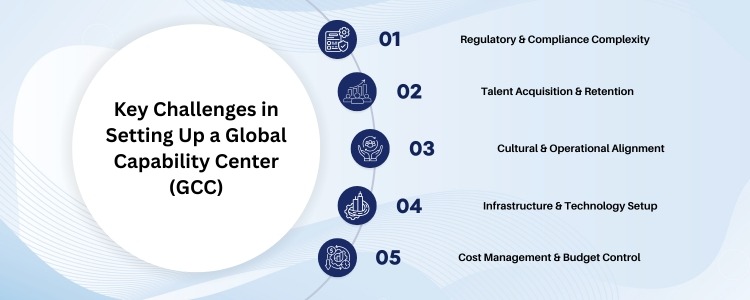
3. Cultural and Operational Alignment
4. Infrastructure and Technology
Cloud architecture reduces some infrastructure complexity by enabling remote access and scalability without proportional increases in physical assets. Adoption of cloud computing does not, however, eliminate the requirement for on-site governance of incident response procedures, access controls, and data classification. Before operations start in earnest, both must be set up.
5. Cost Management and Budget Control
6. Managing Scalability and Expansion
According to Inductus research, 364,000 GCC-based jobs are forecasted for India in 2025. Given the intensity of business activity, the availability of real estate, senior personnel, and specialized vendors may be an issue at times. By planning growth phase-by-phase to take into consideration the relationship between the number of hires required and existing facilities, infrastructure, and staffing resources, companies can grow while maintaining their current model of doing business.7. Building a Strong Leadership Pipeline
This degree of involvement necessitates local leadership that is aware of the parent company’s plan and has the power to implement it without waiting for guidance from elsewhere. Businesses that achieve this through succession planning frameworks, cross-posting between headquarters and the GCC, and organized mentorship report improved continuity and less reliance on a small number of key personnel.
Planning Before the First Hire
There are certain traits common among high-performing GCCs across technology companies, BFSI companies, manufacturers, and healthcare providers; one such trait is their approach towards the creation of the center, which is more strategic in nature and not simply based on the idea of cutting costs, as it is viewed more as a long-term operational strategy.

frequently asked questions (FAQs)
1.What cost advantages do GCCs in India offer?
2.How do GCCs in India support AI and innovation?
3.What is the future outlook for GCCs in India?
4.What makes India a top destination for GCC expansion?
5.What are Global Capability Centers (GCCs) in India?

Babita Gangwar








Error: Contact form not found. Error: Contact form not found.Subscribe to our Newsletter
Subscribe to our Newsletter