Recent Posts






The build-operate-transfer model has become one of the more structured approaches US companies use when entering offshore markets for the first time. Unlike establishing a global capability center on its own or outsourcing all its activities to an outsourcing firm, this model establishes a very distinct way through which a firm moves from third-party management to complete control.
Build Operate Transfer (BOT) refers to a three-stage process for creating entities in the GCC. The service provider builds and operates the entity before transferring it to the customer. It is used in various fields such as IT, finance, legal, human resources, and analytics. The BOT Model GCC structure is the most widely used among new entrants into India, although it is also found in the Philippines, Poland, and Mexico. Activities in this phase include: The registration of entities under the Companies Act in India typically takes 4 to 7 weeks based on state and documentation status (Ministry of Corporate Affairs, Government of India). The identification of office spaces that are Grade A in Bengaluru, Hyderabad, and Pune would take 6 to 10 weeks more. Build phase cost: USD 500,000 to USD 1.5 million for a 100-person center, depending on city, function type, and seniority. Phase 2: Operate The operation phase sees the provider operating the facility. The customer gets the report while making decisions regarding the strategy of operations, while the provider handles day-to-day management. The management fee charged by the provider is between 12% and 18% of total operating costs every month. The customer either pays for FTE costs directly or from the consolidated billing arrangement. Key metrics tracked during this phase: In India, the cost for each FTE during this stage varies between USD 18,000 and USD 35,000 yearly based on their role. This particular GCC BOT process allows the customer an 18 to 30-month window to study the functioning of the business, modify the organizational structure, and hire people accordingly before taking full responsibility. Phase 3: Transfer Transfer is the process through which the service provider transfers the center to the client. Transfer includes legal, financial, and operational transfers. Activities during transfer include: Transfer is by far the most complicated stage and the most common cause of failure. Businesses that do not explicitly detail the terms of transfer in their original agreement often run into problems with scheduling, costs, and employee retention. The transfer fee may either be a one-time cost of between USD 200,000 and USD 800,000 or a multiple of the monthly management fee.
After the transfer, the same 100-member GCC in India becomes cheaper by 35% to 50% per year against onshore equivalents in the US. The above figures are for India-based centers only. The Philippines comes at 10% to 15% cheaper on FTE costs for voice and customer support work. Poland and other Central Europe-based centers come at 20% to 35% higher prices than India for engineering services.
Companies that operate for less than 18 months see greater attrition rates after the transfer process. The operation stage requires ample time for the client to familiarize itself with the local market environment and develop internal management capabilities so that the recipient entity is ready to take over completely. Why US Companies Use the Build-Operate-Transfer Model. Regulatory exposure Hiring speed
In the case of the BOT model of shared services center implementation, there are a few more elements that come into play when comparing it with technology-only GCCs. Finance and accounting, procurement, human resource-related activities, and other types of shared services require knowledge of domestic labor laws from the outset. State-based registration and compliance rules for taxes and payroll operations exist in India, and existing facilities need to be set up. Provider Selection Criteria When selecting a BOT provider, companies typically evaluate across five areas: Providers with more than 10 completed GCC transfers include Infosys BPM, Wipro, Capita, Inductus, and EXL Service. Contract Terms That Require Attention Transfer triggers Post-Transfer Operations
The BOT model GCC in the US provides US companies with a roadmap for owning the GCC. Through the BOT model GCC system, risk is mitigated during the early stages, investment is distributed, and there is an avenue to exit before transferring full ownership. The model is most effective if the operation phase lasts at least 18 to 24 months and if transfer conditions are specified in advance of signing the building contract.
Companies can cut their costs by 30-50% due to the availability of high-quality but inexpensive labor from India. The low cost of property and infrastructure investments also adds to the efficiency of operations. A favorable currency position also assists multinational corporations in managing their expenditures and maximizing benefits. Most significantly, all these economies are achieved without sacrificing quality, innovation, or speed of delivery. India is home to a massive resource pool of skilled professionals in AI and data science, making innovation easier. Over 500 GCCs with an emphasis on AI are available for technologies such as machine learning and GenAI. These GCCs assist firms in developing their own proprietary platforms and IP. .Thus, Indian GCCs are crucial in the context of global AI innovation and transformation. India is expected to have 2,100-2,500 GCCs by 2030 due to high growth. These centers will become more important for international business, innovation, and product development. GCCs will be at the forefront of innovation, including AI, digitization, and decision-making. In general, they will make a significant contribution to India’s economy and international business. India boasts an enormous reservoir of STEM professionals, which allows firms to expand their workforce rapidly. It has a robust digital infrastructure, which fosters innovation and international business. Its cost efficiencies make it extremely effective as opposed to other international destinations. A developed environment in AI, cloud computing, and data science ensures constant innovation and development. Global Capability Centers (GCCs) in India are enterprise-owned hubs that deliver end-to-end services like product development, R&D, AI, and digital transformation. They go beyond traditional outsourcing to drive innovation and business strategy. With a keen analytical mindset and a passion for data-driven insights, Babita Gangwar brings expertise in research, analysis, and strategic evaluation. As a Research Analyst, she focuses on transforming complex data into actionable intelligence that supports informed decision-making. She collaborates across teams to deliver high-quality research outputs, ensuring accuracy, relevance, and impact. Her interests span market research, data analytics, and emerging industry trends. A detail-oriented professional, she actively contributes to knowledge development through reports, presentations, and research initiatives.
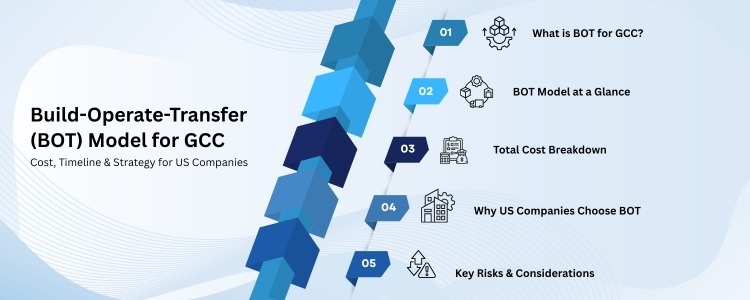
This blog covers how the model works in practice, what it costs, and the timeline US companies should expect when using it for GCC setup. What the Build-Operate-Transfer Model Covers
The model is different from outsourcing since the ownership changes hands. The model is also different from the direct setup model since the client will not bear all responsibilities for the first year.
Phase 1: Build
Duration: Months 1 to 6
In the building phase, legal incorporation, facilities establishment, early employment, and IT framework are included. The service provider takes care of all these things on behalf of the client.
Duration: Months 7 to 36
Duration: Months 24 to 48 (execution: 3 to 6 months)
Full Cost Estimate: 100-Person GCC Over 36 Months
Cost Item
Estimated Range (USD)
Build phase setup
600,000 to 1,200,000
Management fees over 24 months
900,000 to 1,800,000
FTE costs: 100 employees over 24 months
3,600,000 to 7,000,000
Transfer fee
200,000 to 600,000
Total over 36 months
5,300,000 to 10,600,000
Timeline from Decision to Full Ownership
Phase
Duration
Provider selection and contract signing
2 to 3 months
Build phase
4 to 6 months
Operate phase
18 to 30 months
Transfer execution
3 to 6 months
Total end-to-end
27 to 45 months
Several factors push US companies toward this model over a direct setup.
Labor laws in India have been layered between the central government and individual states. A service provider that already has a system of complying with these laws minimizes legal problems during the beginning phase.
These providers have active recruitment pipelines in large technology and shared service centers. Recruitment time in managed centers is 30% to 40% faster than client recruitment in the same centers.
Capital structure
Setup costs are allocated within the context of a fee structure, spreading capital investment across 24 to 36 months, compared to lumping the expense in year one.
Exit optionality
If the GCC is unable to deliver its expected performance in the operation stage, then the client has predefined exit strategies prior to handing over ownership. This cannot be done in a direct setup.Shared Services Center Setup Using BOT: Specific Considerations
The operation stage for shared service A BOT deal is likely to take longer, at around 24 to 36 months, due to longer process standardizations and quality benchmarking periods than in IT operations. The management fee percentage, on the other hand, is slightly higher in the case of shared services, at between 15% and 20% of total costs.
Most disputes in the build-operate-transfer model arise from vague contract language in three areas.
Contracts must specify precisely when the client is able to transfer. Open-ended language causes delays.
Employee innovation terms
Employment offers to transferring employees, including changes to compensation, should be established before transfer, not after. Those employees who receive unclear or unfavorable employment offers during transition leave.
Fee caps and adjustment clauses
Management fees based on headcount may become very high as the GCC expands. The contracts must have a clause that sets a cap on the fees or reduces them as the number of headcounts increases.
The GCC will then come under the client’s ownership fully, at which point cost control is the primary concern. Attrition after the transfer normally increases by 10% to 15% within the initial 12-month period as the employees evaluate themselves within the new organization. The retention plan, along with pay benchmarking according to local market information and career pathing communication, must be set up beforehand. Summary
The total cost required to establish a GCC with 100 people in India would be between $5.3 million and $10.6 million in 36 months. After transferring, savings can be realized at an annual rate of 35% to 50% relative to US-based GCCs within one year.
frequently asked questions (FAQs)
1.What cost advantages do GCCs in India offer?
2.How do GCCs in India support AI and innovation?
3.What is the future outlook for GCCs in India?
4.What makes India a top destination for GCC expansion?
5.What are Global Capability Centers (GCCs) in India?

Babita Gangwar








Error: Contact form not found. Error: Contact form not found.Subscribe to our Newsletter
Subscribe to our Newsletter
