



Global Capability Centres and the Next 100 Unicorns: The Startup-Inside-the-Enterprise Model

July 28, 2025
GCC
0

The Global Capacity Centres in India are going through a transformational change from box-office competence to future unicorn incubators. By 2025, India will have more than 1,930 GCCs, with major centers in Bangalore, Hyderabad, Pune, and Gurgaon, collectively contributing US $64 billion to India’s economy. The region now employs more than 1.9 million professionals, whose annual growth is estimated at 11% CAGR by 2030.

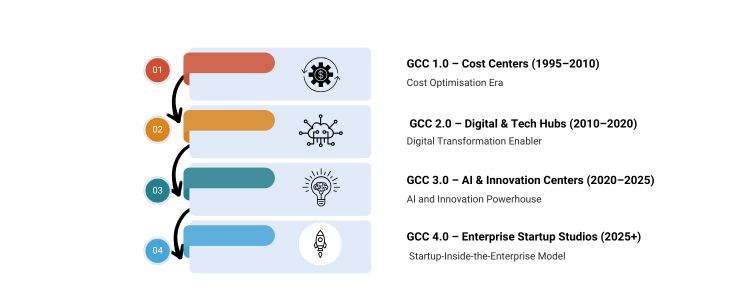
From cost adaptation centers to AI-operated innovation centers, GCCs of India are developing as prominent players in global digital changes. But the latest trend is even more disruptive: GCC/ODC enterprise-led startup factories are being made. With the offshore development centers adopting the GCC as a service model, companies are creating internal startups, eternally solving problems, and creating intellectual property that can develop into independent enterprises.

In Inductus GCC, we see it as a “startup inside the enterprise” model, where the GCC of India prepares the next 100 unicorns for the world.

Quiet Revolution: Enterprise as Startup Plan

Global companies are converting their GCCs into internal innovation studios. Instead of depending on external startups only, they are making enterprise-style startups within their enterprises from their GCC in India.

This change provides the following features:

  • Fast product development.
  • Direct control over innovation, and
  • Measurable cost benefits using India’s technical workforce.

Startup Model

  • Entrepreneur Pods: Small teams in the GCC work as an internal startup. Each pod is dedicated to a certain business problem or the development of a new product that can work more or less independently.
  • Startup Culture: Instead of raising funds externally, these innovation pods are funded by enterprises as internal enterprise investments, and they also foster the work culture, risk, experimentation, and rapid decision-making.
  • Independent Product Development: These self-contained startups lead the development of items that address company-wide issues or design an innovative product line. The development cycles are basic, repetitive, and innovation-oriented.
  • IP Ownership and Commercialisation Strategy: Solutions that have been constrcted may be: Internal separated to stand as autonomous business enterprises or Commercialised outside the business so that the businesses have a chance to make money out of internal inventions.
  • Fast Failure: Teams are engaged in speedy MVP creation, and then teams are trying to create a rapid repetition so that the ideas could be tested quickly and teams could fail quickly when required, and they could also go in the right path in order to find out the decent solutions.

Why is GCC Startup Factory India?

  • Highly Skilled Labour: India produces over 1.5 million engineers every year, and this workforce links the high-end technical expertise and the psyche of an emerging entrepreneurship.
  • Ecosystem coordination: India is an ecosystem of startups worth 120 billion dollars that enhance cross-pollination. Local startups, universities, and collaboration with accelerators work to the benefit of GCCs and raise the level of innovation.
  • Policy and Infrastructure Advantages: India offers a wide range of policies and Supporting schemes, such as Digital India and Startup India, which allow business innovation with the best industry tech parks and digital infrastructures in the world.
  • 40-60% Cost Decrease: The operational price in India is significantly lower than the price in the Western countries, and enterprises are able to create and develop the team of innovators by sustainable prices.
  • Shift in GCC Functions: The GCC in India has shifted to product ownership; it handles the entire product life cycle of products and has an innovative work culture stressing problem-solving.

Examples of Enterprise-Spawned Innovations

Enterprise GCC Location Startup Incubated Problem Solved Outcome
Global Bank Bangalore AI Risk Engine Real-time fraud detection Enterprise-wide adoption
Pharma Major Hyderabad Digital Health Tracker Clinical trial engagement Spun off as a SaaS tool
Retail Giant Pune Delivery Optimisation SaaS Last-mile delivery tracking Deployed across APAC
Insurance Conglomerate Gurgaon Claims Automation Engine AI-driven claims processing Licenced externally
Energy Corporation Chennai Renewable Asset Manager App Real-time renewable asset tracking Became a spin-off product line

Why will GCC Make the Next 100 Unicorns?

  • Internal Product Commercialisation: Products manufactured inside the GCC will develop as licenced platforms or spin-off startups.
  • Corporate Enterprise Branches within GCC: Enterprises will directly install corporate VC funds inside the Indian GCC to fund internal innovations.
  • Adopting the Venture Studio Model: GCC will work like Venture Studio and create several internal startups simultaneously.
  • Talented Entrepreneurship: Employees will be encouraged to launch products, where they will get funding and IP support from enterprises.
  • Rise of Offshore Innovation Ecosystems: The GCC market ready will partner with Indian startups and the education world for co-development of innovations.

Remote Obstacles

  • Enterprise Bureaucracy: Traditional processes in large enterprises can disrupt the agility of startups within GCC pods, which can delay the innovation cycle.
  • Depletion: It is challenging to maintain high capacity because employees often move into external startups after achieving skills.
  • Balance of Control Versus Autonomy: Enterprises often struggle to provide real freedom to innovation pods while maintaining governance and monitoring.
  • IP rights and Commercialisation Challenges: The legal complications associated with intellectual property ownership and spin-off strategies can slow down the commercialisation of innovations.
  • Interval in Leadership Mentality: Senior leaders often see the GCC as not an innovation engine but as operating centers – this mentality needs a change to support the startup approach within the body.

Construction of Internal Unicorn: Enterprise Playbook
  • Adopt GCC as a service model: Outsource not only operations but also innovation incubation through Indian GCC partners.
  • The Composition of Micro-Innovation Pods: Teams focusing on internal problems and product development.
  • Install Venture Funding Pools: Create special enterprise VC branches funding the GCC innovations.
  • Cooperate with India’s Startup Ecosystem: Develop the products with the support of Indian startups and universities.
  • Enable IP commercialisation strategy: Install structure to give spin-offs or licences globally to products developed by GCC.

https://inductusgcc.com/wp-content/uploads/2025/07/53.1-1.jpg
Conclusion

In the next decade, India’s global capacity centres will not only support enterprises, they will also make startups. The enterprises that will use their GCC as an innovation engine will lead the next 100 unicorns.

https://inductusgcc.com/wp-content/uploads/2025/07/53.2-1.jpg

As a leading GCC consulting and outsourcing partner, Inducts Global helps to convert businesses into scalable, innovative-based price centres in India. Our integrated approach is a mixture of talent access, startup ecosystem cooperation, and operational excellence.

frequently asked questions (FAQs)
1.
How are the GCC costs beyond the cost centres in India?

Indian GCC is now focused on innovation, artificial intelligence (AI), product growth, and internal startup incubation, promoting enterprise-based growth.

2.
What is a startup-inside-the-enterprise model?

This is a structure where enterprises install internal startups within their GCC to solve problems, create intellectual property (IP), and promote product innovation.

3.
How can GCC help make the next 100 unicorns?

By acting as an innovation studio, where internal products develop in scalable platforms, spin-offs, or independent startups.

4.
What is the GCC As a Service Model?

This model enables enterprises not only to operate but also to outsource specific GCC providers in India.

5.
What are common challenges in making startups inside the GCC?

Challenges include corporate bureaucracy, retention, IP management, and balance of control with freedom of innovation.

https://inductusgcc.com/wp-content/uploads/2025/05/1-3.png

Aditi

Aditi, with a strong background in forensic science and biotechnology, brings an innovative scientific perspective to her work. Her expertise spans research, analytics, and strategic advisory in consulting and GCC environments. She has published numerous research papers and articles. A versatile writer in both technical and creative domains, Aditi excels at translating complex subjects into compelling insights. Which she aligns seamlessly with consulting, advisory domain, and GCC operations. Her ability to bridge science, business, and storytelling positions her as a strategic thinker who can drive data-informed decision-making.


Hey, like this? Why not share it with a buddy?

Related Posts

Leave a Reply

Your email address will not be published. Required fields are marked *