Recent Posts







A Decision Framework for Global Enterprises Discover whether a Global Capability Center (GCC) is the right strategic move for your enterprise. This comprehensive framework draws on insights from McKinsey, BCG, and Big 4 consulting to help you navigate GCC establishment decisions with real-world expertise on scaling challenges, total cost optimization, and operational transformation.
The conversation around Global Capability Centers has fundamentally shifted. Yet, despite the maturation of the GCC model, with over 1,800 centers operating in India alone and double the same across Eastern Europe, Latin America, and Southeast Asia, the decision to establish a GCC remains one of the most complex and consequential choices a global enterprise can make. Having architected GCC strategies across regions and industry verticals, I’ve witnessed both spectacular successes and costly failures. The difference rarely lies in the business case. Most organizations can model attractive ROI projections. The differentiator is in execution nuance, ecosystem understanding, and honest assessment of organizational readiness. This framework cuts through the noise to address the real questions keeping C-suite executives awake: ‘Should we build a GCC, and if so, how do we avoid the predictable pitfalls?’
The Evolution of Value Proposition Today’s GCC is not your predecessor’s captive center. The value being added has expanded from tactical cost reduction to strategic capability building. Organizations are establishing GCCs to access specialized talent pools, AI/ML engineers in Bangalore, cybersecurity experts in Tel Aviv, and financial analytics talent in Poland, not merely to reduce labor costs. The numbers tell the story. While labor arbitrage still delivers 40-60% cost savings in traditional functions, the strategic GCC model now emphasizes: The Hidden Complexity of GCC Economics Here’s where most business cases fall apart. The vendor-supplied TCO models typically underestimate true costs by 25-40%. The consistent blind spots include:
Dimension 1: Strategic Alignment and Organizational Readiness The first and most critical question is not ‘Can we afford a GCC?’ but ‘Why do we need one?’ The Business Case, The Problem Statement. Organizations succeed with GCCs when the strategic rationale extends beyond cost reduction. Green lights: Your organization should pursue a GCC if you have: Red flags: Abort the GCC path if: Dimension 2: Function Selection and Scope Definition Not all functions transfer well to GCC models. The highest-success functions share common characteristics: well-documented processes, digital workflows, minimal regulatory constraints, and high volume transaction orientation. High-probability success functions: Application development and maintenance, cloud infrastructure management, financial analytics and reporting, HR operations and payroll processing, digital marketing and content operations, data engineering and analytics, customer service and technical support. Proceed-with-caution functions: Product management, strategic sourcing, advanced analytics requiring deep business context, legal and compliance functions with jurisdiction-specific requirements, customer-facing sales requiring cultural nuance. It is primary to start with a ‘beachhead’ function, typically IT application support or finance operations, where you can prove the model, build organizational muscle, and create reference success before expanding scope. Dimension 3: Location Strategy and Geo-Political Risk Location selection has become exponentially more complex. The traditional India-first strategy is being reconsidered as organizations embrace geo-distributed, resilient operating models. The sophisticated approach? Multi-location strategy from day one. Establish primary capability in one geography, but plan for 20-30% capacity in a secondary location within 24 months. This hedge against geo-political risk, talent market volatility, and business continuity scenarios is worth the complexity. Dimension 4: Build vs. Partner Operating Model The spectrum ranges from pure-play captive (100% owned and operated) to managed service provider partnerships. Most successful implementations land somewhere in the middle. Pure captive model: Complete control, cultural integration, and IP protection. However, requires 18-36 months to operational maturity, significant upfront investment, and in-house capabilities for HR, legal, finance, and facilities management in foreign jurisdictions. Best for Fortune 500 organizations with 1,000+ FTE targets and long-term commitment. Build-Operate-Transfer (BOT): Partner establishes and operates the center for 2-3 years before transitioning to captive ownership. Accelerates time-to-value and de-risks market entry. The catch: transition costs and complexity at the handover point often exceed expectations. Budget 15-20% premium over pure captive long-term costs. Hybrid model: Own and operate core strategic functions (product engineering, data science) while partnering for infrastructure and support services (IT operations, facilities, recruitment). This is the BCG-recommended approach for mid-market enterprises, balancing control with speed-to-market. Dimension 5: Talent and Cultural Integration This is where strategy meets reality. Your GCC business case is irrelevant if you cannot attract, retain, and integrate talent effectively. The talent war in markets like India is brutal. Organizations compete not just with local GCCs but with product companies, startups, and global tech giants. Your employee value proposition must extend beyond compensation: Dimension 6: Governance, Compliance, and Risk Management The regulatory landscape for GCCs has become increasingly complex. Data localization laws, transfer pricing regulations, IP protection frameworks, and labor law compliance require specialized expertise. Critical considerations:
Having consulted on struggling GCC implementations, the failure patterns are consistent:
Assuming your organization has decided to proceed, here’s the ideal implementation sequence: 1.Foundation and Strategy Finalize location selection with boots-on-ground assessment, not just desktop analysis. Establish legal entity with expert local counsel. Recruit your GCC leader, someone who has built centers before, not a high-potential developmental assignment. Lock in executive sponsorship with explicit success metrics and quarterly business reviews. 1.Infrastructure and Initial Hiring Secure office space allowing for 3x growth. Build core infrastructure: secure connectivity, collaboration platforms, and development environments. Begin recruitment with modest initial targets (20-30 FTEs). Over-invest in onboarding and cultural integration. Bring initial cohort to headquarters for 2-4 weeks; the relationships built will pay dividends for years. 1.Transition and Stabilization Execute knowledge transfer with structured methodology—not ad hoc Zoom calls. Maintain parallel operations until quality metrics meet thresholds (typically 6-9 months). Scale headcount deliberately—no more than 30-40% growth per quarter. Implement robust governance: weekly operations reviews, monthly business reviews, and quarterly executive steering committees. Add adjacent functions only after proving the initial scope. Build talent pipelines with universities, training programs, and campus partnerships. Develop local leadership—your GCC cannot remain dependent on expat leaders indefinitely. Celebrate wins, share successes broadly, and build the GCC brand internally and externally.
The decision to establish a GCC exists on a spectrum of strategic fit, organizational readiness, and execution capability. Organizations that succeed with GCCs share common characteristics: multi-year strategic vision, executive commitment that survives leadership transitions, willingness to invest before returns, cultural openness to distributed operating models, and management discipline to execute complex transformations. The organizations that should proceed with GCCs are large enterprises with sustained technology and operations scale requirements, firms facing acute talent shortages in specialized domains, companies with 3-5-year digital transformation roadmaps requiring sustained engineering capacity, organizations culturally capable of distributed collaboration and global team integration, and leadership teams with patience for 18-24 -month break-even timelines. The GCC model has proven its value across industries and geographies. However, success requires a clear-eyed assessment of strategic rationale, an honest evaluation of organizational readiness, and disciplined execution that respects the complexity of building distributed global operations. The difference between a GCC that becomes a competitive advantage and one that becomes a costly distraction lies not in the business case spreadsheet but in the hard work of change management, cultural integration, and operational excellence. The question is not whether GCCs work; the evidence is overwhelming that they do. The right questions are whether your organization has the strategic clarity, leadership commitment, and execution discipline to make them work for you.
The GCC BOT model is a phased approach where a partner builds and operates a GCC before transferring full ownership to the enterprise once maturity criteria are met. It progresses through build, operate, and transfer phases with defined governance, allowing enterprises to assume ownership gradually. BOT offers a transitional ownership path, while captive GCCs require full ownership and responsibility from inception. Hybrid models suit organizations seeking flexibility, combining partner-led execution with selective internal control. Operational stability, governance maturity, compliance readiness, and leadership capability are key transfer thresholds. With multifaceted experience in Legal, Advisory, and GCCs, Yashasvi weaves law, business growth, and innovation. He leads a cross-functional team across legal, marketing, and IT to drive compliance and engagement. His interests span Law, M&A, and GCC operations, with 15+ research features in Forbes, ET, and Fortune. A skilled negotiator, he moderates webinars and contributes to policy forums.
The GCC Inflection Point: When Offshoring Becomes Transformation
Understanding the Modern GCC Ecosystem:
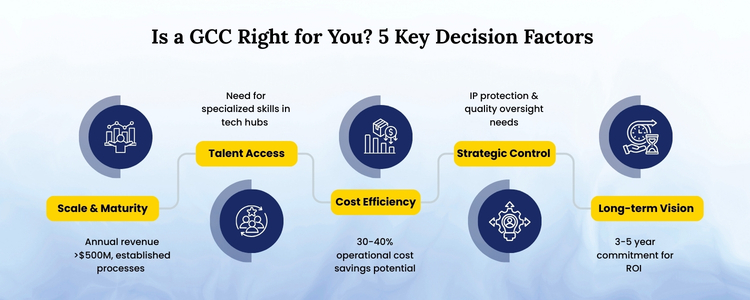
The Decision Framework: Six Critical Dimensions
Common Failure Patterns: Learning from $100M Mistakes
The Pragmatic Implementation Roadmap
When GCCs Create Value and When They Destroy It

frequently asked questions (FAQs)
1.What is the GCC BOT model?
2.How does Build Operate Transfer work for GCCs?
3.BOT vs captive GCC: what is the difference?
4.Is a hybrid GCC model suitable for enterprises?
5.What factors determine BOT transfer readiness?

Yashasvi Rathore









Error: Contact form not found. Error: Contact form not found.Subscribe to our Newsletter
Subscribe to our Newsletter