Recent Posts






The worldwide semiconductor industry has exceeded $600 billion in value by 2024, and the competition to establish overseas capacity capabilities remains intense in Asia. Vietnam is courting Samsung. Malaysia is pushing its National Semiconductor Strategy. STEM education in the Philippines is growing. However, as multinationals evaluate location options for their semiconductor GCC facilities in India compared to Southeast Asia, India always seems to be the winner, and it’s not just about money. Whereas a decade ago the question that was asked around boardroom tables was “Why India?”—the 2025 GCC Landscape report shows the answer to this question has been decisively made. The new question posed by global leaders is now “What more can we build out of India?” This blog explores the underlying structure that makes it a “no-brainer” to pursue a Semiconductor GCC India strategy. As of early 2026, there are around 1,800+ GCCs operating in India, and 2.1 million employees have been employed, which has brought an export value of $64 billion to the country in FY2024.
The semiconductor landscape has changed due to geopolitical factors. A global search for new locations for semiconductor design and development has been sparked by U.S. export restrictions on semiconductors headed for China, the $52 billion CHIPS Act passed in the United States, and growing demands for diversification along lines like China plus one. With a compound annual growth rate (CAGR) of 13.05%, the Indian semiconductor market, which was projected to be worth $45 billion in 2025, is expected to reach $100 billion by 2030. Simultaneously, the IoT ecosystem is exploding. From edge-AI chipsets and 5G modems to automotive SoCs and industrial sensors, the IoT GCC India opportunity is massive. Indian startups like Mindgrove Technologies (which launched the country’s first IoT-enabled microcontroller chip in 2024, aimed at enabling smart, connected devices with locally designed silicon), Netrasemi (which secured $13 million to build an edge-AI chip facility focused on high-efficiency processors for real-time data processing at the device level), C2i Semiconductors (developing advanced RF and mixed-signal semiconductor solutions for high-frequency and communication applications), AGNIT Semiconductors (focused on next-generation GaN-based power and RF devices for 5G, defense, and high-power electronics), InCore Semiconductors (designing RISC-V-based processor IP cores for embedded and IoT systems), and Calligo Technologies (building energy-efficient AI and high-performance computing chip architectures) signal a maturing domestic design ecosystem that Southeast Asian rivals have yet to replicate. In such a scenario, while considering a semiconductor GCC India option against setting up a development center offshored to Vietnam, Malaysia, or the Philippines, MNCs have to consider four basic questions: The data-backed responses for all these invariably favor India.
Cost is table stakes in any GCC decision. The key difference between the Semiconductor GCC India strategy and an entirely cost-based offshore development center approach in Southeast Asia lies in the richness and high level of talent that can be found.
The contribution of India is as high as 20% in terms of chip design workforce, which is not even matched by any Southeast Asian country. Every year, the number of graduates in STEM disciplines from India exceeds 2 million, most of whom specialize in VLSI design, RTL code, verification, and embedded systems. The number of global leadership roles in Indian GCCs increased by a 40% CAGR in the last five years, hitting the mark of 6,500+, with more than 1,050+ women leaders. By 2030, that pool is projected to surpass 30,000. India’s semiconductor leadership is anchored in a tightly integrated ecosystem where international businesses and institutions support one another at every stage of chip design and invention. Premier institutes such as IIT Bombay and IIT Madras consistently produce engineers skilled in VLSI design, RTL coding, and verification, while IISc Bangalore advances cutting-edge research in chip architecture, AI hardware, and nanotechnology. This academic strength is complemented by government-backed platforms like Semiconductor Laboratory (SCL), which supports semiconductor fabrication and strategic R&D, and Semiconductor Fabless Accelerator Lab (SFAL), which enables startups to design and commercialize chip IP at scale. Building on this foundation, global leaders have embedded India into their core engineering. Workflows: AMD drives processor architecture and high-performance computing design; Qualcomm develops 5G modems, mobile SoCs, and automotive chipsets; Intel leads CPU design, validation, and system integration; and Texas Instruments specializes in analog and embedded chip design. Together, this ecosystem creates a self-reinforcing cycle of talent, research, and real-world product innovation, giving India a sustained and scalable advantage in global semiconductor design.
Vietnam has become a significant hub for semiconductor packaging and testing, with the government investing $1.06 billion (VND 26 trillion) to educate 50,000 semiconductor engineers. Samsung has established a substantial manufacturing presence in the country. However, Vietnam’s talent pool for chip design is still in its early stages. The engineering graduates in the country tend to focus more on manufacturing operations rather than front-end design, RTL, or IP generation, which are the high-value tasks that Semiconductor GCC India centers specialize in. Additionally, the existing gaps in power infrastructure make it more challenging to scale up design-intensive operations.
Malaysia is the strongest Southeast Asian candidate for a semiconductor offshore development center, with decades of Assembly, Testing, Marking, and Packaging (ATMP) and a plan to train 60,000 qualified engineers under its National Semiconductor Strategy 2024, Malaysia has about 33 million workers overall, while India has 1.4 billion. The depth and quantity of chip-design experts in India just cannot be matched by the skill pool. For companies needing 500+ VLSI engineers at multiple experience levels, Malaysia runs short quickly.
The Philippines is recognized globally as a top outsourcing destination for software and business process solutions; however, its semiconductor design sector is still in the early stages of development. While there are initiatives to develop engineering talent in hardware design, the Philippines has virtually no established semiconductor GCC India equivalent history, no comparable fab or design infrastructure, and a talent pool primarily oriented toward software, call center, and IT services. For IoT GCC India-type mandates requiring embedded systems, FPGA, or SoC design expertise, the Philippines is not a competitive alternative today.
Semiconductor GCC in India is not just a talent game but an ecosystem of design that has been developed for over 30 years. Over 880 GCCs exist in Bengaluru alone, and Intel, Qualcomm, AMD, Texas Instruments, NXP, and Infineon, along with many others, have their design centers operating at full capacity and are responsible for products worldwide. The IoT GCC India landscape mirrors this maturity. In these same cities there are VLSI design companies, EDA tools companies, embedded software companies, fabless start-ups, and a new group of semiconductor IP companies. The presence of these specialized companies generates an effect of networking that an offshore development center in Vietnam or Malaysia would take at least 10 years to create. Key Design Ecosystem Indicators in India The differentiation is crucial: multinational corporations establishing Semiconductor GCC operations in India are focusing on generating intellectual property, owning products, and managing the design-to-deployment processes. Meanwhile, multinational corporations launching ATMP-focused ventures in Southeast Asia are concentrating on advanced precision manufacturing. Both approaches hold significant value; however, they fulfill completely distinct strategic objectives.
One of the most significant differentiators for a semiconductor GCC is the scope and complexity of the incentive structure that is put into place by the government. The Indian government’s support towards the semiconductor and electronics industry has been the biggest national-level effort made in favor of any industry through the PLI program. India’s Incentive Stack for Semiconductor & IoT GCCs The DLI program has specific significance in offshore R&D activities for India: it will provide reimbursement of 50% of IP development costs as well as provide an incentive of 4–6% of income-based deployment incentives, thus making chip design risk-free both for multinational companies and startups. Incentives on the state level enhance the federal scheme. The GCC policy in Karnataka, the Beyond Bengaluru program, T-AIM (Telangana AI Mission) in Telangana, and a semiconductor drive by the government of Tamil Nadu all contribute extra financial benefits in terms of land, infrastructure, and human capital.
In global firms looking to make long-term plans for development offshore for 10 to 15 years, scalability emerges as the single-most critical issue. This is where the India-against-Southeast Asia GCC conundrum finds its resolution. Scale of Workforce India’s GCC workforce is expected to increase from 2.1 million in 2025 to roughly 3.4–3.5 million by 2030, with nearly one million high-skill positions added in the second half of the decade. IoT and semiconductor roles, including embedded firmware, verification, SoC design, analog layout, and AI inference, are the fastest-growing categories. In Southeast Asia, this depth of specialist talent is still unparalleled. Although 6 big cities account for 94% of India’s GCCs, Tier-2 sites like Pune, Ahmedabad, Coimbatore, Jaipur, and Kochi are quickly becoming scalable options. These cities provide By 2030, Tier-2 cities are expected to account for nearly 39% of the GCC workforce. This regional heterogeneity greatly lowers the danger of talent concentration for companies constructing large-scale centers (e.g., 5,000+ employees).
The Indian intellectual property regime has been bolstered significantly, with more funding allocated to patent processing facilities, dedicated IP courts, and enforcement systems for trade secrets. This is especially important for semiconductor and deep technology GCCs working on creating their own proprietary material, like chip design, RTL, and verification IP. Although India is still catching up to U.S. and European standards, its progress seems promising and exceeds that of Vietnam and the Philippines.
Global supply chains are changing structurally. India is becoming a major beneficiary of diversification away from China, as indicated by Kearney’s Reshoring Index. On the other hand, nations like Malaysia and Vietnam are still more vulnerable to supply chains connected to China and geopolitical balancing concerns, which might cause long-term uncertainty in GCC plans. Revenue Scale of Mature GCC Operations An indication of the level of maturity that India’s GCCs have reached can be seen in a remarkable statistic; for the fiscal year 2024–25, out of the GCCs functioning in India, 24 GCCs had surpassed the $1 billion revenue from exports, compared to only 19 GCCs in the last year. That would be the benchmark for any successful Semiconductor GCC India or IoT GCC India center to achieve.
For design-led semiconductor and IoT work, the India vs. Southeast Asia GCC debate is largely settled. With 20% of the world’s chip design talent, a 25-year GCC ecosystem, robust government incentives, and an expanding pool of senior semiconductor leadership, India boasts an unparalleled scale. Southeast Asia has more specialized responsibilities, such as the Philippines in communication-driven services, Malaysia in packaging and testing, and Vietnam in packaging and testing, but none of them can match India’s depth in core engineering and design. For a multinational corporation investing in a decade-long venture in designing chips, developing IoT solutions, and validating them, India offers the only ecosystem capable of operating at a true global scale. The transition is apparent; India is no longer the answer to “why,” but rather the default option for firms seeking to create impactful and innovation-driven GCCs.
Companies can cut their costs by 30-50% due to the availability of high-quality but inexpensive labor from India. The low cost of property and infrastructure investments also adds to the efficiency of operations. A favorable currency position also assists multinational corporations in managing their expenditures and maximizing benefits. Most significantly, all these economies are achieved without sacrificing quality, innovation, or speed of delivery. India is home to a massive resource pool of skilled professionals in AI and data science, making innovation easier. Over 500 GCCs with an emphasis on AI are available for technologies such as machine learning and GenAI. These GCCs assist firms in developing their own proprietary platforms and IP. .Thus, Indian GCCs are crucial in the context of global AI innovation and transformation. India is expected to have 2,100-2,500 GCCs by 2030 due to high growth. These centers will become more important for international business, innovation, and product development. GCCs will be at the forefront of innovation, including AI, digitization, and decision-making. In general, they will make a significant contribution to India’s economy and international business. India boasts an enormous reservoir of STEM professionals, which allows firms to expand their workforce rapidly. It has a robust digital infrastructure, which fosters innovation and international business. Its cost efficiencies make it extremely effective as opposed to other international destinations. A developed environment in AI, cloud computing, and data science ensures constant innovation and development. Global Capability Centers (GCCs) in India are enterprise-owned hubs that deliver end-to-end services like product development, R&D, AI, and digital transformation. They go beyond traditional outsourcing to drive innovation and business strategy. With a keen analytical mindset and a passion for data-driven insights, Babita Gangwar brings expertise in research, analysis, and strategic evaluation. As a Research Analyst, she focuses on transforming complex data into actionable intelligence that supports informed decision-making. She collaborates across teams to deliver high-quality research outputs, ensuring accuracy, relevance, and impact. Her interests span market research, data analytics, and emerging industry trends. A detail-oriented professional, she actively contributes to knowledge development through reports, presentations, and research initiatives.
1. The Stakes: Semiconductor & IoT GCCs in the Post-2024 World
2. Talent Depth: India's Most Irreplaceable Advantage
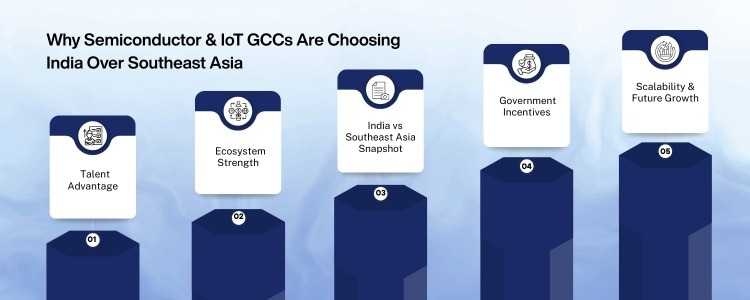
India: The 20% Chip Design Talent Powerhouse
Vietnam: Packaging Expertise, Design Nascency
Malaysia: Narrow Design Depth Despite ATMP Strength
The Philippines: BPO Heritage, Limited Deep-Tech Depth
Metric
India
Vietnam
Malaysia
Philippines
STEM Graduates / Year
2M+
~400K
~180K
~500K (broad STEM)
Chip Design Talent Share
~20% global
<1% global
~2–3% global
<0.5% global
Established GCC Ecosys.
✅ 25+ years
🔶 Emerging
🔶 ATMP-focused
🔶 BPO-dominant
Senior Design Talent
✅ Deep bench
❌ Shallow
🔶 Moderate
❌ Very shallow
Engineer Training Target
85,000 in 10 yrs
50,000
60,000
N/A specific target
3. The Design Ecosystem: Why India Leads on IP
4. Government Incentives: Structural Support That Changes the Math
5. Long-Term Scalability: The 10-Year View
6. Ecosystem Maturity and IP Infrastructure
7. The Geopolitical Diversification Argument
8. The Bottom Line: India’s Structural GCC Advantage
frequently asked questions (FAQs)
1.What cost advantages do GCCs in India offer?
2.How do GCCs in India support AI and innovation?
3.What is the future outlook for GCCs in India?
4.What makes India a top destination for GCC expansion?
5.What are Global Capability Centers (GCCs) in India?

Babita Gangwar









Error: Contact form not found. Error: Contact form not found.Subscribe to our Newsletter
Subscribe to our Newsletter