Recent Posts







The $400 Billion Reassessment: How the Outsourcing Playbook Became Obsolete The death of traditional outsourcing is already here. What we’re witnessing in 2026 is the largest structural reorganization of enterprise capabilities since offshoring began four decades ago. Fortune 500 companies are quietly dismantling vendor relationships worth billions and building something fundamentally different: Global Capability Centers that generate competitive advantage. Having architected GCC transformations for enterprises across three continents, I’ve observed a pattern that contradicts conventional practice. The companies making this shift are discovering that the real expense wasn’t what they paid vendors; it was what they lost in translation, speed, and strategic control.
Traditional outsourcing operated on a simple premise: transfer the work, eliminate the overhead, and focus on core business. But here’s what decades of implementation data reveal: every handoff creates friction that compounds exponentially. This velocity gap is what’s killing outsourcing models in 2026. In sectors where competitive advantage is measured in weeks—FinTech, consumer technology, biotech—the vendor relationship structure itself has become the constraint. You’re essentially asking a third party to care about your business outcome as much as you do, while their incentive structure rewards billable hours and scope expansions.
The recalibration happening now stems from four fundamental breaks in the outsourcing value equation: I’ve talked to delivery teams at major BPO providers where the average tenure on specific client accounts was 11 months. Compare this to GCCs where tenure averages 4.2 years and top performers stay 7+ years because they’re building careers within an enterprise brand they’re proud to represent, not cycling between client assignments. The Architecture of Control: Every enterprise I’ve worked with that scaled successfully discovered the same counterintuitive insight—you can’t digitally transform what you don’t directly control. Vendors will implement your requirements, but they won’t challenge your assumptions or redesign the underlying operating model. A telecommunications company spent $30 million over five years having vendors digitize legacy processes. Their Gurgaon GCC spent six months questioning why those processes existed at all, then redesigned the customer service architecture to eliminate 60% of the workflows entirely. That’s not something you get from a vendor whose revenue model depends on process volume.
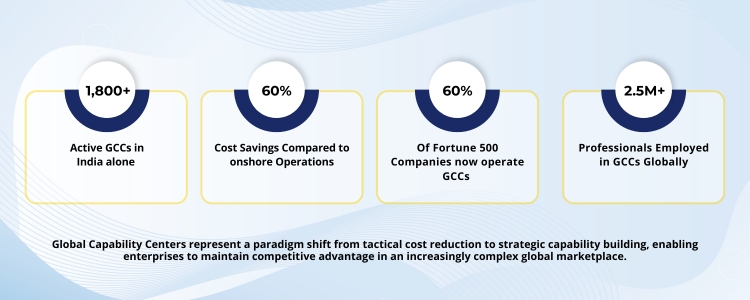
The conventional wisdom suggests GCCs are just “captive outsourcing“, essentially the same work done by employees instead of vendors. That’s a fundamental misunderstanding of how modern GCCs operate. Elite GCCs function as distributed innovation hubs embedded in talent-rich ecosystems. They’re accessing capabilities that don’t exist in enough depth at headquarters. Consider the math on specialized AI talent. A Fortune 100 technology company needed 200 machine learning engineers. In Silicon Valley, that’s a $90 million annual payroll competing against every tech giant. Their Bengaluru GCC recruited equivalent talent at $28 million annually, but the real value wasn’t the cost differential. It was access to 400 qualified candidates instead of 40. It was the ability to build teams of 15-20 ML engineers working in tight collaboration, rather than scattering individuals across product groups. It was proximity to AI research communities at IIT and IISc generating breakthrough papers. The total cost of ownership calculation is revealing. Outsourcing appears cheaper on paper, you avoid infrastructure, HR overhead, facility management. But factor in the costs of: And suddenly the GCC model shows superior returns within 15 months for most enterprise-scale operations.
Two macro forces are accelerating this transition in ways that weren’t predictable even three years ago. First, governments are actively incentivizing GCC establishment over outsourcing vendor expansion. India’s GCC-focused infrastructure zones now offer tax benefits and regulatory fast-tracking unavailable to traditional IT services companies. Poland, Mexico, and Vietnam have created GCC-specific immigration pathways for talent acquisition. Governments recognize that GCCs create fundamentally different economic value. They bring deeper skill transfer, stronger local ecosystem development, and more stable employment than the volume-driven BPO model. Second, the fragmentation of global trade agreements is making the vendor model riskier. When a single outsourcing partner operates across multiple geographies, you inherit their exposure to every bilateral trade tension, sanctions regime, and tariff structure. Several enterprises I’ve advised are consolidating vendor relationships not because of vendor performance issues, but because of geopolitical portfolio risk. GCCs, paradoxically, offer more flexibility because you control the operating model. If trade conditions shift, you can adjust workflows, data routing, or service delivery patterns without renegotiating commercial terms with an external party optimizing for their own revenue.
Having done stock take on both successful GCC scale-ups and expensive failures, the differentiators are clear.
The hardest part of shifting from outsourcing to GCCs isn’t the economics or the talent, it’s the organizational psychology of taking back control. I’ve watched a transition falter because headquarters teams felt threatened by capable GCC organizations. The vendors were a convenient attribution sink for delays and quality issues. Internal GCCs create accountability that some leaders actively resist. The successful transitions involve explicit social contracts. One approach that works: establish GCCs as centers of excellence for specific capabilities, with explicit authority to set standards that headquarters must also follow. The 2026 Inflection Point: Why Now? Three convergent forces make 2026 the pivot year for this transition.
For enterprises evaluating this transition, the implementation sequence matters enormously. Start with capabilities where speed and innovation matter more than scale. Don’t begin by transitioning 5,000 call center seats. Start with a 40-person pilot project with zero Capex team tackling a business problem that the headquarters has struggled to solve. Demonstrate value through outcomes, not cost savings. The first-year story should sound like “our GCC discovered a new customer segmentation approach that increased conversion,” not “we saved $4 million in vendor costs. “Build cultural bridges obsessively. The companies succeeding at this rotate headquarters talent through GCC assignments and bring GCC leaders into headquarters for extended periods. You’re building one organization across multiple geographies, not managing remote workers. Most critically, resist the temptation to recreate vendor management practices internally. The whole point is fundamentally different operating principles. If you’re measuring your GCC on ticket resolution times and SLA compliance, you’ve just built an expensive vendor. The Competitive Chasm Opening Now What should concern any enterprise leader, is how quickly this transition creates irreversible competitive separation. Companies building sophisticated GCC capabilities now are developing organizational muscle that can’t be rapidly replicated. By the time competitors recognize the strategic disadvantage, the talent has been locked up, the ecosystems established, the learning curves climbed. I’m watching real-time examples of this. A financial services company with mature GCCs in three locations is launching products faster than competitors still dependent on vendor cycles. In fast-moving markets, that’s an existential advantage. The shift from outsourcing to Global Capability Centers is a strategic repositioning that’s redrawing competitive boundaries. The question is whether you can afford to be late to it. This transformation requires courage to question decades of accepted practice and wisdom to execute what replacement models actually work. The evidence is overwhelming, the strategic advantages belong to enterprises that own their capabilities, even when those capabilities are globally distributed.
The GCC BOT model is a phased approach where a partner builds and operates a GCC before transferring full ownership to the enterprise once maturity criteria are met. It progresses through build, operate, and transfer phases with defined governance, allowing enterprises to assume ownership gradually. BOT offers a transitional ownership path, while captive GCCs require full ownership and responsibility from inception. Hybrid models suit organizations seeking flexibility, combining partner-led execution with selective internal control. Operational stability, governance maturity, compliance readiness, and leadership capability are key transfer thresholds. With multifaceted experience in Legal, Advisory, and GCCs, Yashasvi weaves law, business growth, and innovation. He leads a cross-functional team across legal, marketing, and IT to drive compliance and engagement. His interests span Law, M&A, and GCC operations, with 15+ research features in Forbes, ET, and Fortune. A skilled negotiator, he moderates webinars and contributes to policy forums.
The Hidden Tax on Outsourced Intelligence
Why C-Suites Are Reversing Twenty-Year Decisions
The GCC Economic Model That Actually Works
The Geopolitical Tailwind Behind GCC Expansion
What Separates Thriving GCCs from Expensive Experiments
The Transition Mechanics Nobody Talks About
Building the Roadmap Forward

frequently asked questions (FAQs)
1.What is the GCC BOT model?
2.How does Build Operate Transfer work for GCCs?
3.BOT vs captive GCC: what is the difference?
4.Is a hybrid GCC model suitable for enterprises?
5.What factors determine BOT transfer readiness?

Yashasvi Rathore









Error: Contact form not found. Error: Contact form not found.Subscribe to our Newsletter
Subscribe to our Newsletter